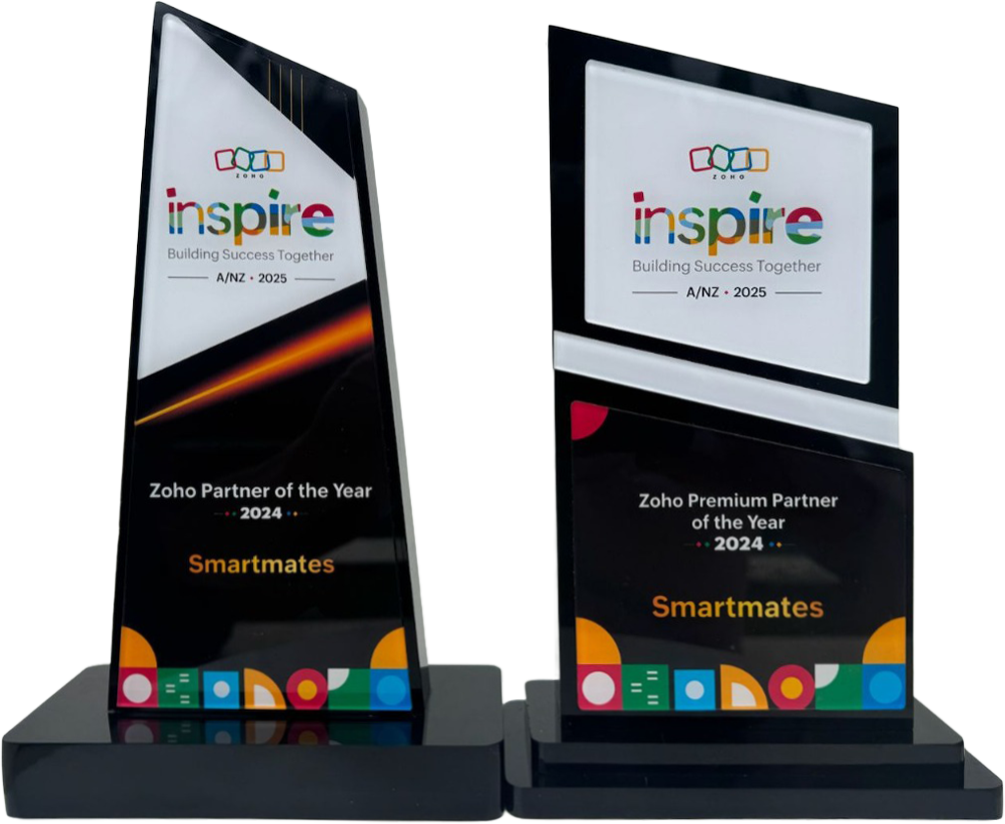
4 Years in a Row
Officially awarded Zoho Partner of the Year in Australia for 2022, 2023, 2024 and 2025. Chosen from 60+ Australian Zoho Partners by Zoho themselves.*
- First Top-Up Special $129 $99/hr + GST
Book your free video conference with our Zoho Consultants
Get your free comprehensive Zoho rollout quotation
Recognised as Australia’s #1 Zoho Partner, 4 years running
Minimum project size 10 consulting hours.

Zoho Integration Partners Connecting CRM, Accounting And Marketing Platforms

Finally, Everything Talks to Everything
Imagine this scenario. Your sales team closes a deal in Zoho CRM. Someone manually exports the customer details and emails them to accounting. Another person enters the information into Xero. Meanwhile, marketing is supposed to update their records but that email got buried. Three days later, someone notices the new client hasn’t been added to the onboarding campaign. Chaos ensues.
This isn’t an edge case. This is daily reality for most Australian businesses. Your systems don’t talk to each other. Information lives in silos. Data gets copied manually between platforms. Things fall through cracks. People spend hours every week doing work that technology should handle automatically.
Here’s the thing: you chose best-of-breed software for good reasons. Zoho CRM for customer relationships. Xero or MYOB for accounting. HubSpot or Mailchimp for marketing. Each tool excels at what it does. The problem isn’t your software choices. It’s that they’re not connected.
This is exactly what professional Zoho integration partners solve. Let me show you how proper integration transforms disconnected software into a unified business system.
The Real Cost of Disconnected Systems
Before we talk about solutions, let’s be honest about what disconnected systems actually cost your business. The expenses are bigger than most people realise.
Direct Labour Costs: Someone is manually moving data between systems. Whether that’s copying customer details from CRM to accounting software, updating marketing lists based on sales data, or reconciling information across platforms. At $50-75 per hour, even 10 hours per week costs you $26,000-$39,000 annually.
Error and Rework Costs: Manual data entry means human errors. Wrong email addresses. Duplicate records. Mismatched information. Someone has to find and fix these errors. Customers notice when your different systems have conflicting information about them.
Opportunity Costs: Time spent on manual data management is time not spent on revenue-generating activities. Your sales team should be selling, not updating multiple systems. Your marketing team should be creating campaigns, not maintaining spreadsheets.
Customer Experience Impact: When systems don’t connect, customer experiences suffer. They have to repeat information. Different departments give conflicting answers. Response times slow because people are hunting for data. These friction points push customers toward competitors.
Strategic Decision Delays: Without integrated data, getting a complete picture of your business requires manual reporting. By the time you’ve compiled information from various sources, the insights are outdated. Decisions get delayed or made on incomplete information.
Add it all up and disconnected systems easily cost Australian businesses $50,000-$150,000 annually in direct and indirect expenses. That’s real money that integration could redirect toward growth.
What Professional Zoho Integration Actually Looks Like
When Zoho integration partners connect your systems properly, it’s transformative. Not because integration is magical, but because it eliminates so much unnecessary friction.
Data flows between systems automatically. When something happens in one platform, relevant information updates everywhere it needs to be. No manual intervention. No time lag. No errors from copying information incorrectly.
Let me show you what this looks like in practice across the three most common integration points.
CRM to Accounting Integration: The Foundation
Your CRM captures customer relationships and deals. Your accounting system manages invoicing, payments, and financial records. These absolutely must connect seamlessly.
When Zoho integration partners build proper CRM-to-accounting connections:
A deal closes in Zoho CRM. The customer record automatically syncs to your accounting platform (Xero, MYOB, QuickBooks, whatever you use). All relevant details transfer correctly: company name, contact information, billing address, agreed terms, product or service details.
Invoices generate automatically based on the deal parameters. No one needs to manually re-enter anything. Payment terms, amounts, and schedules all flow from CRM to accounting perfectly.
When clients pay invoices, that information flows back to CRM. Your sales team can see payment status without asking accounting. Customer service can verify account standing instantly.
If customer details change in either system, updates sync bidirectionally. Change an address in CRM and it updates in your accounting software. Update payment terms in Xero and the sales team sees it in CRM.
This integration eliminates hours of weekly admin work while dramatically improving accuracy and visibility.
CRM to Marketing Integration: The Growth Engine
Your CRM knows who your customers are and how they interact with your business. Your marketing platform manages campaigns, nurture sequences, and communication. Connecting these creates powerful automation.
When Zoho integration partners link CRM and marketing platforms properly:
New leads in CRM automatically sync to marketing systems and enter appropriate nurture campaigns based on lead source, industry, or other criteria you define.
When leads engage with marketing campaigns (opening emails, clicking links, downloading content), that activity appears in CRM. Sales teams see exactly how prospects are engaging before making contact.
When deals close, customers automatically move from prospect campaigns to customer onboarding sequences. No manual list management required.
Customer segmentation happens automatically based on CRM data. High-value clients get different communications than small accounts. Different industries receive relevant content.
Unsubscribes and preference changes sync bidirectionally. Someone opts out in your marketing platform and their CRM record updates automatically. Privacy compliance happens systematically.
Marketing attribution becomes accurate. You can see which campaigns actually drive revenue, not just which ones generate leads. ROI becomes measurable.
Accounting to Marketing Integration: The Profitability Loop
This integration often gets overlooked but it’s incredibly valuable. Connecting accounting and marketing data reveals which marketing efforts actually drive profitable business.
When Zoho integration partners connect accounting and marketing:
Customer lifetime value data from accounting systems informs marketing segmentation. High-value customers get different treatment than low-value ones.
Actual revenue and profit data by customer segment shows which marketing campaigns drive not just sales but profitable sales.
Payment behaviour influences communication. Customers with perfect payment history might receive offers that late payers don’t.
Renewal and repeat purchase data triggers automated campaigns at the right moments.
Marketing can calculate true ROI based on actual revenue and profit, not just pipeline value or estimated deal sizes.
The Integration Scenarios That Transform Operations
Let me walk you through specific scenarios that happen in Australian businesses every day and show you how proper integration handles them.
Scenario One: New Customer Onboarding
Without integration: Deal closes. Someone exports customer details from CRM. Another person manually enters them into accounting software. Marketing gets notified via email (maybe) and manually adds the customer to onboarding campaigns. Welcome emails go out (if someone remembers). First invoice gets created manually. Total time: 45-90 minutes per customer.
With Zoho integration partners: Deal marked as won in CRM. Customer record automatically syncs to accounting with all relevant details. Onboarding campaign triggers automatically in marketing platform. Welcome series begins immediately. First invoice generates based on deal terms. Sales team, accounting, and marketing all see the same information. Total time: 2 minutes to mark deal as won. Everything else is automatic.
Scenario Two: Customer Information Updates
Without integration: Customer changes address. They tell someone in your company. That person updates their own system. Maybe they notify others. Maybe not. Weeks later, an invoice goes to the old address. Customer gets frustrated. Someone has to track down what happened and fix it across multiple systems.
With Zoho integration partners: Customer updates address via any touchpoint. Change syncs across all systems automatically. Next invoice goes to the correct address. Marketing emails update. Everyone has current information without manual coordination.
Scenario Three: Marketing Campaign Analysis
Without integration: Marketing wants to know which campaigns drive revenue. They export campaign data from their platform. Sales exports opportunity data from CRM. Accounting provides revenue data via spreadsheet. Someone manually matches records across three sources. Analysis takes days. Results are already outdated by the time they’re ready.
With Zoho integration partners: Campaign performance dashboard shows real-time data combining marketing engagement, sales pipeline, and actual revenue. Marketing sees which campaigns drive profitable customers. Analysis happens instantly. Decisions can be made immediately based on current data.
Platform-Specific Integration Expertise
Different platforms require different integration approaches. Professional Zoho integration partners have deep expertise across all the major systems Australian businesses use.
Xero Integration: The most common accounting platform for Australian SMBs. We build bidirectional sync between Zoho CRM and Xero that handles customers, invoices, payments, products, and financial data. Special attention to Australian tax requirements including GST.
MYOB Integration: Another popular Australian choice. Similar capabilities to Xero integration but accounting for MYOB’s specific data structures and API limitations. We ensure reliable sync that handles the platform’s quirks.
HubSpot Integration: Many businesses use Zoho CRM alongside HubSpot for marketing. We connect them so leads, contacts, companies, and engagement data flow seamlessly. Marketing and sales finally work from the same information.
Mailchimp Integration: Email marketing integration where subscriber lists, campaign engagement, and segmentation sync with CRM data. Powerful combination for targeted communication.
Shopify/WooCommerce Integration: E-commerce platforms connect to CRM so online orders create customer records, purchase history is visible to sales and support, and marketing can target based on buying behaviour.
Google Workspace Integration: Email, calendar, contacts, and documents sync with Zoho. Your team works in familiar tools while information captures to CRM automatically.
Each platform has specific technical requirements, API limitations, and optimal integration approaches. Professional Zoho integration partners navigate these complexities so you get reliable, robust connections.
The Technical Architecture Behind Reliable Integration
Good integration isn’t just about connecting systems. It’s about building reliable, maintainable connections that work consistently over time.
Real-Time vs Scheduled Sync: Some data needs instant synchronisation. Other information can sync on a schedule (every 15 minutes, hourly, daily). We determine optimal timing based on your business needs and technical constraints.
Bidirectional vs Unidirectional: Some integrations need two-way data flow. Others should only push information in one direction. Proper architecture prevents conflicts and infinite loops.
Error Handling: APIs fail sometimes. Networks have issues. Systems go down for maintenance. Professional integration includes robust error handling that alerts you to problems and recovers gracefully.
Data Mapping: Fields in one system don’t always match fields in another. We map data correctly so information flows to the right places in the right formats.
Transformation Logic: Sometimes data needs to be transformed as it moves between systems. Text formatting, calculations, lookups, all handled automatically.
Conflict Resolution: What happens when the same record updates in two systems simultaneously? We build rules that handle conflicts intelligently based on your business logic.
| Integration Aspect | DIY Approach | Professional Zoho Integration Partners |
|---|---|---|
| Initial Setup | Hours of trial and error | Configured correctly from start |
| Data Mapping | Often incomplete or incorrect | Comprehensive and accurate |
| Error Handling | Systems break, no one knows why | Proactive monitoring and alerts |
| Ongoing Maintenance | Falls to whoever set it up | Professional support and updates |
| Scalability | Often breaks as volume increases | Designed to scale from day one |
| Documentation | Usually nonexistent | Complete documentation provided |
| Business Logic | Generic or missing | Customised to your workflows |
Custom Integration for Unique Requirements
Sometimes your integration needs go beyond standard platform connections. You’re using industry-specific software. You have unique workflows. Your data structures are complex.
This is where Zoho integration partners with development capabilities become invaluable. We build custom integrations using Zoho’s APIs, webhooks, and developer tools.
Custom API Connections: Connecting Zoho to proprietary systems or niche industry tools that don’t have pre-built integrations.
Complex Data Transformations: When data needs significant processing as it moves between systems. Calculations, validations, enrichment, all handled automatically.
Multi-Step Workflows: Integration that orchestrates actions across multiple systems based on complex business rules.
Legacy System Integration: Connecting modern cloud platforms like Zoho to older on-premise systems still running critical business processes.
Partner Portal Integration: Connecting Zoho to partner or supplier systems so information flows across organisational boundaries.
Custom integration is more involved than standard platform connections, but for businesses with unique requirements, it’s the difference between systems that constrain your operations and systems that enable them.
The Integration Process: What to Expect
When you work with professional Zoho integration partners, here’s what the process typically looks like:
Discovery and Requirements (1-2 weeks): We document what systems need to connect, what data should flow, in which directions, and on what schedule. We identify business rules that should govern integration.
Architecture Design (1 week): We design the technical architecture for your integrations. How systems will connect, how data will map, how errors will be handled. You review and approve before we build anything.
Development and Configuration (2-6 weeks depending on complexity): We build the integrations according to the approved design. This includes development, testing in sandbox environments, and refinement.
Testing and Validation (1-2 weeks): Thorough testing with real data in safe environments. We verify that data flows correctly, transformations work properly, and error handling functions as designed.
Deployment and Monitoring (1 week): Careful rollout to production systems with close monitoring to catch any issues immediately.
Documentation and Training (Ongoing): Complete documentation of how integrations work and training for your team on monitoring and basic troubleshooting.
Ongoing Support: Continued monitoring, maintenance, and support as your needs evolve.
The Business Transformation Integration Enables
Proper integration doesn’t just save time on manual work. It fundamentally changes how your business operates.
Single Source of Truth: Everyone works from the same information. No more conflicting data across systems. No more wondering which system has the “right” information.
Improved Decision Making: Real-time access to comprehensive data means better, faster decisions. You can see the complete picture without manual reporting.
Better Customer Experience: Customers never have to repeat information. Every interaction is informed by complete context. Response times improve dramatically.
Scalable Operations: As you grow, integrated systems scale smoothly. Adding customers, team members, or transactions doesn’t proportionally increase administrative overhead.
Reduced Risk: Automated data sync means fewer errors. Audit trails are complete. Compliance becomes easier to demonstrate.
Team Efficiency: Your team focuses on high-value work instead of manual data management. Job satisfaction improves when people aren’t doing tedious admin tasks.
Competitive Advantage: You can move faster, operate more efficiently, and deliver better experiences than competitors still working with disconnected systems.
Common Integration Challenges and How We Solve Them
Integration isn’t always straightforward. Professional Zoho integration partners anticipate challenges and solve them proactively.
API Rate Limits: Most platforms limit how quickly you can sync data. We design integration that respects these limits while meeting your business needs.
Data Volume: Large datasets require special handling. We implement efficient sync strategies that handle volume without performance degradation.
System Downtime: When one platform is down for maintenance, integration needs to handle it gracefully. We build queuing and retry logic that ensures no data is lost.
Version Updates: Platforms update their APIs regularly. We monitor for changes and update integrations before they break.
Customisation Conflicts: Both platforms might be heavily customised. We ensure integration works with your specific configuration, not just standard setups.
Security Requirements: Integration must maintain security and compliance standards. We implement appropriate authentication, encryption, and access controls.
Why Australian Businesses Choose Smartmates for Integration
Integration expertise isn’t generic. You need partners who understand the platforms Australian businesses actually use, the regulatory environment we operate in, and the practical realities of running a business here.
Smartmates isn’t an offshore provider following generic playbooks. We’re Australian experts who’ve integrated Zoho with every major platform used by businesses here. We understand GST requirements, privacy regulations, and local business practices.
We also understand that integration projects need to fit within real business constraints. Budgets, timelines, change management capacity. We work within your reality to deliver solutions that actually get implemented and used.
Our integration work is backed by certified Zoho expertise and years of experience connecting complex business systems. We’ve solved the tricky problems before and we bring that knowledge to every project.
Transform Your Business Through Integration
You’ve invested in good software. You’ve built good processes. But if your systems don’t talk to each other, you’re leaving enormous value on the table.
The businesses winning in today’s competitive Australian market aren’t necessarily the ones with the most expensive software or the largest teams. They’re the ones with integrated operations where information flows seamlessly and teams can focus on work that matters.
That’s exactly what professional Zoho integration partners deliver. Not just technical connections between systems, but fundamental transformation of how your business operates.
Smartmates has helped dozens of Australian businesses eliminate the chaos of disconnected systems through expert Zoho integration. From simple two-platform connections to complex multi-system architectures. From standard integrations to fully custom solutions.
Ready to stop wasting time on manual data management? Ready to give your team the integrated systems they deserve? Ready to see what your business can accomplish when technology actually works together?
Visit smartmates.com.au and schedule an integration consultation. We’ll discuss your current systems, identify integration opportunities, and show you exactly how connected platforms could transform your operations.
No confusing technical jargon. No pressure tactics. Just honest conversation about whether integration makes sense for your business and how we’d approach it.
Your systems should work for you, not against you. Your team should spend time on strategy and growth, not copying data between platforms. Your customers should experience seamless service, not the friction of disconnected operations.
Integration isn’t a luxury for enterprise businesses. It’s a practical necessity for any Australian business that wants to compete effectively. The question isn’t whether your systems should connect. It’s when you’ll make it happen.
The businesses that integrate their systems today will be miles ahead of those that wait. Which group will your business be in?
Also read: Better Business Systems Built By A Zoho Consulting Partner
Request a Callback from Smartmates

Sarah
I’ll listen to your Zoho needs to understand your business challenges and goals, ensuring a tailored approach.
I’ll bring a certified Zoho engineer to our first consultation to explore solutions and clarify your requirements.
We’ll deliver your free project plan quotation, detailing the steps, timeline, and costs—up to this point, it’s completely free!
“My mission is to solve your key problems, build your trust in our capabilities and deliver exceptional value for money.”