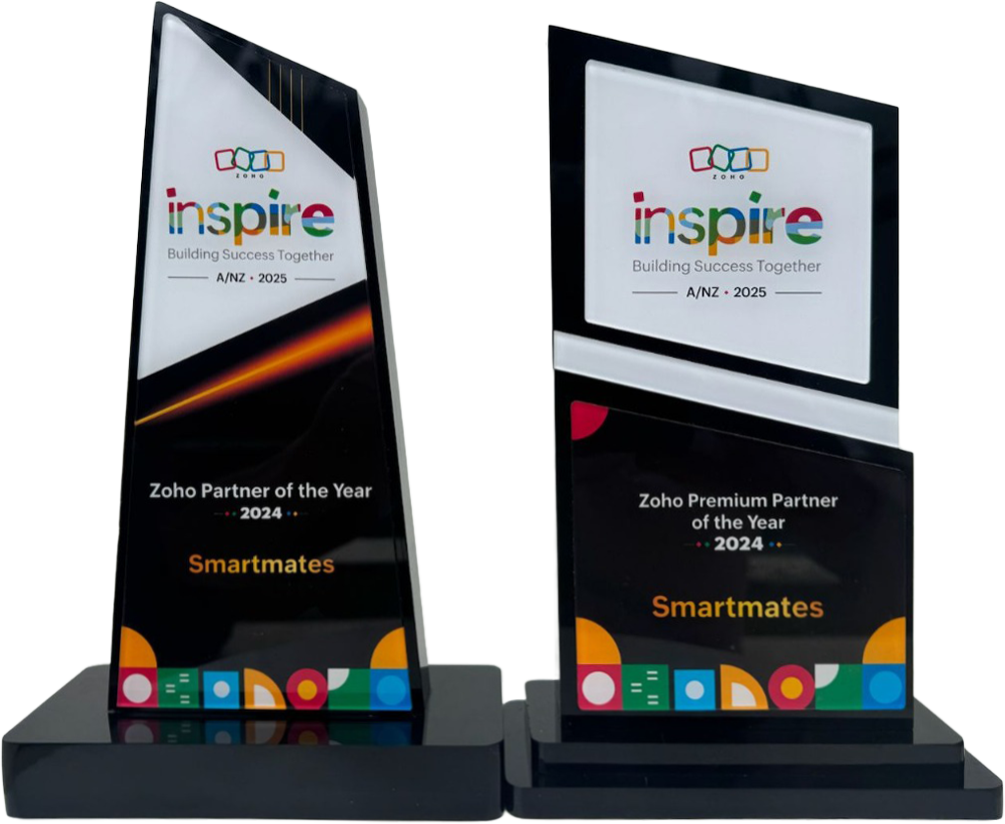
4 Years in a Row
Officially awarded Zoho Partner of the Year in Australia for 2022, 2023, 2024 and 2025. Chosen from 60+ Australian Zoho Partners by Zoho themselves.
- First Top-Up Special $129 $99/hr + GST*
Book your free video conference with our Zoho Consultants
Get your free comprehensive Zoho rollout quotation
Recognised as Australia’s #1 Zoho Partner, 4 years running

Zoho FSM vs ServiceM8 Australia: Which Fits a Growing Field Service Business?

Smartmates helps Australian field service businesses compare Zoho FSM and ServiceM8 around the complete job lifecycle, not just the scheduling screen. Both platforms can coordinate field work, but the better fit depends on quoting, dispatch, technicians, work orders, invoicing, payments, customer history and how closely field operations need to connect with CRM and finance.
Field Service Complexity Changes the Software Decision
A small service business may need little more than a calendar, job details and fast invoicing from the field. As operations grow, scheduling becomes more complicated. Teams may need territories, skills-based assignments, multiple technicians, structured work orders, service reports and stronger links between sales, field operations and finance. Choosing between Zoho FSM and ServiceM8 should therefore start with how a job moves from initial enquiry through completion and payment.
Read more: Zoho FSM for Australian Field Teams
What Field Service Businesses Should Compare
- How new jobs enter the system
- Quotes and estimates
- Work order structure
- Technician scheduling
- Dispatch requirements
- Field territories
- Technician skills
- Multi-person crews
- Recurring work
- Customer notifications
- Mobile job access
- Photos and notes
- Service reports
- Time tracking
- Materials used
- Invoicing
- On-site payments
- Accounting integration
- CRM integration
- Reporting
- Internal administration capacity
ServiceM8 is designed around the operational workflow of trade and service businesses, covering job cards, scheduling, quotes, invoicing, client history, online bookings, payments and accounting integrations. Its field service feature overview is useful when assessing how much of the day-to-day job process should live in one field-focused application.
Zoho FSM Versus ServiceM8
| Requirement | Zoho FSM | ServiceM8 |
|---|---|---|
| Work order management | Core capability | Job-based workflow |
| Scheduling and dispatch | Strong | Strong |
| Territories and skills | Supported | Different scheduling approach |
| Multi-person crews | Supported | Staff can be scheduled to jobs |
| Quotes and invoicing | Connected Zoho finance workflow | Strong built-in field workflow |
| On-site payments | Depends on connected setup | Strong focus |
| CRM connection | Strong Zoho advantage | Integration required |
| Accounting | Zoho Finance integration | Xero, MYOB and QuickBooks integrations |
| Best fit question | Connected service architecture | Job-centric trade operation |
Choose Around the Complete Job Lifecycle
Zoho FSM is built around work requests, work orders, service appointments, dispatching and field agents. Businesses can configure territories and skills, assign appointments to individual agents or crews and use map and Gantt views to coordinate field activity.
That can be particularly useful where field work begins in Zoho CRM or needs to connect closely with other Zoho applications.
ServiceM8 takes a highly practical job-management approach. It combines scheduling, customer communication, quoting, invoicing, field notes, photos and payments in a workflow designed heavily around trades and service businesses.
Neither approach is automatically better.
During a Planning Session, Smartmates can review how enquiries become jobs, how dispatch decisions are made, which information technicians need in the field and how completed work reaches finance.
For an Australian business already running customer and operational processes in Zoho, FSM may reduce integration points and create a more connected customer history.
For a trade business with a mature ServiceM8 workflow, particularly where quoting, invoicing and payments are already efficient, replacing it simply to standardise on Zoho may add unnecessary change.
The Project Plan Estimate can define configuration, migration, integrations, mobile workflows, testing and training if a transition is justified.
The right platform should reduce coordination between the office and field, not simply move that coordination into another screen.
See also: Zoho Connected Operations Australia
Frequently Asked Questions
Is Zoho FSM designed only for large field teams?
No. It can support smaller teams, although the value becomes clearer where structured work orders, dispatch and connected business processes are required.
Can ServiceM8 handle quoting and invoicing in the field?
Yes. Quoting, invoicing and payment collection are central parts of the ServiceM8 workflow.
Should an existing Zoho business automatically move to Zoho FSM?
No. Existing Zoho use is a strong reason to assess FSM, but migration effort and the quality of the current field workflow should still be considered.
Choose the Platform Around How Work Really Reaches the Field
If your Australian service business is comparing Zoho FSM and ServiceM8, Smartmates can help map the journey from enquiry through dispatch, completion and invoicing.
Book a free Planning Session to compare both options against your actual field operation.
Request a Callback from Smartmates

Zoe
I’ll listen to your Zoho needs to understand your business challenges and goals, ensuring a tailored approach.
I’ll bring a certified Zoho engineer to our first consultation to explore solutions and clarify your requirements.
We’ll deliver your free project plan quotation, detailing the steps, timeline, and costs—up to this point, it’s completely free!
“My mission is to solve your key problems, build your trust in our capabilities and deliver exceptional value for money.”