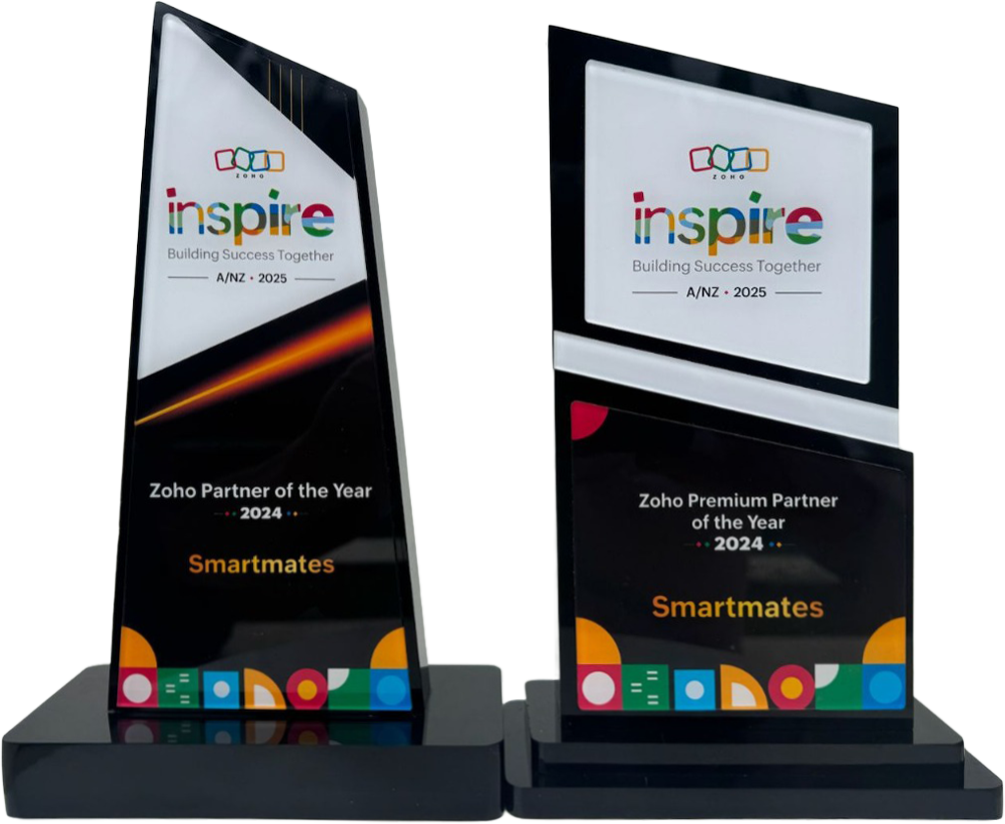
4 Years in a Row
Officially awarded Zoho Partner of the Year in Australia for 2022, 2023, 2024 and 2025. Chosen from 60+ Australian Zoho Partners by Zoho themselves.*
- First Top-Up Special $129 $99/hr + GST
Book your free video conference with our Zoho Consultants
Get your free comprehensive Zoho rollout quotation
Recognised as Australia’s #1 Zoho Partner, 4 years running
Minimum project size 10 consulting hours.

Zoho CRM Specialist vs Automation Tools Alone


Automation tools are seductive. Really seductive.
Look at what they promise. Workflows that run automatically. Data that updates itself. Tasks that complete without human intervention. Leads that get nurtured, scored, and routed while you sleep. All you need to do is turn on the features, set a few rules, and watch the magic happen.
Except that is not quite how it works in practice.
Most Australian businesses that dive into automation tools without expert guidance end up with workflows that trigger incorrectly, rules that conflict with each other, automation that creates more confusion than it solves, and a team that quietly reverts to doing things manually because the automated version is more trouble than it is worth.
This is not because automation tools are bad. Zoho CRM has genuinely powerful automation capabilities. The problem is that automation without strategy is just automated chaos. Tools without expertise rarely deliver the results they promise.
A Zoho CRM specialist brings the strategic thinking, platform depth, and business understanding required to make automation actually work. Not just technically function, but genuinely transform how your business operates.
Let’s talk about the difference, because understanding it changes how you approach the entire project.
The Automation Tool Trap Most Businesses Fall Into
Here is how the trap usually works. You implement Zoho CRM. Someone discovers the workflow automation features. The possibilities look incredible. Automatically assign leads based on territory. Send follow-up emails after specific actions. Update deal stages when certain conditions are met. Create tasks for team members at the right time.
Early experiments feel promising. You build a simple workflow. It triggers correctly. Confidence builds. You create more workflows. Each one seems logical in isolation.
Three months later, your CRM is running a dozen different automation rules that interact in ways nobody fully understands. Some workflows conflict with others. Some trigger too often. Others never trigger when they should. Nobody is quite sure which automation is doing what. The team starts getting task notifications for things that do not make sense. Lead assignments go to the wrong people. Follow-up emails send at inappropriate times.
Rather than fixing the problem, which would require understanding the full automation architecture, someone just turns off the problematic workflows. Slowly, automation gets disabled piece by piece until the business is back where it started, doing most things manually.
This pattern is incredibly common. The tools existed. The intention was good. But the expertise required to design, build, and maintain effective automation was missing.
What a Zoho CRM Specialist Brings That Tools Alone Cannot
A Zoho CRM specialist is not simply someone who knows where automation features sit in the menu. Anyone can find those. What sets a specialist apart is platform depth, strategic thinking, and strong business process understanding applied to automation design.
Strategic workflow design before building.
Specialists map the entire automation architecture first. What should be automated? In what sequence? What triggers each action? How do workflows interact? Where should human oversight remain? This planning prevents the conflicting, overlapping chaos common in DIY setups.
Business process understanding, not just platform knowledge.
Automation should reflect how the business actually operates, not default system templates. Specialists analyse your sales process, team structure, customer journey, and operational constraints before designing anything.
Ecosystem wide platform depth.
Effective automation often spans multiple Zoho apps. A closed deal in CRM may create a project in Zoho Projects, generate an invoice in Zoho Books, and trigger onboarding in Zoho Campaigns. This requires cross application expertise, not just CRM familiarity.
Deluge scripting for complex logic.
Advanced requirements exceed basic workflow rules. Custom calculations, multi branch logic, data transformations, and external API calls require Deluge scripting. Specialists build automation that goes beyond standard tools.
Rigorous testing before go live.
Automation is tested against real world scenarios before deployment. Simultaneous updates, empty required fields, data imports, and edge cases are identified early, not after problems surface.
Ongoing optimisation.
Processes evolve. Teams change. Automation must adapt. Specialists monitor performance and refine workflows to ensure systems remain aligned with business growth.
The Direct Comparison: Tools Alone vs Zoho CRM Specialist
Here is what the difference looks like across the dimensions that actually matter:
| Factor | Automation Tools Alone | Zoho CRM Specialist |
|---|---|---|
| Workflow design | Trial and error, often conflicting rules | Strategic architecture designed before building |
| Business alignment | Based on tool defaults and tutorials | Designed around actual business processes |
| Complexity handling | Limited to simple if/then rules | Can build sophisticated multi-step logic |
| Testing approach | Launch and hope it works | Systematic testing before deployment |
| Error handling | Silent failures or unexpected behaviour | Built-in error handling and alerting |
| Cross-application automation | Rarely attempted | Designed and executed systematically |
| Custom scripting | Not possible without development skill | Deluge scripts for complex requirements |
| Team adoption | Often low due to unreliable automation | High because automation genuinely helps |
| Maintenance | Workflows deteriorate over time | Ongoing monitoring and refinement |
| True business impact | Marginal or negative | Measurable efficiency gains |
The gap in that table is not subtle. It represents the difference between automation that technically exists and automation that genuinely transforms operations.
Real Scenarios Where Specialists Add Critical Value
Let’s get specific with some real-world automation scenarios and why specialists deliver better outcomes.
Lead routing and assignment. Tools alone can route leads by territory or round-robin. A specialist designs routing logic that considers territory, product expertise, current workload, team member availability, deal value thresholds, and historical performance. The difference in speed to contact and conversion rates is measurable.
Deal stage automation. Tools can move deals to the next stage when a field updates. A specialist builds automation that validates whether a deal genuinely meets the criteria for advancement, checks for required documentation, ensures proper approval workflows, and triggers appropriate follow-up tasks. Deals move through the pipeline cleanly instead of getting stuck or advancing prematurely.
Email nurture sequences. Tools can send a series of emails on a schedule. A specialist designs nurture sequences that adapt based on recipient behaviour, integrate with broader marketing campaigns, respect communication preferences, handle unsubscribes gracefully, and trigger sales notifications at the right moment. Engagement improves because the automation is intelligent rather than mechanical.
Quote and proposal automation. Tools can generate documents from templates. A specialist builds automation that pulls the right pricing based on multiple variables, applies approval workflows for discounts, integrates with e-signature platforms, creates invoices automatically upon acceptance, and updates CRM records throughout the process. The entire quote-to-cash cycle compresses because manual steps are removed.
Customer onboarding workflows. Tools can create tasks and send emails. A specialist designs onboarding automation that spans CRM, project management, document signing, and communication platforms. Creates projects, assigns resources, schedules kickoff meetings, sends welcome sequences, tracks completion, and alerts teams when things fall behind. Customers receive consistent, professional onboarding regardless of which team member handles them.
In every scenario, the tools provided the capability. The specialist provided the strategy, design, and execution that made it actually work.
When DIY Automation Makes Sense (And When It Doesn’t)
To be intellectually honest, there are situations where businesses can handle basic automation without specialist help.
If your requirements are genuinely simple, your team is small, and you have a technically capable person with time to learn the platform properly, basic workflow automation is achievable internally. Simple lead assignment. Basic email responses. Task creation on deal stage changes. These can work without specialist involvement.
But the moment any of the following apply, bringing in a Zoho CRM specialist becomes the smarter choice:
- Your automation needs to span multiple applications in the Zoho ecosystem
- You need custom logic that goes beyond simple if/then rules
- Your sales or operational process has genuine complexity
- Previous attempts at automation have created problems rather than solved them
- You need automation that adapts based on multiple variables
- Your business is scaling and automation needs to support growth
- The cost of automation failure would be significant
If you recognised your situation in that list, you already know specialist help makes sense.
What to Look for in a Zoho CRM Specialist
The quality of automation you get depends entirely on the quality of the specialist building it. Here is how to assess who you are talking to.
Zoho certification is the baseline. Make sure they hold current certification, particularly in Zoho CRM and any other applications your automation will touch. Ask to see credentials.
Deluge scripting capability. Ask directly whether they write Deluge code. If the answer is vague or negative, they are limited to basic workflow rules. Complex automation requires scripting capability.
A discovery-led process. Good specialists spend significant time understanding your business before building automation. If someone is ready to start building workflows before asking detailed questions about your process, that is worth noting.
Examples of complex automation they have built. Ask for specific examples. Multi-application workflows. Custom logic handling. Integration with external systems. The sophistication of their previous work predicts the sophistication of what they will build for you.
Post-deployment support model. Automation needs monitoring and occasional adjustment. Your specialist should have a clear support offering beyond initial implementation.
Clear communication about what automation can and cannot do. Specialists who promise automation will solve everything are overselling. Good specialists are honest about where automation adds value and where human judgment should remain.
Also read: What Zoho CRM Implementation Partners Do Differently
How Smartmates Approaches Zoho CRM Automation
Smartmates is an Australian tech consultancy and a certified Zoho Premium Partner. Our team of Zoho CRM specialists has built automation for Australian businesses across industries, from simple workflow efficiency through to complex multi-application processes.
Every automation project we deliver starts with understanding the business process we are automating. Not the tool features. The actual work your team does, where time is wasted, where errors occur, and what outcomes matter. That understanding shapes the automation architecture we design.
Our Zoho CRM automation services include:
- Business process mapping and automation strategy
- Workflow automation design and implementation
- Custom Deluge scripting for complex logic requirements
- Multi-application automation spanning CRM, Books, Projects, and other Zoho tools
- Integration automation connecting Zoho to external platforms
- Testing and validation before deployment to production
- Team training on using and managing automated workflows
- Ongoing monitoring and optimisation as business needs evolve
We have built automation that handles everything from simple lead routing through to complete quote-to-cash processes, customer onboarding sequences, and complex approval workflows that span departments and systems.
The consistent outcome is automation that genuinely works. Not just technically functions, but delivers measurable business value through time savings, error reduction, and process consistency.
The Transformation Specialists Deliver
There is a version of your business in which automation genuinely transforms operations. Repetitive tasks run automatically and reliably. The team focuses on work that requires human judgment while the system handles the rest. Processes remain consistent regardless of who is on leave or how busy things get. Scaling no longer demands proportional headcount because automation absorbs the increased volume.
That version does not happen through automation tools alone. It happens when a Zoho CRM specialist brings the strategic thinking, platform expertise, and business understanding required to design and build automation that genuinely works.
Businesses that invest in specialist-led automation do not just save time. They operate at a different level. Faster. More consistent. More scalable. With teams freed from repetitive work to focus on the activities that drive growth.
This is what proper automation delivers. This is the transformation a quality Zoho CRM specialist provides.
Book Your Free Planning Session
Let’s start with where you’re at. If you have been trying to build automation yourself and hitting walls, or if you are starting fresh and want to do it properly from the beginning, this is the conversation worth having.
We will listen to which processes you want to automate, discuss what is realistic and valuable. We also provide a free Zoho trial so you can experience it firsthand and see how it supports your workflows.
Request a Callback from Smartmates

Sarah
I’ll listen to your Zoho needs to understand your business challenges and goals, ensuring a tailored approach.
I’ll bring a certified Zoho engineer to our first consultation to explore solutions and clarify your requirements.
We’ll deliver your free project plan quotation, detailing the steps, timeline, and costs—up to this point, it’s completely free!
“My mission is to solve your key problems, build your trust in our capabilities and deliver exceptional value for money.”