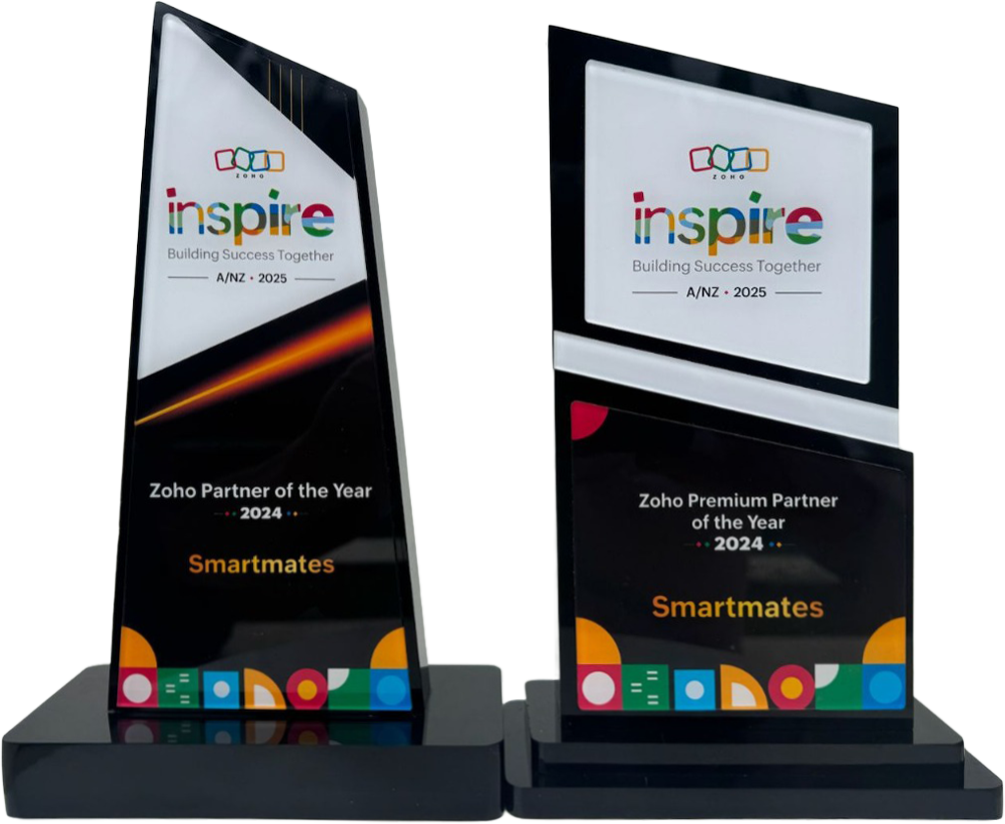
4 Years in a Row
Officially awarded Zoho Partner of the Year in Australia for 2022, 2023, 2024 and 2025. Chosen from 60+ Australian Zoho Partners by Zoho themselves.*
- First Top-Up Special $129 $99/hr + GST
Book your free video conference with our Zoho Consultants
Get your free comprehensive Zoho rollout quotation
Recognised as Australia’s #1 Zoho Partner, 4 years running
Minimum project size 10 consulting hours.

Zoho CRM Partner to Centralise Sales Data Across Apps


Here is a question that reveals more than it should. If someone asked you right now for an accurate view of your sales pipeline, how many different places would you need to check?
The CRM, obviously. But also probably your email to see which deals have active conversations happening. Your accounting software to check which invoices have actually been paid. The spreadsheet someone built six months ago that tracks things the CRM does not capture. Maybe Slack or Teams where half the deal updates actually happen. Possibly a proposal tool where quotes are sitting in various stages of approval.
If that list feels uncomfortably familiar, you are living with scattered sales data. And scattered sales data creates a version of reality that is always incomplete, always slightly out of date, and always requiring manual effort to piece together.
This is one of the most common and most expensive problems in Australian businesses today. Not because the data does not exist, but because it lives in too many places for anyone to see the full picture without significant effort.
A Zoho CRM partner solves this by centralising your sales data properly, not through brute force consolidation, but through intelligent integration and workflow design that brings everything into a single, trustworthy source of truth.
Let’s talk about what that actually means and why it matters.
The Scattered Sales Data Problem Nobody Admits To
Most businesses do not set out to scatter their sales data across platforms. It happens gradually, one reasonable decision at a time.
A CRM is adopted for contact and deal management. An accounting platform handles invoices and payments. Email campaigns run through a marketing tool. Proposals are stored in a document management system. Customer support interactions sit inside a helpdesk platform. Deal collaboration happens in Slack or Teams. And somewhere along the way, sales data stops living in one place and starts living everywhere.
The consequences are more significant than most people realise.
Your pipeline visibility is always incomplete. A deal might show as “negotiation” in the CRM, but the proposal has been sent and is waiting on signatures. The CRM does not know this because the proposal tool is not connected. So your forecast is based on incomplete information.
Your team wastes time searching for context. Before calling a prospect, a rep needs to check the CRM for contact history, their email for recent conversations, the marketing platform to see which campaigns the prospect engaged with, and possibly the support system to see if they have raised tickets. That is four different logins and several minutes of context gathering before the actual work begins.
Your reporting requires manual compilation. Leadership wants to know which marketing campaigns are generating the most qualified pipeline. That requires pulling data from the marketing tool, matching it to contacts in the CRM, tracking those contacts through to closed deals, and then correlating revenue from the accounting system. Nobody does this regularly because it is too time-consuming, so decisions get made on incomplete information.
Data gets duplicated and conflicts. The same contact exists in multiple systems with slightly different information. Which version is correct? Nobody is quite sure, so everyone just uses the version they trust most, which perpetuates the fragmentation.
This is the scattered data problem. And a Zoho CRM partner exists specifically to fix it.
What Centralising Sales Data Actually Means
Before we get into how a Zoho CRM partner does this, it is worth being clear about what centralisation actually means, because it is not what most people think.
Centralisation is not about moving all sales related data into the CRM and retiring every other platform. That is impractical and often undesirable. The accounting platform still needs to exist. The email system still needs to function. A proposal tool may also remain necessary if it serves a purpose the CRM cannot handle effectively.
Centralisation is about making the CRM the single source of truth while intelligently connecting it to the other systems where related data lives. So when you look at a deal record in Zoho CRM, you can see everything relevant without leaving the platform. Email history. Proposal status. Invoice details. Support ticket count. Marketing engagement score. All of it surfaces in the CRM because the systems are properly integrated.
This is the distinction that matters. You are not consolidating platforms. You are centralising visibility.
And that centralised visibility is what transforms how your sales team operates and how your leadership team makes decisions.
What a Zoho CRM Partner Does to Centralise Sales Data
The work of centralising sales data through Zoho CRM is more nuanced than most businesses expect. It is not just about turning on integrations. It is about strategic design of how data should flow, what should be visible where, and how the full system should support your sales process.
Here is what a quality Zoho CRM partner delivers in a data centralisation project:
They map the current data landscape. Before building anything, sales related data is audited across platforms, data types, and cross system workflows. This map forms the foundation of the centralisation strategy.
They design the data flow architecture. Not all data should move both ways. Certain information flows from CRM to other systems. Other data feeds into CRM. In select cases, bi directional sync is appropriate. Design decisions are driven by business process, not just technical capability.
They build the right integrations. Some integrations are simple. Others require custom API development. Native Zoho connectors may handle basic sync. Complex needs demand custom builds.
They configure CRM to surface data intelligently. Data must appear in the right context, at the right time, for the right people. Layouts, modules, and related lists are structured so reps see everything relevant without searching.
They automate synchronisation. Manual updates defeat centralisation. Workflows ensure records update automatically across systems. A closed deal creates an invoice. A received payment updates deal status. A signed proposal moves the opportunity forward.
They implement data governance. Centralisation only works with clean data. Validation rules, required fields, and standards maintain accuracy and trust.
The Integration Scenarios That Matter Most
Let’s get specific about the kinds of integrations that typically deliver the most value in a sales data centralisation project:
| Integration Type | What It Centralises | Why It Matters |
|---|---|---|
| Email platform (Gmail, Outlook) | All email correspondence with prospects and customers | Sales reps see communication history without leaving CRM |
| Accounting software (Xero, MYOB) | Invoice status, payment history, outstanding balances | Reps know financial status of every account in real time |
| Marketing automation | Campaign engagement, email opens, content downloads | Sales understands prospect interest level before outreach |
| Proposal and quoting tools | Quote status, approval stages, signed agreements | Pipeline reflects actual deal progress, not outdated assumptions |
| Customer support platforms | Ticket history, resolution status, satisfaction scores | Sales has full context on customer experience and issues |
| E-commerce platforms | Purchase history, product interest, cart abandonment | B2C and hybrid businesses see complete customer behaviour |
| Calendar and meeting tools | Scheduled meetings, past interactions, no-shows | Activity tracking is automated and accurate |
| Communication platforms (Slack, Teams) | Deal updates, internal discussions, approvals | Context that lives in chat becomes accessible in CRM |
Each of these integrations removes a data silo and brings critical sales information into the centralised view. And when they work together, they create a genuinely complete picture of every prospect, every deal, and every customer relationship.
The Difference Between Generic Integrations and Partner-Built Solutions
It is worth understanding why working with a Zoho CRM partner delivers better centralisation than attempting it with generic marketplace integrations alone.
Generic integrations sync certain fields in certain directions under certain conditions. They are built for the average use case. If your needs align perfectly with that average, they work fine. But the moment you need custom field mapping, conditional logic, bi-directional sync, or real-time updates instead of batch processing, generic integrations hit their limits fast.
A partner-built integration is designed around your specific requirements. The fields that matter to your business. The logic that reflects your process. The sync frequency that matches your operational pace. The error handling that prevents silent failures. The data transformation that ensures records land in the right format.
This level of customisation is what makes centralisation genuinely work. Because your sales process is not generic, and your data centralisation should not be either.
What Centralised Sales Data Actually Changes
When sales data centralisation is done properly, the operational impact is significant and immediate.
Sales reps become more effective. Instead of spending 15 minutes gathering context before every call, they have everything they need in a single view. More time selling. Less time admin. That time savings compounds across every rep, every day.
Pipeline forecasting becomes trustworthy. When deal records reflect the complete, current state including proposal status, invoice generation, and payment tracking, your forecast is based on reality rather than optimistic assumptions. Leadership can make better decisions on better data.
Marketing attribution becomes possible. When marketing engagement data flows into the CRM and connects to deal records, you can finally see which campaigns generate revenue, not just leads. That insight transforms how marketing budget gets allocated.
Customer relationships improve. When your team has visibility into support tickets, previous interactions, and purchase history before engaging, every conversation is more informed and more valuable. Customers notice this.
Onboarding new sales team members gets easier. New reps do not need to learn six different platforms and piece together context manually. They learn Zoho CRM, where everything they need is already centralised and accessible.
The business scales more smoothly. As your team grows, your data remains centralised and your processes remain consistent. Growth does not create the chaos it would with scattered data.
How Smartmates Centralises Sales Data for Australian Businesses
Smartmates is an Australian tech consultancy and a certified Zoho Premium Partner. We specialise in helping Australian businesses centralise their scattered sales data into Zoho CRM environments that genuinely work.
Our approach to data centralisation projects is structured around understanding first. We audit your current data landscape comprehensively before we design anything. Where does your sales data live? Which systems need to integrate? What workflows span multiple platforms? What does your team actually need to see when they look at a deal?
Those answers shape the integration architecture we build.
Our sales data centralisation services include:
- Data landscape audit and centralisation strategy
- Custom API integrations connecting Zoho CRM to your accounting, marketing, support, and operational tools
- Bi-directional sync configuration for data that needs to flow both ways
- Real-time webhook integrations for businesses that need instant updates
- CRM layout and module design that surfaces integrated data intelligently
- Automated workflow building that keeps data synchronised across systems
- Data migration that brings your existing records into the centralised environment cleanly
- Team training on using the centralised system effectively
We have delivered sales data centralisation projects for Australian businesses across industries, from professional services firms connecting CRM to project management and accounting, to retail businesses linking e-commerce, inventory, and customer support into a unified sales view.
The consistent outcome is a sales operation that runs on complete, current, centralised information rather than fragmented data scattered across platforms.
The Transformation Centralisation Delivers
There is a version of your sales operation in which every person has access to complete information about every prospect, deal, and customer. Forecasting is grounded in reality. Decisions are driven by accurate data. Time spent searching for context is redirected toward actual selling.
That version does not happen through good intentions or generic integrations. It happens when an experienced Zoho CRM partner brings the strategic thinking, technical capability, and integration expertise required to centralise sales data properly.
Businesses that invest in proper centralisation do not just improve efficiency. A clear competitive advantage emerges. Opportunities move faster. Customers receive stronger service. Forecasting becomes more accurate. Scaling happens with far less friction.
That is what centralised sales data delivers. And it is one of the most valuable transformations a quality Zoho CRM partner can provide.
Book Your Free Planning Session
Let’s start with where you’re at. If your sales data is scattered across platforms and you are tired of piecing together the full picture manually, or if you have started trying to integrate systems and realised you need expert help, this is the conversation worth having.
We will audit your current data landscape and discuss which integrations will deliver the most value. We also provide a free Zoho trial so you can experience it firsthand and see how it supports your workflows.
Also read: Zoho CRM Consultants And The Difference Between Setup And Success
Request a Callback from Smartmates

Sarah
I’ll listen to your Zoho needs to understand your business challenges and goals, ensuring a tailored approach.
I’ll bring a certified Zoho engineer to our first consultation to explore solutions and clarify your requirements.
We’ll deliver your free project plan quotation, detailing the steps, timeline, and costs—up to this point, it’s completely free!
“My mission is to solve your key problems, build your trust in our capabilities and deliver exceptional value for money.”