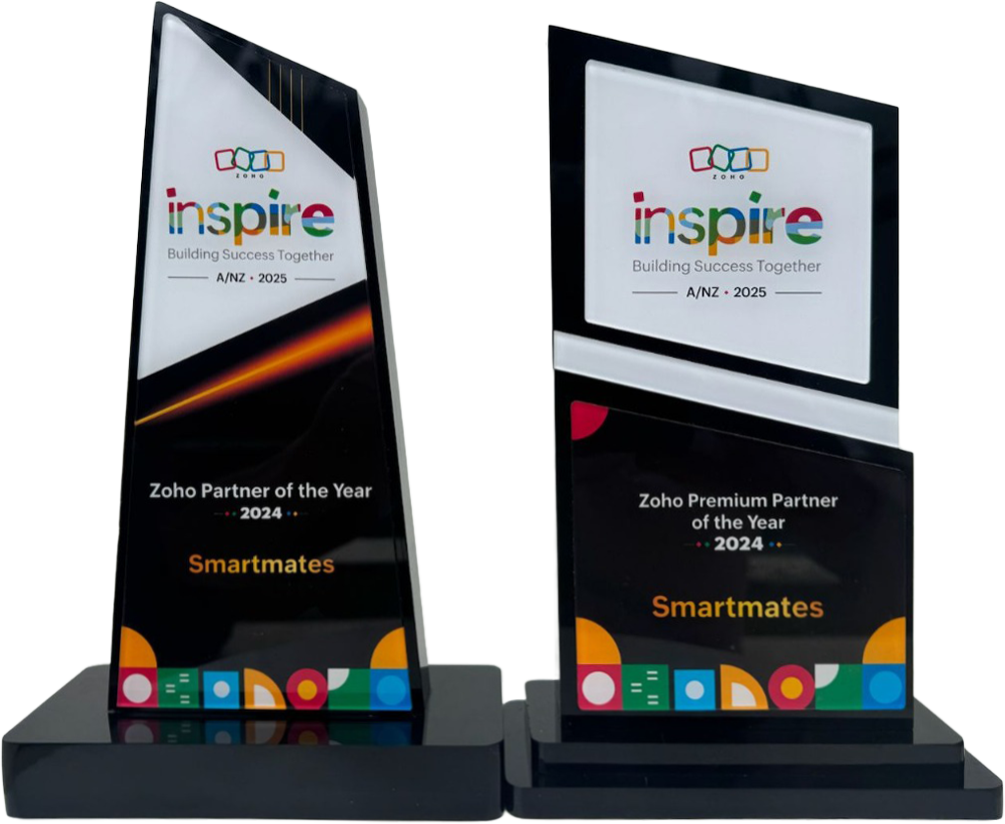
4 Years in a Row
Officially awarded Zoho Partner of the Year in Australia for 2022, 2023, 2024 and 2025. Chosen from 60+ Australian Zoho Partners by Zoho themselves.*
- First Top-Up Special $129 $99/hr + GST
Book your free video conference with our Zoho Consultants
Get your free comprehensive Zoho rollout quotation
Recognised as Australia’s #1 Zoho Partner, 4 years running
Minimum project size 10 consulting hours.

Zoho CRM Implementation Partners For Complex Sales Models


Let’s be brutally honest about something most CRM vendors won’t tell you: complex sales models break standard CRM configurations.
You know your sales process is complex. Maybe you’re selling enterprise software with six-month cycles involving multiple stakeholders. Perhaps you’re in construction where each project requires detailed proposals, approvals, variations, and staged payments. Or you’re in professional services where relationship selling spans years and involves intricate networks of decision-makers.
Whatever your specific situation, you’ve probably already discovered that out-of-the-box CRM solutions don’t work. The templates are too simple. The workflows don’t match your reality. The reporting misses what you actually need to know. And when you try to customise things yourself, you end up with a Frankenstein system that nobody wants to use.
Here’s the uncomfortable truth: complex sales models require sophisticated CRM implementation. Not just installation. Not just basic configuration. Actual strategic implementation by people who understand both the technology and the nuances of complex B2B sales.
That’s precisely what Zoho CRM implementation partners do. They take Zoho’s powerful but complex platform and configure it specifically for your complicated sales reality, creating systems that actually support rather than hinder your sales process.
Let’s explore why this matters and how the right implementation partner transforms complex sales from a CRM nightmare into a competitive advantage.
Understanding Complex Sales Models: Why Standard CRMs Fail
Before diving into solutions, let’s clarify what makes a sales model complex and why that complexity defeats standard CRM approaches.
Multiple decision-makers multiply complexity exponentially. In simple sales, you’re dealing with one buyer. In complex sales, you might have economic buyers, technical evaluators, end users, and executive approvers, each with different priorities and concerns. Standard CRMs treat contacts as individuals, not as part of a decision-making ecosystem.
Long sales cycles demand sophisticated tracking. When deals take months or years to close, you can’t just track “last contact date” and call it pipeline management. You need to understand which stage each deal is in, what actions move it forward, what risks might derail it, and how historical patterns predict outcomes.
Custom pricing and proposals require flexibility. Complex sales rarely involve fixed pricing. Each deal requires custom quoting based on scope, terms, volume, and negotiation. Standard CRM quote modules assume simple product catalogues and standard pricing, which is useless in complex scenarios.
Multiple touchpoints across channels need coordination. Your prospects engage through website visits, content downloads, webinar attendance, phone calls, emails, meetings, and demos. Understanding the full engagement picture requires tracking and connecting all these touchpoints, not just logging individual activities.
Team selling demands collaboration features. Complex deals typically involve account executives, technical specialists, solution architects, executives, and support staff working together. Standard CRMs built for individual contributors don’t support this collaborative selling reality.
Industry-specific processes need customisation. Construction sales differ radically from software sales, which differ from professional services, which differ from manufacturing. Generic processes don’t work when your industry has unique stages, requirements, and compliance needs.
This complexity is exactly why businesses with sophisticated sales models need Zoho CRM implementation partners rather than attempting DIY configuration or using basic setups.
What Zoho CRM Implementation Partners Actually Do
Let’s clarify what implementation partners provide beyond just installing software and showing you where buttons are.
Discovery is where real value starts. Expert partners spend significant time understanding your sales model: stages, stakeholders, typical obstacles, win/loss patterns, team structure, compensation models, and integration requirements. They’re mapping your reality, not imposing generic templates.
Custom architecture solves unique challenges. Based on discovery, partners design CRM architecture specifically for your sales model. This includes custom modules, fields, relationships, automation rules, approval workflows, and reporting structures that match how you actually sell.
Technical implementation brings designs to life. Partners configure Zoho CRM according to the architecture, developing custom functionality where needed, building integrations with other systems, and creating workflows that automate your specific processes.
Data migration preserves historical intelligence. Your existing data contains valuable historical patterns and customer intelligence. Partners migrate this data cleanly, maintaining relationships and history while eliminating duplicates and correcting errors.
Sales process automation eliminates friction. Partners build automation that guides reps through your complex sales process: automatic task creation, stage progression rules, notification triggers, document generation, approval routing, and pipeline management that matches your methodology.
Integration connects your tech ecosystem. Complex sales typically involve multiple systems: marketing automation, proposal software, contract management, project delivery tools, accounting platforms. Partners integrate everything so data flows seamlessly.
Training ensures sophisticated adoption. Complex CRM configurations require comprehensive training. Partners don’t just show features; they teach your specific workflows, explain why processes matter, and create champions who can support others.
Ongoing optimisation adapts to evolution. As your sales model evolves, your CRM should too. Partners provide continuing support, regular reviews, and optimisation to ensure the system grows with your business.
This comprehensive approach transforms Zoho CRM from generic software into a strategic asset specifically engineered for your complex sales reality.
Key Features Complex Sales Models Require
Let’s get specific about what functionality complex sales models need from CRM implementation.
Relationship mapping visualises decision networks. You need to see how stakeholders connect, who influences whom, what roles they play, and how relationships evolve throughout the sales cycle. Standard contact lists don’t cut it; you need visual relationship maps.
Custom deal stages match your process. Your sales stages are unique to your business and industry. Implementation partners create stage definitions that reflect your actual process, with clear entry/exit criteria and required activities for progression.
Sophisticated forecasting predicts outcomes. Complex sales need weighted pipeline forecasting, probability calculations based on stage and age, win/loss analysis, and predictive analytics that help you understand what your pipeline actually means for future revenue.
Document management tracks proposals and contracts. Complex deals generate massive documentation: proposals, technical specifications, contracts, amendments, change orders. Everything needs to be version-controlled, accessible, and connected to the relevant deal.
Approval workflows enforce governance. Discounting, contract terms, custom pricing, and special arrangements all require approvals. Implementation partners build workflow automation that routes requests to appropriate approvers based on rules and thresholds.
Activity tracking captures full engagement. Every email, call, meeting, demo, proposal, and follow-up needs to be logged and visible. Partners configure activity tracking that’s comprehensive enough to be useful but streamlined enough that reps actually use it.
Territory and account management enable collaboration. Complex sales often involve territory rules, account ownership, team selling, and handoffs between different specialists. Partners configure ownership rules and collaboration features that support your go-to-market model.
Commission and compensation tracking drives behaviour. If compensation is complex (and in sophisticated sales, it usually is), CRM needs to track the metrics that matter for calculating commissions accurately and transparently.
Reporting reveals what matters. Standard CRM reports are useless for complex sales. Partners build custom reports and dashboards showing deal velocity, stage duration, win rates by source or industry, forecast accuracy, and other metrics specific to your business.
These features don’t come out of the box. They require expert implementation by partners who understand both Zoho CRM’s capabilities and complex sales realities.
Industry-Specific Challenges And Solutions
Different industries have unique complex sales characteristics. Let’s explore how Zoho CRM implementation partners address industry-specific challenges.
For enterprise software and SaaS companies, the challenge is managing lengthy evaluation cycles with multiple proof-of-concept stages, technical validations, and procurement processes. Partners configure systems tracking technical requirements, evaluation milestones, competitive positioning, and expansion opportunities within existing accounts.
For construction and engineering firms, complexity comes from project-based selling with detailed estimates, variations, staged payments, subcontractor coordination, and regulatory compliance. Partners build systems connecting quotes to project delivery, tracking variations, managing approvals, and integrating with project management tools.
For professional services organisations, relationship selling dominates. Individual deals matter less than long-term client relationships, cross-selling opportunities, and resource allocation. Partners configure account-centric views, practice area tracking, resource planning integration, and relationship health monitoring.
For manufacturing businesses, complexity includes technical specifications, custom engineering, quote-to-manufacturing handoffs, and supply chain coordination. Partners build systems connecting CRM to ERP, tracking technical requirements, managing custom product configurations, and coordinating between sales and production.
For financial services firms, regulatory compliance, risk assessment, multi-product relationships, and detailed documentation requirements create complexity. Partners implement systems with built-in compliance workflows, risk tracking, relationship consolidation, and comprehensive audit trails.
For technology system integrators, multiple stakeholder approval, technical solution design, partner ecosystem coordination, and implementation project handoffs require sophisticated CRM. Partners build systems bridging sales and delivery, tracking technical architectures, managing partner relationships, and coordinating complex team selling.
Each industry has unique patterns, terminology, processes, and requirements. Expert Zoho CRM implementation partners configure systems that speak your industry’s language and support your specific selling reality.
The Implementation Journey For Complex Sales
Understanding what to expect during implementation helps set realistic expectations and ensures success.
Phase one is deep discovery. For complex sales models, this isn’t a quick conversation. Partners might spend days shadowing sales calls, interviewing reps and managers, reviewing existing processes, analysing historical data, and understanding your competitive landscape. This investment in understanding pays dividends throughout implementation.
Phase two involves process design. Before touching technology, partners work with your team to document and optimise your sales process. Where are the bottlenecks? What activities correlate with wins? Which stages take too long? This process design ensures technology supports an effective methodology, not just a familiar one.
Phase three creates technical architecture. Partners design your CRM structure: modules, relationships, fields, validation rules, automation logic, integration points, and reporting architecture. This blueprint guides all subsequent configuration work.
Phase four is configuration and development. The technical implementation happens here: building custom modules, creating fields and relationships, configuring automation workflows, developing custom functionality, and establishing reporting infrastructure.
Phase five handles data migration. For complex sales, historical data is particularly valuable because deal patterns reveal important intelligence. Partners migrate data carefully, cleaning and enriching it, maintaining relationships, and validating accuracy before going live.
Phase six builds integrations. Connecting Zoho CRM to marketing automation, proposal tools, contract systems, project management platforms, accounting software, and other systems ensures seamless data flow and eliminates manual handoffs.
Phase seven focuses on testing. Before launch, partners test scenarios thoroughly: can reps progress deals properly? Do automations trigger correctly? Are reports accurate? Does everything work under realistic conditions?
Phase eight delivers training. Complex systems require comprehensive training. Partners typically provide role-specific training for different users (reps, managers, executives, operations), documentation, and ongoing support resources.
Phase nine is controlled launch. Rather than flipping a switch, partners often recommend phased rollouts, starting with pilot teams, gathering feedback, making refinements, then expanding to the full organisation.
Phase ten involves ongoing optimisation. After launch, partners monitor usage, gather feedback, identify improvement opportunities, and continuously refine the system based on real-world performance.
The timeline for complex sales CRM implementation typically ranges from two to six months, depending on complexity, customisation needs, and integration requirements.
Common Pitfalls And How Partners Avoid Them
Let’s address the mistakes that derail complex sales CRM implementations and how expert partners prevent them.
The over-complication trap is real. It’s tempting to track everything. But systems that are too complicated don’t get used. Partners balance comprehensiveness with usability, capturing critical information without creating admin burden.
The process transfer mistake hurts adoption. Just replicating your existing process in CRM isn’t enough. Partners challenge and optimise processes during implementation, ensuring technology enables better selling, not just digital versions of existing inefficiency.
The training shortcut backfires. Complex systems require comprehensive training. Partners who rush or minimise training see poor adoption. Expert partners invest heavily in training and change management.
The integration afterthought creates chaos. Attempting to integrate systems after CRM launch often fails. Partners design integrations from the beginning, ensuring seamless operation from day one.
The customisation overkill problem emerges. Excessive customisation makes systems fragile and hard to maintain. Partners balance custom functionality with standard features, customising only where it genuinely adds value.
The data quality disaster undermines everything. Migrating messy data creates messy CRM. Partners enforce data cleanup before migration, establishing quality standards that maintain cleanliness ongoing.
The adoption assumption fails. Assuming people will naturally adopt new systems is naive. Partners build change management into implementation, creating champions, addressing resistance, and ensuring actual usage.
The static implementation becomes obsolete. Business needs evolve constantly. Partners who implement and disappear leave clients stuck. Expert partners provide ongoing support and optimisation.
These pitfalls destroy value and waste investment. Working with experienced Zoho CRM implementation partners who’ve learned from past mistakes prevents these problems entirely.
Why Australian Businesses Choose Local Implementation Partners
There are compelling reasons Australian businesses should work with Australian-based Zoho CRM implementation partners like Smartmates.
Timezone alignment enables real-time collaboration. When you have questions during implementation or need support after launch, you get immediate responses during your business hours, not 12 hours later when the issue has already cost opportunities.
Local market understanding shapes solutions. Australian business culture, customer expectations, competitive dynamics, and market conditions are unique. Local partners configure systems that make sense in our specific context.
Regulatory and compliance knowledge is built in. Privacy laws, consumer protection regulations, industry-specific compliance requirements, and Australian business standards are second nature to local partners. You’re not explaining Australian rules to overseas consultants.
Face-to-face collaboration is practical. Complex sales CRM implementations benefit from workshops, process mapping sessions, and collaborative design work. Being in the same country makes this affordable and practical.
Industry connections add value. Australian partners often have relationships with other local technology providers, making integrations smoother and opening doors to additional tools and services.
Cultural communication reduces friction. Australian communication style and business approach are distinctive. Working with local partners means more efficient collaboration and less time lost to cultural misunderstandings.
Economic contribution stays local. Supporting Australian businesses strengthens our economy and keeps high-value expertise and jobs onshore.
Long-term partnership is practical. Ongoing support, regular reviews, and continuous optimisation work better when your partner is local, accessible, and invested in the Australian market.
These advantages aren’t trivial. They directly impact implementation success and long-term value realisation.
The Smartmates Approach To Complex Sales CRM
At Smartmates, we’ve developed specific expertise in implementing Zoho CRM for Australian businesses with complex sales models.
We start with sales process, not technology. Our discovery phase focuses on understanding how you actually sell, not just what CRM features you think you need. Technology serves process, never the other way around.
We bring both technical and sales expertise. Our team combines certified Zoho knowledge with real-world sales experience. We understand complex selling because we’ve lived it, not just read about it.
We configure for your specific reality. No templates. No generic setups. Every implementation is designed specifically for your sales model, industry, and competitive situation.
We balance sophistication with usability. Complex sales need powerful systems, but complexity shouldn’t mean difficulty. We design interfaces and workflows that are sophisticated yet intuitive.
We build for scale and evolution. Even if your sales model is manageable now, we configure systems that can handle growth and adapt as your business evolves.
We integrate deeply with your ecosystem. CRM doesn’t exist in isolation. We connect it to all your other business systems, creating unified operations rather than disconnected silos.
We train comprehensively for adoption. Technology only works if people use it. We invest heavily in training, change management, and building internal champions who can support ongoing adoption.
We provide ongoing partnership. Implementation isn’t the end; it’s the beginning. We stick around for support, optimisation, and continuous improvement as your needs evolve.
We’ve made it our mission to be the Zoho CRM implementation partner Australian businesses with complex sales models want to work with.
Measuring Success: What Good Implementation Delivers
Let’s talk concrete outcomes so you know what success looks like with expert Zoho CRM implementation for complex sales.
Pipeline visibility becomes crystal clear. You know exactly what’s in your pipeline, what stage each deal is in, what actions move deals forward, and what your pipeline actually means for future revenue.
Sales cycle duration typically decreases 15 to 30 percent. Better process discipline, automated follow-ups, and clear visibility into deal progress accelerate deals from first contact to close.
Win rates often improve 10 to 25 percent. When reps have complete context, proper tools, and systematic processes, they win more deals. Better qualification also means fewer wasted opportunities.
Forecast accuracy increases dramatically. Sophisticated forecasting based on stage, probability, historical patterns, and deal characteristics enables confident revenue prediction and resource planning.
Sales productivity jumps significantly. Automation handling routine tasks, easy access to information, and streamlined workflows free reps to focus on actual selling rather than admin work.
Deal sizes often increase. Better relationship visibility, expansion tracking, and cross-sell coordination enable reps to identify and pursue larger opportunities within accounts.
Team collaboration improves measurably. When everyone has visibility into accounts and deals, team selling becomes coordinated rather than chaotic. Handoffs are smooth. Nothing falls through gaps.
Management insights get actionable. Custom reporting reveals which activities drive wins, where deals get stuck, which reps need support, and what strategic adjustments would improve performance.
Customer experience becomes consistent. When systems capture complete history and guide interactions, every touchpoint is informed and professional regardless of which team member is involved.
These outcomes transform sales operations from gut-feel chaos to systematic excellence.
Taking The Next Step: Your Complex Sales Solution
You’ve made it this far, which suggests you recognise that your complex sales model needs sophisticated CRM implementation, not basic setup.
The question now is straightforward: when do you start?
Every week you continue with inadequate CRM is a week of lost opportunities, frustrated reps, and competitive disadvantage. Complex sales are too important to your business to be supported by systems that don’t work properly.
At Smartmates, we’ve helped numerous Australian businesses implement Zoho CRM for complex sales models across multiple industries. We know the challenges you’re facing because we’ve solved them before.
We understand complex B2B sales because we’ve lived it. We know Zoho CRM deeply through certification and extensive implementation experience. And we care about your success because that’s how we measure ours.
Conclusion: Transform Complex Sales Through Expert Implementation
Complex sales models require sophisticated CRM implementation. There’s no way around this fundamental truth. Standard configurations fail. DIY attempts disappoint. Only expert implementation by partners who understand both technology and complex selling delivers the systems your sales team needs.
The Australian businesses succeeding with complex sales aren’t necessarily the ones with the biggest sales teams or the most leads. They’re the ones with systems that support sophisticated selling, capture complete intelligence, enable team collaboration, and provide the visibility needed for smart decision-making.
Your competitors are already building these capabilities. Some have probably already implemented sophisticated CRM with expert partners and are realising advantages while you’re still struggling with inadequate systems.
You don’t have to figure this out alone. You don’t have to waste months on implementations that fail to deliver. You can leverage the expertise of Zoho CRM implementation partners who’ve successfully configured systems for complex sales many times before.
At Smartmates, we’re ready to implement Zoho CRM specifically for your complex sales model. We bring certified expertise, sales knowledge, industry experience, and genuine commitment to delivering systems that transform your sales operations.
Ready to stop struggling with CRM that doesn’t support your complex sales reality? Ready to give your sales team the sophisticated tools they need to win? Ready to transform your sales operations through expert Zoho CRM implementation?
Also read: Zoho CRM Training That Improves Adoption and Accuracy
Request a Callback from Smartmates

Sarah
I’ll listen to your Zoho needs to understand your business challenges and goals, ensuring a tailored approach.
I’ll bring a certified Zoho engineer to our first consultation to explore solutions and clarify your requirements.
We’ll deliver your free project plan quotation, detailing the steps, timeline, and costs—up to this point, it’s completely free!
“My mission is to solve your key problems, build your trust in our capabilities and deliver exceptional value for money.”