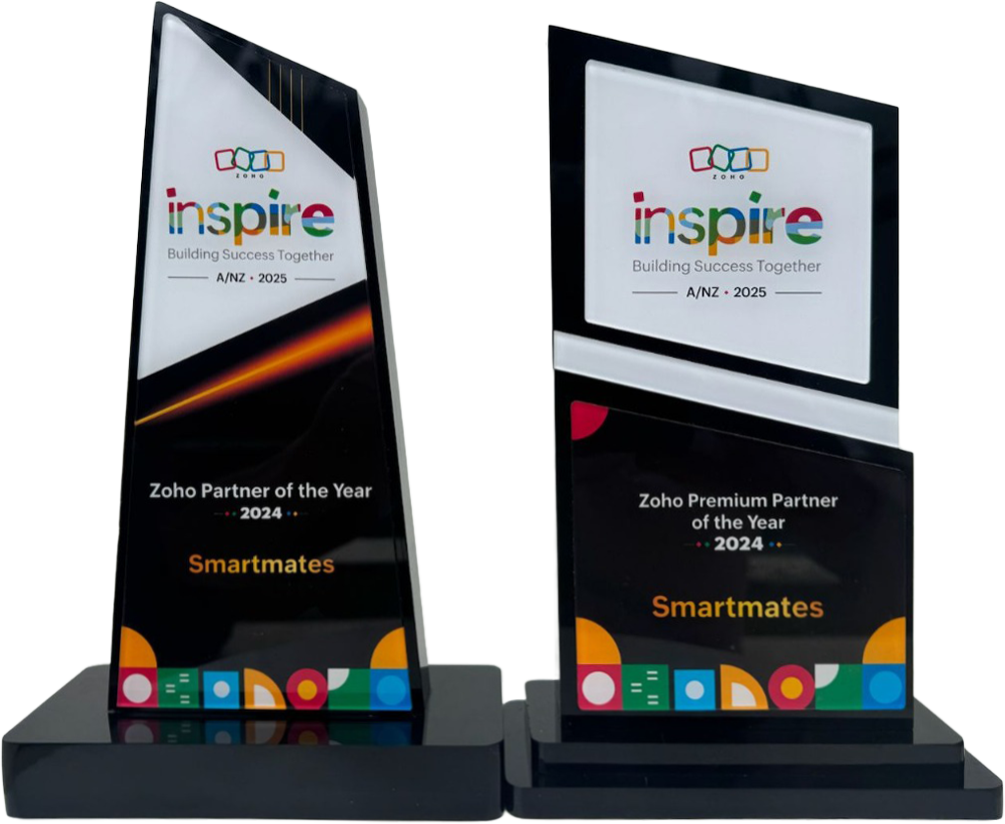
4 Years in a Row
Officially awarded Zoho Partner of the Year in Australia for 2022, 2023, 2024 and 2025. Chosen from 60+ Australian Zoho Partners by Zoho themselves.*
- First Top-Up Special $129 $99/hr + GST
Book your free video conference with our Zoho Consultants
Get your free comprehensive Zoho rollout quotation
Recognised as Australia’s #1 Zoho Partner, 4 years running
Minimum project size 10 consulting hours.

Zoho Authorized Partners Simplifying Reporting And Analytics


Your board meeting starts in two hours and you’ve just been asked to present last quarter’s sales performance by region, product category, and customer segment. Simple request. Except the data lives in three different systems, nobody’s quite sure which version of the spreadsheet is current, and compiling this report manually will take at least four hours you don’t have.
So you do what everyone does: pull together whatever incomplete information you can find quickly, add caveats about data accuracy, and present numbers nobody fully trusts while secretly hoping no one asks detailed questions that would expose the gaps in your analysis.
This is what reporting looks like for most Australian businesses. Not because they don’t value data, but because creating accurate, comprehensive reports from fragmented systems is genuinely difficult and time-consuming. By the time you’ve manually compiled information from multiple sources, reconciled inconsistencies, and built presentations, the data’s already outdated and the insights have lost value.
Meanwhile, some businesses seem to have reporting that just works. They produce detailed analytics instantly. They make decisions based on current data, not month-old spreadsheets. Their stakeholders trust the numbers because reporting is consistent, accurate, and comprehensive. The secret? Zoho authorized partners who build reporting and analytics infrastructure that turns data chaos into reliable business intelligence.
Let me show you how proper reporting implementation transforms guesswork into genuine insight.
The Reporting Problem Nobody Wants To Admit
Before we talk solutions, let’s acknowledge how most Australian businesses actually handle reporting and analytics. The reality is messier than anyone wants to admit:
Manual compilation from multiple sources. Sales data lives in CRM. Finance uses accounting software. Operations tracks metrics separately. Marketing has their own dashboards. Creating comprehensive reports means manually exporting from each system, cleaning inconsistencies, and hoping you haven’t made formula errors in Excel.
Outdated by the time it’s finished. Monthly reports take days to compile, so the February report you finish in mid-March reflects data from six weeks ago. You’re making decisions based on historical snapshots, not current reality.
Inconsistent definitions across teams. Sales counts a “lead” differently than marketing. Finance calculates “revenue” differently than operations. Your reports compare numbers that aren’t actually measuring the same things, creating false insights.
Nobody trusts the accuracy. Manual processes create errors. People have seen reports with mistakes. So when you present numbers, stakeholders discount them mentally rather than making confident decisions based on data they trust.
Analysis gets skipped entirely. You’re so exhausted from compiling basic reports that actual analysis rarely happens. You report what happened without exploring why it happened or what it means for decisions.
Ad-hoc requests are nightmares. Standard reports are painful enough. When executives ask for custom analysis, you’re looking at days of work that pulls people away from productive activities.
One Perth distributor we worked with had a finance person spending literally two full days monthly just compiling sales reports. That’s 10% of their capacity consumed by work that should be automatic. The opportunity cost was staggering.
Also read: Zoho One Partners For Unified Business Platforms
Why Zoho Authorized Partners Make Reporting Actually Work
You might think: “Can’t we just build some reports in Zoho ourselves?” Basic reports, sure. But there’s massive difference between creating a few charts and implementing comprehensive business intelligence that enables confident decision-making.
Here’s what Zoho authorized partners bring to reporting and analytics:
Strategic reporting design. They don’t just build reports you ask for. They understand what decisions you need to make and design analytics that inform those specific decisions rather than generating generic dashboards.
Data architecture expertise. Good reporting requires proper data structure. Authorized partners design databases that make sophisticated analysis possible rather than creating reporting nightmares through poor architecture.
Advanced analytics capability. They leverage Zoho Analytics’ full capabilities including custom formulas, calculated fields, data blending from multiple sources, and predictive analytics that basic implementations never access.
Automated data integration. They build pipelines that pull data from all your systems automatically rather than requiring manual exports and imports that waste time and introduce errors.
User-appropriate design. Different stakeholders need different information presented differently. Authorized partners create role-specific dashboards and reports appropriate for each audience rather than generic views nobody finds useful.
Performance optimization. They build reports that load quickly even with large datasets rather than dashboards that take minutes to refresh and frustrate users.
Ongoing evolution. Business intelligence needs change as your business evolves. Authorized partners provide continued refinement rather than one-time implementations that become obsolete.
A Melbourne manufacturing business worked with Zoho authorized partners to implement comprehensive reporting. Their report compilation time dropped from roughly 40 hours monthly to about 2 hours while accuracy and depth both improved dramatically. Management stopped making decisions based on gut feel and started using actual intelligence.
How Zoho Authorized Partners Build Reporting Intelligence
Let’s get specific about what quality authorized partners actually implement:
Automated Data Integration and Centralization
Foundation of good reporting is having all relevant data in one analyzable location. Authorized partners build this infrastructure properly.
Multi-source data pipelines. Automatically pulling data from your CRM, accounting system, operations tools, marketing platforms, and any other sources into unified analytics environment without manual intervention.
Scheduled refresh. Data updates automatically on schedules you define (real-time, hourly, daily, weekly) ensuring reports always reflect current state without anyone remembering to refresh manually.
Data transformation and cleaning. Standardizing inconsistent data, handling missing values, and preparing information for analysis rather than leaving these problems to explode during reporting.
Historical data warehousing. Maintaining trends over time rather than just current snapshots, enabling year-over-year comparisons and trend analysis that manual approaches struggle to sustain.
We implemented automated integration for a Brisbane professional services firm pulling data from five different systems. Before, creating monthly reports required manually exporting and reconciling. After, reports updated automatically overnight with complete accuracy. The time savings allowed their finance team to focus on actual financial planning rather than data compilation.
Custom Dashboard Design For Different Stakeholders
Generic dashboards satisfy nobody because different people need different information. Authorized partners create appropriate views for each user type.
Executive dashboards. High-level KPIs, trend indicators, and exception alerts giving leadership strategic oversight without overwhelming detail.
Department manager dashboards. Operational metrics specific to each function with drill-down capability to investigate details when needed.
Team member views. Individual performance tracking and goal progress helping people understand their contribution without exposing them to irrelevant organizational data.
Board reporting packages. Governance-appropriate information showing strategic progress, risk indicators, and performance against plans in formats suitable for board review.
Client-facing reports. Professional outputs demonstrating value delivered to customers, customizable for different client needs and preferences.
Advanced Analytics Beyond Basic Reporting
Moving beyond “what happened” to “why it happened” and “what should we do” requires sophisticated analytics. Authorized partners implement these capabilities properly.
Cohort analysis. Comparing customer groups acquired at different times or through different channels, revealing how acquisition quality and retention patterns evolve.
Trend forecasting. Using historical patterns to project future performance with confidence intervals rather than just hoping trends continue.
Correlation identification. Finding relationships between variables that aren’t obvious, like discovering which sales activities actually correlate with deal closure or which marketing content predicts customer success.
Predictive scoring. Identifying which leads or opportunities are likely to convert, which customers are at churn risk, or which prospects are worth pursuing based on patterns in historical data.
What-if scenario modeling. Exploring potential outcomes of different decisions before committing resources, like estimating revenue impact of pricing changes or market expansion.
An Adelaide SaaS company implemented predictive analytics with Zoho authorized partners. Instead of just reporting churn that already happened, their dashboards now flag customers at elevated churn risk 60 to 90 days before they typically cancel. This early warning enables proactive intervention that’s improved retention 24%.
Operational Reports That Drive Action
Best reports don’t just inform. They trigger appropriate action. Authorized partners build operational reporting that makes this happen.
Exception-based alerts. Automatic notifications when metrics exceed thresholds requiring intervention rather than hoping people notice problems in daily dashboard reviews.
Automated report distribution. Right reports reaching right people on appropriate schedules without manual sending, ensuring stakeholders have current information for decisions.
Drill-down navigation. Moving from high-level summaries to detailed investigation seamlessly when questions arise rather than needing separate analysis processes.
Goal tracking and visualization. Clear progress indicators showing performance against targets motivating teams and surfacing problems early.
Comparative analysis. Easy comparison across regions, products, time periods, or segments making patterns obvious and decisions clearer.
Self-Service Analytics Capability
Empowering teams to answer their own questions rather than depending on IT or analysts for every report request. Authorized partners build appropriate self-service capability.
User-friendly report builders. Enabling business users to create custom reports without requiring technical expertise or SQL knowledge.
Saved view sharing. Allowing users to save useful analyses and share with colleagues rather than everyone recreating the same custom reports.
Data exploration tools. Providing controlled access to underlying data with guardrails preventing misuse while enabling legitimate investigation.
Template libraries. Pre-built report templates for common questions allowing quick answers without starting from scratch.
Real Reporting Transformation Results From Australian Businesses
Let’s look at actual improvements from businesses working with Zoho authorized partners on reporting:
| Reporting Metric | Manual Approaches | With Authorized Partners | Improvement |
|---|---|---|---|
| Report Compilation Time | 30-50 hours monthly | 2-5 hours monthly | 90% reduction |
| Data Accuracy | 75-85% reliable | 95-99% reliable | Near perfection |
| Report Latency | 2-4 weeks old | Real-time to daily | Current intelligence |
| Stakeholder Trust | Low to moderate | High | Confidence in decisions |
| Analysis Depth | Minimal | Comprehensive | Strategic insights |
Take David’s Sydney technology distributor. Before working with Zoho authorized partners, their reporting was manual compilation nightmare consuming roughly 45 hours monthly across finance, sales, and operations teams. Reports were outdated and incomplete. Management made decisions on instinct dressed up with inadequate data.
After implementation of automated reporting by authorized partners, compilation time dropped to about 4 hours monthly for review and refinement. More importantly, decision quality improved dramatically because leadership finally had reliable, comprehensive intelligence. Revenue grew 38% year-over-year while headcount grew only 12% because better decisions compounded advantages.
Or consider Lisa’s Melbourne professional services business. Her challenge was client reporting. Demonstrating value to clients required manually compiling project metrics, outcome data, and performance indicators from multiple systems. Creating these reports consumed billable hours while delays in delivery damaged client relationships.
After Zoho authorized partners implemented automated client reporting, value demonstration became seamless. Reports generated automatically with current data, sent to clients on schedules they preferred. Client satisfaction improved, renewal rates increased, and the firm reclaimed hundreds of billable hours annually.
The Australian Business Reporting Context
Building effective reporting for Australian businesses requires understanding specific local contexts:
Australian financial year. July to June fiscal year affects reporting periods and comparative analysis differently than calendar year reporting many international tools assume.
EOFY requirements. End of financial year creates specific reporting demands that systems should accommodate automatically rather than requiring special manual processes.
Australian accounting standards. Financial reporting must align with Australian standards (AASB) rather than international variants, affecting how numbers get presented.
Privacy compliance reporting. Demonstrating Australian Privacy Principles compliance requires specific data handling and retention reports.
Multi-state operations. Businesses operating across Sydney, Melbourne, Brisbane, Perth, and regional areas need geographic reporting that makes Australian distribution patterns clear.
Industry-specific benchmarks. Australian industry standards and comparative data for contextualizing performance against local market realities.
Zoho authorized partners with Australian expertise build reporting that fits these contexts rather than forcing adaptation to overseas assumptions.
Common Reporting Implementation Mistakes
We’ve rescued several Australian businesses from reporting implementations that created more confusion than clarity. The mistakes are predictable:
Mistake one: Too many metrics. Dashboards with 40 different charts overwhelm users. Effective reporting focuses on metrics that actually inform decisions rather than displaying everything measurable.
Mistake two: Vanity metrics. Tracking impressive-looking numbers that don’t correlate with business success. Page views, email opens, social media followers, these matter only if they drive outcomes.
Mistake three: No update schedule. Reports that update inconsistently or unpredictably. Users don’t know when data’s current, undermining trust in the entire system.
Mistake four: Poor visual design. Charts that confuse rather than clarify. Good reporting uses visualization that makes patterns obvious, not obscure.
Mistake five: Inadequate segmentation. Reporting only totals and averages rather than meaningful segments. You miss critical patterns hiding in aggregate numbers.
Mistake six: Static implementations. Building reporting once without capability to adapt as business questions evolve. Analytics should grow with your business, not become obsolete.
Quality Zoho authorized partners avoid these through expertise in both technical implementation and business intelligence design.
Your Path To Reporting Excellence
Right now, you’re probably making important decisions with inadequate information because creating comprehensive reports is too difficult and time-consuming. Your team wastes hours compiling data manually. Your stakeholders don’t fully trust numbers because they’ve seen too many errors.
You can keep struggling with manual reporting processes that consume time and deliver late, unreliable intelligence, or you can work with Zoho authorized partners who transform reporting from burden into competitive advantage.
The businesses making confidently data-driven decisions aren’t luckier or better staffed. They’ve invested in reporting infrastructure that makes comprehensive analytics automatic rather than heroic.
At Smartmates, we’re Zoho authorized partners specializing in reporting and analytics for Australian businesses. We’re not generic consultants building basic dashboards. We’re business intelligence experts who design analytics that genuinely inform strategic and operational decisions.
We’ve implemented comprehensive reporting for manufacturers, distributors, professional services firms, technology companies, and numerous other businesses across Sydney, Melbourne, Brisbane, Perth, and throughout Australia. We know the difference between dashboards that look impressive and analytics that actually drive better business outcomes.
We understand Australian business contexts, financial reporting standards, operational patterns, and decision-making needs. We build intelligence infrastructure appropriate for your reality while maximizing Zoho Analytics capabilities.
If manual reporting is consuming excessive time, if stakeholders don’t trust your data, if important decisions feel like guesswork because intelligence is inadequate, if you know better analytics should exist but can’t create them, we should talk.
Not next quarter after more time gets wasted on manual compilation. Now, while we can build reporting infrastructure that compounds advantages through better decisions.
Because every month without proper reporting is another month of decisions made on insufficient information. Another month of team capacity wasted on manual compilation. Another month where competitors with better business intelligence pull ahead.
Transform your manual reporting burden into automated intelligence. Transform your data chaos into decision clarity. Transform your analytics capability into genuine competitive advantage.
Let’s make it happen.
Request a Callback from Smartmates

Sarah
I’ll listen to your Zoho needs to understand your business challenges and goals, ensuring a tailored approach.
I’ll bring a certified Zoho engineer to our first consultation to explore solutions and clarify your requirements.
We’ll deliver your free project plan quotation, detailing the steps, timeline, and costs—up to this point, it’s completely free!
“My mission is to solve your key problems, build your trust in our capabilities and deliver exceptional value for money.”