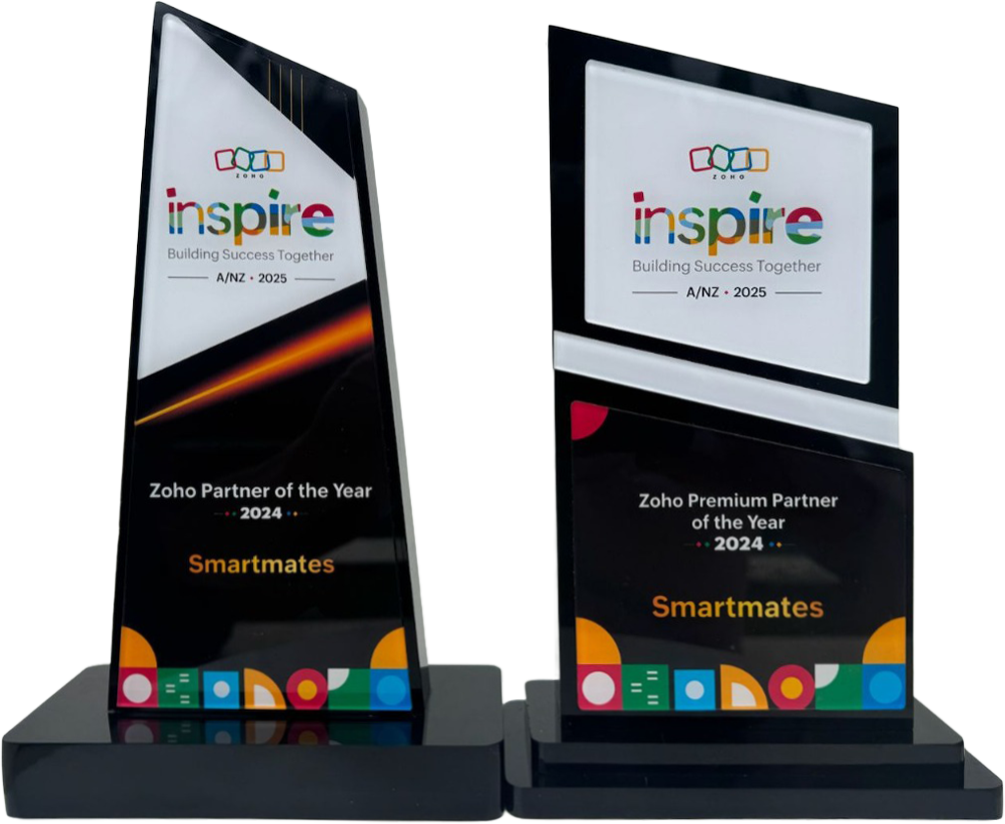
4 Years in a Row
Officially awarded Zoho Partner of the Year in Australia for 2022, 2023, 2024 and 2025. Chosen from 60+ Australian Zoho Partners by Zoho themselves.*
- First Top-Up Special $129 $99/hr + GST
Book your free video conference with our Zoho Consultants
Get your free comprehensive Zoho rollout quotation
Recognised as Australia’s #1 Zoho Partner, 4 years running
Minimum project size 10 consulting hours.

Where Most Businesses Get Zoho Training Wrong


Here’s the uncomfortable truth: you’ve invested in Zoho, your team attended a training session, and three months later, everyone’s back to using spreadsheets and sticky notes. Sound familiar?
You’re not alone. Across Australia, businesses are bleeding productivity because they’ve approached Zoho training like it’s a box-ticking exercise rather than a genuine transformation of how work gets done. The irony? Zoho is one of the most powerful business platforms available, yet most companies use about 10% of its capability.
Let’s talk about why this happens and, more importantly, what you can do about it.
The One-and-Done Training Trap
Picture this: your entire team crammed into a conference room for a four-hour training session. The trainer clicks through slides faster than a Formula 1 pit stop, everyone nods politely, and by the time they return to their desks, the information has evaporated like morning dew.
This is mistake number one.
The reality check: Learning Zoho isn’t like learning to ride a bike. It’s more like learning a new language. You need immersion, practice, and time. One session creates the illusion of competence without the substance.
Most businesses assume training is a single event. They schedule it, complete it, then wonder why adoption rates hover around 30%. Here’s what actually works: ongoing, bite-sized learning that happens in the flow of work.
Think about how you learned to use your smartphone. Did someone give you a four-hour lecture? Or did you explore features gradually, asking questions when you got stuck, and discovering capabilities over time?
The fix: Structure Zoho training as a journey, not a destination. Start with core functions, then layer in advanced features as your team gains confidence. Weekly 15-minute sessions beat monthly marathons every single time.
Training the Wrong People (Or Everyone the Same Way)
Not everyone needs to know everything about Zoho. Shocking, right?
Yet companies routinely put their entire workforce through identical training programs. The sales director sits through inventory management tutorials. The warehouse manager endures CRM relationship mapping exercises. Everyone leaves confused and slightly resentful.
Here’s the thing: Your marketing manager needs different Zoho skills than your finance team. Your executives need dashboard insights, not data entry tutorials. Training everyone the same way is like serving the same meal at every occasion, whether it’s a business breakfast or a wedding reception.
We’ve seen companies waste thousands on comprehensive training that taught people features they’d never use. Meanwhile, the specific functions they needed daily remained mysterious.
| Role | Essential Zoho Functions | Often Over-Trained On | Result |
|---|---|---|---|
| Sales Team | CRM, lead tracking, pipeline management | Inventory, accounting modules | 40% feature adoption |
| Marketing | Campaigns, analytics, social integration | Sales forecasting, inventory | 35% feature adoption |
| Operations | Workflow automation, project management | Marketing campaigns, CRM details | 45% feature adoption |
| Executives | Dashboards, reports, analytics | Day-to-day data entry, technical setup | 25% feature adoption |
The solution: Role-based training that focuses on what each person actually does. Your sales team needs to master CRM functions inside-out. Your operations crew needs workflow automation. Custom training paths mean people learn what matters to their daily work, which dramatically improves adoption and ROI.
Also Read: For Manufacturing Giants Supported By Zoho CRM Consultants
Treating Zoho Like a Software Tool Instead of a Business System
This might sting a bit, but it needs saying: if you think Zoho is just software, you’ve already lost.
Zoho isn’t Microsoft Word. It’s not a tool you open, use, and close. It’s a comprehensive business operating system that touches every part of your company. Yet most Zoho training focuses on clicking buttons and filling forms rather than reimagining workflows.
The missed opportunity: When businesses approach Zoho training purely from a technical angle, they miss the transformative potential. The real power isn’t in knowing where the buttons are. It’s in understanding how Zoho can eliminate bottlenecks, automate tedious tasks, and give you business intelligence that was previously invisible.
Consider this example from our work with Australian businesses. One client spent considerable money training staff on Zoho Books functions, teaching them how to create invoices, record expenses, and manage accounts. Technically, everyone knew how to use the software.
But nobody taught them how to automate invoice generation from CRM deals, how to set up approval workflows that eliminated email chains, or how to create reports that predicted cash flow problems before they happened. They learned the “what” without the “why” or the “what if.”
The transformation mindset: Effective Zoho training asks different questions. Instead of “How do I create a contact?” it asks “How can we ensure every customer interaction is captured and accessible to everyone who needs it?” Instead of “How do I generate a report?” it asks “What business decisions will this data help us make?”
This shift from tool-focused to outcome-focused training changes everything.
Ignoring the Integration Advantage
Zoho’s greatest strength is also its greatest training challenge: integration.
Most businesses use multiple Zoho applications. They’ve got CRM for sales, Books for accounting, Desk for customer service, and Projects for team collaboration. But training typically happens in silos. The CRM trainer doesn’t mention Books. The Projects instructor ignores Desk. Everyone learns their little corner without understanding how the ecosystem connects.
This creates data islands and duplicated effort. Your sales team enters customer information in CRM. Your accounts team re-enters the same information in Books. Your support team asks customers for details that already exist in the system. Multiply this across your entire organization and you’ve got chaos masquerading as process.
The integration advantage: When you understand how Zoho applications talk to each other, magic happens. A lead in CRM automatically becomes a contact in Books when they make their first purchase. Support tickets in Desk trigger workflow alerts in Projects. Marketing campaigns in Campaigns sync with sales pipelines in CRM.
But you’ll never discover these possibilities if training treats each application as separate.
What works better: Integrated training that follows real business processes across multiple applications. Show how a customer journey flows from marketing contact to qualified lead to paying customer to support ticket to renewal opportunity. Demonstrate workflows that span applications. Make the connections explicit and obvious.
This is where proper Zoho training separates the amateurs from the professionals.
Skipping the Customisation Conversation
Out-of-the-box Zoho is powerful. Customised Zoho is transformative. Yet most training programs barely touch customisation, leaving businesses stuck with generic workflows that don’t match their actual processes.
Here’s what happens: Your team learns Zoho’s standard setup. They try to make it work for your business. It doesn’t quite fit, so they create workarounds, use external tools, or simply avoid using Zoho for certain tasks. Before long, you’ve got a Frankenstein system that frustrates everyone.
The problem isn’t Zoho. The problem is training that doesn’t address your specific business context. Every company operates differently. Your sales process isn’t identical to your competitor’s. Your customer service workflow has unique elements. Your reporting needs reflect your specific business model.
Generic training produces generic results.
The customisation opportunity: Zoho is incredibly flexible. Custom fields, custom modules, custom workflows, custom reports – the platform bends to fit your business, not the other way around. But taking advantage of this requires training that explores customisation possibilities and teaches your team how to adapt Zoho to your needs.
This doesn’t mean everyone needs to become a Zoho developer. It means understanding what’s possible, knowing when to customise, and having access to expertise when you need deeper modifications.
Businesses that nail Zoho customisation see 3-4x better adoption rates than those using standard configurations.
Forgetting About the Post-Training Support Structure
Training ends. Questions begin. And that’s when most businesses discover they’ve got a problem.
Someone encounters an issue. They don’t remember the solution from training. They ask a colleague, who guesses. The guess is wrong. Frustration builds. Eventually, they revert to the old way of doing things because it’s easier than figuring out Zoho.
Multiply this scenario across your organization and you’ll understand why training initiatives fail even when the training itself was excellent.
The support gap: Most businesses underestimate the ongoing support required after initial training. They assume once people know the basics, they’ll figure out the rest. In reality, the period immediately following training is critical. This is when questions are highest, confidence is lowest, and habits form.
Without structured support, bad habits solidify. People find workarounds instead of proper solutions. They use Zoho inefficiently or abandon it entirely. Your training investment evaporates.
The support structure that works:
- Internal champions: Designate power users in each department who receive advanced training and become go-to resources
- Documentation: Create quick-reference guides specific to your Zoho setup and common tasks
- Regular check-ins: Schedule brief refresher sessions to address questions and introduce new features
- Expert access: Maintain a relationship with Zoho specialists who can handle complex issues quickly
Think of it like learning to drive. Initial lessons teach the basics, but you need a licensed driver beside you for those first solo drives. Eventually, you’re confident on your own, but it takes time and support.
Measuring the Wrong Success Metrics
Quick question: how do you know if your Zoho training succeeded?
If you answered “everyone attended the session” or “we completed the training program,” you’re measuring activity, not results. And that’s exactly where most businesses go wrong.
Attendance doesn’t equal adoption. Completion doesn’t equal competence. The real question is whether Zoho training changed how work gets done and improved business outcomes.
The metrics that matter:
| Vanity Metrics (Don’t Focus Here) | Real Success Metrics (Focus Here) |
|---|---|
| Training attendance rate | Active daily users in Zoho |
| Hours of training delivered | Reduction in manual data entry |
| Training satisfaction scores | Number of automated workflows created |
| Certificates issued | Time saved on administrative tasks |
| Training budget spent | Revenue tracked through CRM |
| Number of features covered | Customer response time improvement |
We’ve seen companies celebrate 100% training attendance while their Zoho usage remains abysmal. Meanwhile, organizations that track actual usage, efficiency gains, and business improvements can demonstrate real ROI from their training investment.
What to measure instead:
- Login frequency and feature usage across your team
- Time saved on previously manual processes
- Accuracy improvements in data entry and reporting
- Customer satisfaction scores for processes supported by Zoho
- Revenue or deals managed through the platform
- Support ticket volume related to Zoho issues
These metrics tell you whether training actually changed behavior and delivered value.
The Australian Business Context You Can’t Ignore
Let’s get specific about Australia for a moment. The way businesses operate here has unique characteristics that affect Zoho training success.
Australian businesses tend to be more casual in communication style but serious about results. We value efficiency, dislike unnecessary complexity, and appreciate straight talk. These cultural factors influence how training should be delivered.
Additionally, many Australian businesses, particularly small to medium enterprises, operate with lean teams. People wear multiple hats. The person managing your CRM might also handle marketing and dabble in customer service. This makes role-based training more complex but also more critical.
Time zones matter too. If you’re relying on offshore support or training delivered from other regions, you’ll face delays that frustrate Australian teams. Real-time support during Australian business hours isn’t a luxury. It’s a necessity for maintaining momentum after training.
The Smartmates Difference: Training That Actually Works
Here’s where we need to talk about doing Zoho training properly, and yes, this is where we’re going to be direct about how Smartmates approaches this differently.
We’ve spent years watching businesses struggle with Zoho not because the platform lacks capability, but because training wasn’t designed for real-world adoption. So we built a different approach.
Our training philosophy:
First, we don’t do one-size-fits-all sessions. Before training begins, we analyse your business processes, understand your workflows, and identify the specific Zoho functions that will deliver the most value to each role in your organization.
Second, we combine training with implementation. You’re not learning Zoho in a vacuum. You’re learning it while we configure it specifically for your business. This means training happens in context, with your data, your processes, and your actual workflows.
Third, we provide layered learning. Initial training covers essential functions to get you operational quickly. Follow-up sessions introduce advanced features as your team gains confidence. And we’re available for ongoing support when questions arise.
What this looks like in practice:
- Role-specific training modules tailored to your business
- Hands-on sessions using your actual Zoho environment
- Custom documentation reflecting your setup and processes
- Designated support during the critical post-training period
- Regular check-ins to address questions and optimize usage
- Integration training that shows how different Zoho applications work together
We’re certified Zoho experts based in Australia, which means we understand both the platform and the business context you’re operating in. When you’ve got a question at 2pm Sydney time, you get an answer at 2pm Sydney time, not an email saying someone will respond in 12-24 hours.
The results speak clearly:
Our clients typically see 80%+ active usage rates within three months of training, compared to industry averages of 30-40%. They automate workflows that previously consumed hours of manual work. They make business decisions based on real-time data instead of gut feel and outdated spreadsheets.
But here’s what really matters: they actually use Zoho. Daily. Enthusiastically. Because the training gave them not just knowledge, but confidence and capability.
Your Next Steps: Transform How Your Business Operates
Let’s bring this full circle. You invested in Zoho because you recognized its potential to streamline operations, improve efficiency, and support growth. But potential means nothing without proper execution.
The training mistakes we’ve covered are costing Australian businesses productivity, revenue, and competitive advantage. The good news? Every single one of these mistakes is fixable.
Whether you’re implementing Zoho for the first time or trying to salvage a previous implementation that didn’t deliver, the path forward is clear: training that’s role-based, integration-focused, customization-aware, and supported by ongoing expertise.
What you should do right now:
Audit your current Zoho usage honestly. How many team members actively use the platform daily? What features remain unexplored? Where are the bottlenecks and workarounds that signal training gaps?
Talk to your team. Where do they struggle? What tasks feel unnecessarily complicated? What would make their daily work easier?
Then make a decision. Continue with inadequate training that delivers minimal results, or invest in proper training that transforms how your business operates.
Ready to Get Zoho Training Right?
At Smartmates, we’ve helped hundreds of Australian businesses move from Zoho confusion to Zoho mastery. We understand the platform deeply, we know Australian business culture intimately, and we’re committed to training that delivers measurable results.
We offer CRM integration, custom app development, workflow automation, and data migration, all backed by certified experts and a genuinely client-focused approach. But more than technical capability, we offer the training and support that turns Zoho investment into business transformation.
Let’s talk about your specific situation, identify where previous training fell short, and design a learning path that actually works for your team.
Request a Callback from Smartmates

Sarah
I’ll listen to your Zoho needs to understand your business challenges and goals, ensuring a tailored approach.
I’ll bring a certified Zoho engineer to our first consultation to explore solutions and clarify your requirements.
We’ll deliver your free project plan quotation, detailing the steps, timeline, and costs—up to this point, it’s completely free!
“My mission is to solve your key problems, build your trust in our capabilities and deliver exceptional value for money.”