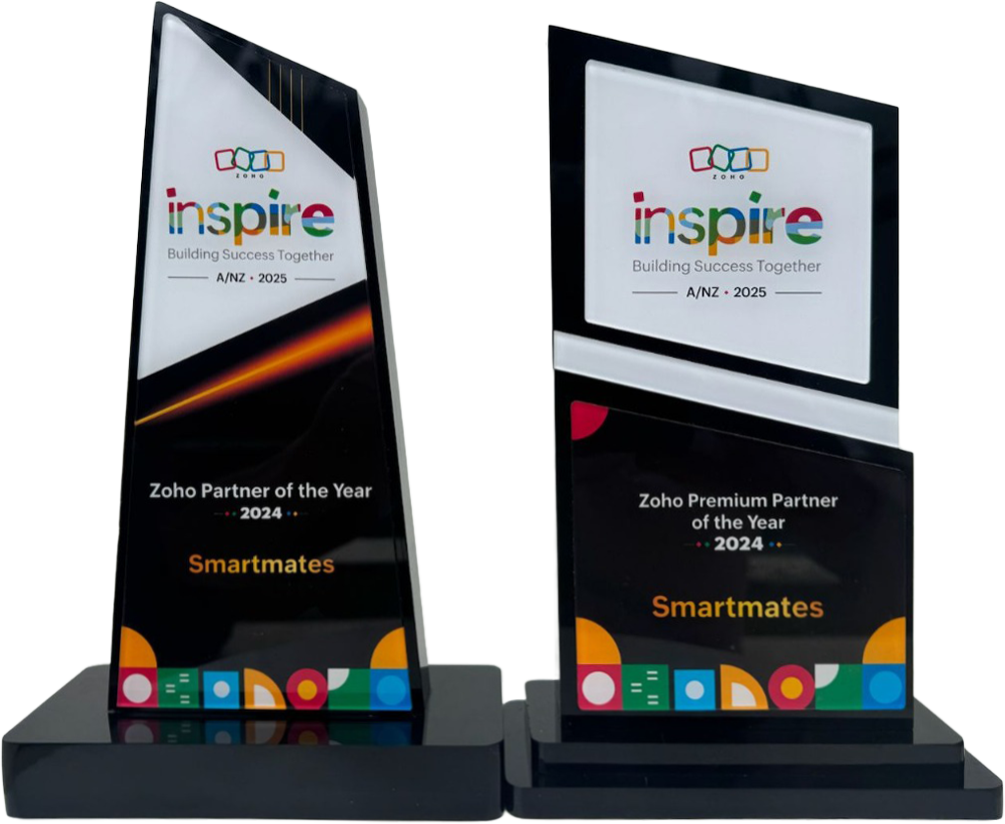
4 Years in a Row
Officially awarded Zoho Partner of the Year in Australia for 2022, 2023, 2024 and 2025. Chosen from 60+ Australian Zoho Partners by Zoho themselves.*
- First Top-Up Special $129 $99/hr + GST
Book your free video conference with our Zoho Consultants
Get your free comprehensive Zoho rollout quotation
Recognised as Australia’s #1 Zoho Partner, 4 years running
Minimum project size 10 consulting hours.

Transform Your Entire CRM Ecosystem With Zoho CRM Consultants


Your CRM doesn’t exist in a vacuum. It connects to your accounting software, your email marketing platform, your e-commerce store, your customer service desk, your project management tools, and probably half a dozen other systems you rely on daily.
But here’s the problem: most of these connections are manual, broken, or non-existent. Your sales team enters data in Zoho CRM. Then someone manually copies it into Xero. Marketing exports contacts to Mailchimp. Customer service logs tickets in a separate system. Nobody has a complete view of the customer because information lives in fragmented silos.
This isn’t a CRM problem. It’s an ecosystem problem.
Your CRM is only as valuable as how well it connects with everything else your business uses. Isolated, it’s just a contact database. Integrated into a unified ecosystem, it becomes the central nervous system of your entire operation.
Most Australian businesses have never experienced truly integrated CRM ecosystems because they’ve only worked with implementers who configure the CRM itself without thinking about the broader technology landscape. They get Zoho CRM working in isolation, then wonder why it doesn’t transform operations.
Professional Zoho CRM consultants don’t just implement software. They transform entire ecosystems by designing and building connections that turn fragmented tools into unified platforms that actually deliver on the promise of digital transformation.
Let’s talk about what ecosystem transformation actually means and how it changes everything about how your business operates.
What a CRM Ecosystem Actually Is
Before we talk about transformation, let’s define what we mean by CRM ecosystem.
Your CRM ecosystem includes every system that either feeds data to your CRM, receives data from your CRM, or shares data with your CRM. It’s the complete web of tools, platforms, and applications that collectively manage your customer relationships and business operations.
For a typical Australian business, this might include:
Core business systems: Accounting software like Xero or MYOB. E-commerce platforms like Shopify or WooCommerce. Inventory management systems. Point-of-sale systems for retail.
Marketing and communication tools: Email marketing platforms. Social media management. Website analytics. Marketing automation. Advertising platforms.
Sales and customer service: Proposal and quoting tools. Document signing services. Customer support ticketing systems. Knowledge bases. Live chat platforms.
Operations and productivity: Project management software. Time tracking. Team collaboration tools. Document storage. Communication platforms like Slack or Teams.
Specialized industry tools: Whatever unique software your industry requires. Practice management for professional services. Booking systems for hospitality. Fleet management for distribution.
Most businesses have 10 to 30 different tools in their ecosystem. Each one serves a purpose. Each one contains valuable information. But without proper integration, they’re disconnected islands requiring manual bridges.
Also read: Zoho CRM Training For Multi-Location Operations
The Cost of Fragmented Ecosystems
Let’s be honest about what disconnected systems actually cost your business.
Duplicate data entry wastes enormous time. Customer details entered in your CRM need manual copying to accounting, marketing, and support systems. Every update requires touching multiple places. One Sydney business we worked with calculated 15 hours weekly on duplicate entry across just five systems.
Information silos prevent complete customer understanding. Sales knows deal history but not support ticket history. Support knows problems but not purchase history. Marketing knows engagement but not actual revenue. Nobody has complete context for customer interactions.
Inconsistent data creates confusion and errors. When customer information exists in multiple places without synchronization, discrepancies emerge. Different phone numbers. Conflicting addresses. Outdated contact details. Which version is correct? Nobody knows.
Manual processes create bottlenecks and delays. Quote approval requires emailing finance. Order fulfillment needs manual coordination between sales and operations. Customer onboarding involves touching six different systems sequentially. Everything takes longer than it should.
Reporting becomes impossible when data is fragmented. Want to know customer lifetime value? That requires pulling data from CRM, accounting, and support systems, then manually reconciling everything. By the time you compile the report, it’s outdated.
Add it up and fragmented ecosystems cost Australian businesses tens of thousands annually in wasted time, lost opportunities, errors, and poor decisions based on incomplete information.
What Ecosystem Transformation Looks Like
Right, those are the problems. Here’s what professional Zoho CRM consultants actually build instead.
Unified Customer Data Platform
Instead of customer information scattered across systems, consultants create unified customer records where all data lives or synchronizes automatically.
Your CRM becomes the master customer database. Every interaction, transaction, communication, and data point connects to one comprehensive customer record. Sales activity. Purchase history. Support tickets. Marketing engagement. Payment status. Project milestones. Everything in one place.
This doesn’t mean abandoning your other systems. It means connecting them so information flows automatically and creates complete visibility without manual compilation.
One Melbourne professional services firm had client information in CRM, project management, time tracking, and accounting systems. We integrated everything so their CRM showed complete client history including projects, time spent, invoices, and support. Their account managers finally had complete context for every client conversation.
Automated Data Flows Between Systems
Instead of people manually moving information between systems, consultants build automated data flows that keep everything synchronized without human intervention.
Deal closed in CRM? Automatically creates customer record in accounting, triggers onboarding sequence in project management, adds to appropriate marketing segments, and notifies relevant teams. No manual handoffs. No waiting. No errors from manual entry.
Customer places order online? Automatically creates deal in CRM, updates inventory, triggers fulfillment workflow, sends confirmation email, and creates support ticket for onboarding. Everything happens instantly without coordination overhead.
Support ticket resolved? Automatically updates customer record with issue details, triggers satisfaction survey, creates task for sales follow-up if upsell opportunity, and feeds reporting dashboards. Nothing gets lost or forgotten.
These automated flows eliminate duplicate work while ensuring information stays current everywhere simultaneously.
Cross-System Workflow Automation
Beyond simple data sync, consultants build sophisticated workflows that span multiple systems, orchestrating complex business processes automatically.
Example: Quote-to-cash automation. Customer requests quote. CRM automatically generates quote using current pricing from accounting and inventory availability from warehouse system. Quote approval routes through multiple managers based on value and customer type. Upon acceptance, deal updates in CRM, invoice generates in accounting, work order creates in project management, and fulfillment begins in operations. All automatic.
Example: Customer onboarding workflow. New customer signed. Welcome email sends from marketing platform. Account setup tasks assign to relevant teams in project management. Training resources deliver through learning platform. Check-in calls schedule in CRM. Progress tracking updates dashboard for visibility. 30-day satisfaction survey triggers automatically. Complete onboarding orchestrated across systems without manual coordination.
Example: Support escalation workflow. Support ticket created. Initial response sends automatically. If unresolved within SLA, escalates to senior support with CRM notification to account manager. If still unresolved, creates task for management review and blocks renewal in accounting until resolved. Priority customers get different escalation paths. All automatic based on ticket details and customer data.
These cross-system workflows eliminate coordination overhead while ensuring consistent execution of complex processes.
Unified Reporting and Analytics
Instead of pulling data from multiple systems and manually combining it, consultants create unified reporting that aggregates data automatically.
Executive dashboards show complete business health. Revenue from accounting. Pipeline from CRM. Marketing performance from campaign tools. Support metrics from ticketing system. Operations efficiency from project management. Everything in one real-time view without manual compilation.
Customer analytics combine all touchpoints. How do marketing campaigns influence deal closure? What’s the relationship between support ticket volume and renewal rates? Which customer segments are most profitable considering acquisition cost, lifetime value, and support burden? These insights require data from multiple systems analyzed together.
Operational reporting spans the ecosystem. Sales team productivity combining CRM activity, closed revenue, and time allocation. Project profitability combining time tracking, expense management, and billing data. Inventory turnover combining warehouse system, sales data, and financial metrics.
This unified reporting transforms decision-making from gut feel to data-driven strategy.
The Ecosystem Transformation Process
How do Zoho CRM consultants actually transform fragmented systems into unified ecosystems?
Phase One: Ecosystem Mapping and Assessment
Consultants start by comprehensively mapping your current technology landscape.
System inventory: What tools does your business actually use? Not just major platforms, but spreadsheets, small utilities, and unofficial tools teams have adopted. Everything matters because everything might need integration.
Data flow analysis: How does information currently move between systems? Manual exports and imports? Email attachments? Verbal communication? This reveals current integration gaps and manual processes.
Pain point identification: Where do disconnections cause problems? What manual work frustrates teams? Where do errors occur from inconsistent data? What decisions can’t be made due to fragmented information?
Integration assessment: Which systems have APIs for connection? Which are integration-friendly versus locked down? What technical challenges exist? This determines integration approach and complexity.
This mapping creates complete understanding of your current ecosystem and transformation opportunities.
Phase Two: Architecture Design
With current state mapped, consultants design target architecture for your integrated ecosystem.
Source of truth designation: For each data type, which system is authoritative? Customer master data might live in CRM. Financial data in accounting. Inventory in warehouse system. Clear source of truth prevents conflicts.
Data flow design: What information flows where? How frequently? In what direction? Bidirectional for some data, unidirectional for others. This ensures data stays current without creating circular dependencies or conflicts.
Integration method selection: APIs for real-time sync. Scheduled batch processes for bulk updates. Webhooks for event-driven automation. Different integration patterns for different scenarios based on requirements and technical capabilities.
Workflow orchestration planning: How will cross-system workflows function? What triggers what? How do you handle errors or exceptions? This systematic design prevents the chaos of unplanned automation.
| System Type | Role in Ecosystem | Integration Approach | Data Flow Direction | Update Frequency |
|---|---|---|---|---|
| Zoho CRM | Customer master, sales pipeline | Central hub, bidirectional | Receives and sends | Real-time |
| Accounting (Xero) | Financial truth, invoicing | API integration | Bidirectional | Real-time for critical data |
| Marketing Automation | Campaign execution | Webhook triggers | Receives from CRM | Real-time for contacts |
| Support Desk | Ticket management | API integration | Bidirectional | Real-time |
| E-commerce | Online sales | Webhook for orders | Sends to CRM | Real-time for transactions |
| Project Management | Work execution | API integration | Receives from CRM | Near real-time |
This architecture provides blueprint for transformation implementation.
Phase Three: Integration Development and Testing
With architecture designed, consultants build the actual integrations.
Standard integration configuration: Many systems offer pre-built connectors with Zoho. Consultants configure these for your specific requirements, mapping fields correctly and setting sync rules appropriately.
Custom integration development: For systems without standard connectors or requiring specialized logic, consultants build custom integrations using APIs. This requires actual development skill, not just configuration knowledge.
Data transformation logic: Information often needs translation between systems. Customer “type” in your CRM might map to “classification” in accounting. Product names might need standardization. Consultants build transformation rules ensuring data maps correctly.
Testing and validation: Integrations get thoroughly tested with real data before going live. Does information sync correctly? Do workflows trigger as expected? How do systems handle edge cases and errors? Rigorous testing prevents production problems.
Phase Four: Data Migration and Cutover
If you’re consolidating from multiple systems or migrating from another CRM, consultants handle data migration carefully.
Data cleanup before migration: No point migrating garbage. Consultants identify duplicates, fix inconsistencies, fill gaps, and standardize formats before moving data.
Staged migration approach: Critical data first. Historical data later. This minimizes disruption while getting essential information in place quickly.
Validation and reconciliation: After migration, comprehensive checking ensures data arrived correctly and completely. Comparing record counts. Spot-checking details. Verifying relationships.
Parallel running when appropriate: For critical systems, running old and new in parallel briefly provides safety net and allows team familiarization before full cutover.
Phase Five: Ongoing Optimization and Evolution
Ecosystem transformation doesn’t end at go-live. Consultants provide ongoing optimization as your business evolves.
Performance monitoring: Are integrations running smoothly? Are sync delays acceptable? Are any workflows creating bottlenecks? Continuous monitoring catches problems early.
Usage analysis: Which integrations deliver most value? Where are teams still working around the system? What new integration needs emerge? Usage data guides ongoing improvement.
Platform evolution adaptation: When Zoho or your other systems update, integrations may need adjustment. Consultants ensure your ecosystem stays current and functioning as platforms evolve.
New system additions: As you add tools to your technology stack, consultants integrate them into the ecosystem maintaining unified operation rather than creating new silos.
Industry-Specific Ecosystem Patterns
Different industries have characteristic ecosystem structures that experienced Zoho CRM consultants recognize and leverage.
Professional Services
Typically integrate CRM with time tracking (Harvest, Toggl), project management (Asana, Monday), accounting (Xero), document management (Google Drive, Dropbox), and proposal tools.
Key workflows: Client onboarding from deal closure. Time tracking to invoicing. Project status to client reporting. Resource allocation based on pipeline.
Manufacturing and Distribution
Connect CRM with ERP systems, inventory management, production planning, supplier portals, and logistics platforms.
Key workflows: Quote generation with real-time inventory and pricing. Order to production workflows. Shipment tracking and customer notifications. Supplier coordination based on forecasted demand.
Retail and E-Commerce
Integrate CRM with e-commerce platforms (Shopify, WooCommerce), POS systems, inventory management, marketing automation, and loyalty programs.
Key workflows: Online and offline purchase unification. Personalized marketing based on purchase history. Inventory allocation across channels. Returns and refund processing.
Healthcare and Allied Services
Connect CRM with practice management systems, appointment scheduling, patient portals, billing systems, and compliance platforms.
Key workflows: Appointment booking to patient records. Treatment plans to billing. Follow-up care automation. Compliance documentation and reporting.
Understanding industry patterns accelerates ecosystem transformation because consultants apply proven approaches rather than designing from scratch.
Common Ecosystem Transformation Challenges
Let’s talk about what goes wrong during ecosystem transformation so you can avoid these problems.
Challenge one: Underestimating complexity. Integration seems simple until you encounter edge cases, data inconsistencies, and system limitations. Professional consultants account for real-world complexity.
Challenge two: Poor change management. Technology alone doesn’t transform ecosystems. People need training on new workflows. Processes need documentation. Teams need support during transition.
Challenge three: Inadequate testing. Integration that works in test environment sometimes breaks in production under real load and data. Thorough testing prevents embarrassing failures after go-live.
Challenge four: No governance model. Without clear rules about who can change what, your carefully designed ecosystem degrades as people make ad-hoc modifications.
Challenge five: Ignoring data quality. Integration magnifies data quality problems. Bad data in one system now automatically corrupts data everywhere. Foundation work on data quality is essential.
Experienced consultants navigate these challenges through proven methodologies developed across multiple implementations.
The Smartmates Ecosystem Transformation Approach
Look, connecting a couple of systems isn’t particularly difficult. Transforming complete ecosystems while maintaining business continuity and delivering measurable value? That requires specialized expertise.
Smartmates specializes in complete ecosystem transformation for Australian businesses using Zoho CRM as the central platform. We’ve integrated dozens of systems across industries, learning what works and what fails.
Our approach starts with comprehensive ecosystem mapping. We don’t just look at your CRM, we understand your complete technology landscape and how you actually work.
We design architecture thoughtfully, not just connecting everything to everything. We create hub-and-spoke patterns, designate clear sources of truth, and build data flows that maintain consistency without creating circular dependencies or conflicts.
We have development capabilities for custom integrations when standard connectors don’t exist or don’t handle your specific requirements. This technical depth separates us from consultants who only configure pre-built connections.
We’re based in Australia, which means we understand local systems (Xero, MYOB), compliance requirements, and business practices. We work in your time zone and can meet face-to-face when valuable.
Plus, we work with both Zoho and HubSpot, giving us cross-platform perspective. We’re not religiously attached to one ecosystem. We design solutions using whatever tools best fit your needs.
And critically, we provide ongoing support as your ecosystem evolves. Integration isn’t one-and-done. We stay engaged, monitoring performance, addressing issues, and adapting as your business and technology stack change.
Your Path to Ecosystem Transformation
Right, you’ve made it through. You understand what CRM ecosystem transformation means and why it matters enormously for operational efficiency and business growth.
The question is what you do with this understanding.
You can keep limping along with fragmented systems, accepting duplicate work and incomplete visibility as unavoidable costs of doing business. You can continue making decisions based on partial information because consolidating data manually is too time-consuming.
Or you can transform your ecosystem into an integrated platform that actually delivers on digital transformation promises.
Imagine every system talking to every other system automatically. Imagine customer data updating everywhere simultaneously without manual entry. Imagine complex workflows spanning multiple platforms executing flawlessly without coordination overhead. Imagine reports that show complete business reality without manual compilation. Imagine the competitive advantage of operations that just work smoothly while competitors struggle with disconnection.
That transformation from fragmented chaos to integrated ecosystem is what expert Zoho CRM consultants deliver. Not through magic, but through systematic architecture design, skilled integration development, and thoughtful implementation that respects business continuity while driving real change.
Your Australian business deserves systems that work together seamlessly instead of requiring constant manual bridging. You deserve complete customer visibility instead of fragmented views. You deserve automation that spans your entire operation instead of isolated pockets of efficiency.
Ready to transform your entire CRM ecosystem with expert Zoho CRM consultants? Smartmates has helped dozens of Australian businesses move from fragmented systems to unified platforms that transform operations. We know what works because we’ve built these ecosystems repeatedly across industries and company sizes.
Let’s talk about your current technology landscape, your integration challenges, and how ecosystem transformation can eliminate manual work while creating visibility and control you’ve never had before. No generic sales pitch, just honest conversation about what’s possible.
Visit smartmates.com.au or reach out today. Your ecosystem transformation starts with a conversation. Let’s make it happen.
Request a Callback from Smartmates

Sarah
I’ll listen to your Zoho needs to understand your business challenges and goals, ensuring a tailored approach.
I’ll bring a certified Zoho engineer to our first consultation to explore solutions and clarify your requirements.
We’ll deliver your free project plan quotation, detailing the steps, timeline, and costs—up to this point, it’s completely free!
“My mission is to solve your key problems, build your trust in our capabilities and deliver exceptional value for money.”