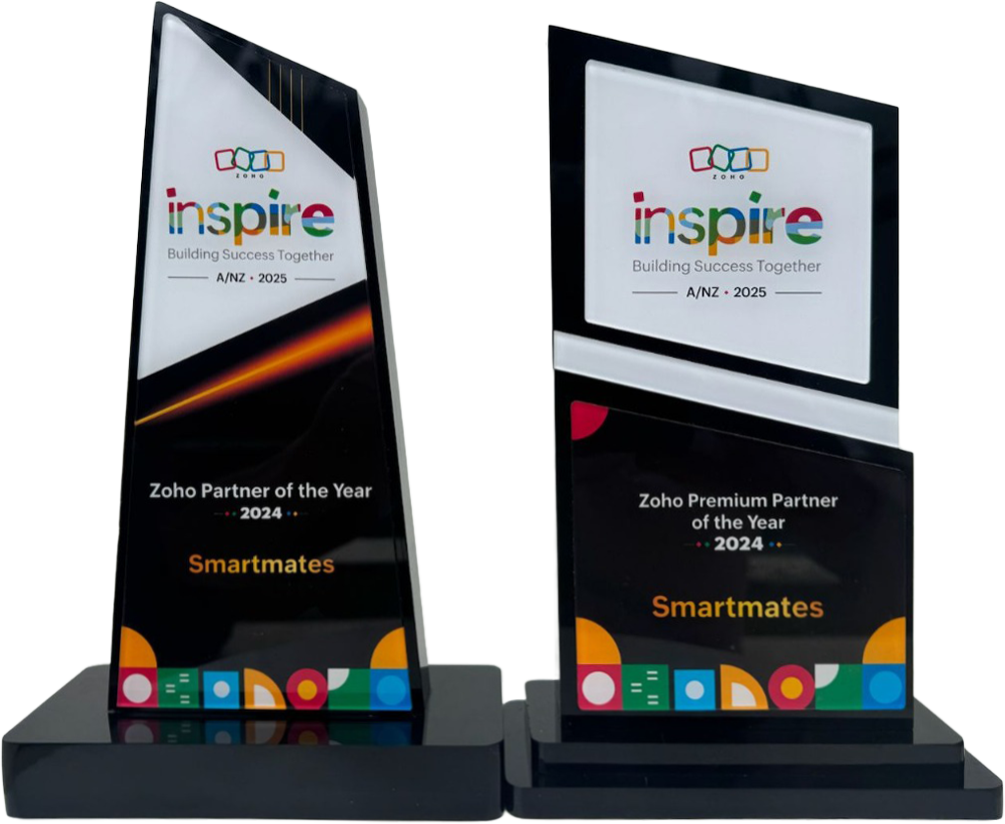
4 Years in a Row
Officially awarded Zoho Partner of the Year in Australia for 2022, 2023, 2024 and 2025. Chosen from 60+ Australian Zoho Partners by Zoho themselves.*
- First Top-Up Special $129 $99/hr + GST
Book your free video conference with our Zoho Consultants
Get your free comprehensive Zoho rollout quotation
Recognised as Australia’s #1 Zoho Partner, 4 years running
Minimum project size 10 consulting hours.

Results First With Zoho CRM Consultants Who Get Your Industry


Three months into their CRM project, the manufacturing director knew they had a problem. The consultants were technically brilliant. They knew Zoho inside out. They could script, integrate, and automate anything. But they had absolutely no idea how manufacturing actually worked.
They built a beautiful lead scoring system that completely ignored production capacity. They automated quote generation without understanding material costs fluctuate. They created sales pipelines that made zero sense for long-cycle capital equipment sales. The system was technically perfect and practically useless.
That’s the moment most businesses learn a painful truth: technical expertise alone doesn’t cut it. You need Zoho CRM consultants who actually understand your industry. Not just the software. Not just business processes in general. Your specific world, with all its quirks, challenges, and unwritten rules.
The difference between generic consultants and industry-savvy experts? About six months and fifty thousand dollars in wasted effort. Let’s talk about why industry knowledge transforms CRM implementations and how to find consultants who actually get your business.
Also Read: Make Project Tracking Easier With A Zoho Creator Partner
Why Your Industry Knowledge Gap Costs More Than You Think
Here’s something that rarely gets discussed openly. Most CRM consultants speak in generalities. They talk about “best practices” and “industry standards” without understanding what those actually mean in your specific sector. They’ve done dozens of implementations, sure, but have they done yours?
Think about what makes your industry different. The regulations you navigate. The buying cycles you manage. The customer relationships you nurture. The operational constraints you work within. These aren’t minor details. They’re fundamental to how your business operates.
A consultant without industry experience approaches your project like a puzzle. They learn as they go, making mistakes you’ll discover later. They ask basic questions that waste your time. They propose solutions that sound reasonable but won’t survive contact with reality. And you’re paying for their education.
The hidden costs of industry ignorance include:
Misaligned workflows that don’t match how your team actually works. Generic consultants design processes based on theoretical best practices, not practical reality. Your team ends up forcing square pegs into round holes, creating frustration and resistance.
Missing functionality that’s critical for your sector. When consultants don’t understand your industry, they don’t know what questions to ask. They overlook requirements that seem obvious to you but aren’t documented anywhere. Those gaps become expensive problems later.
Compliance nightmares waiting to happen. Different industries have different regulatory requirements. Healthcare has HIPAA considerations. Financial services deals with privacy regulations. Construction faces safety documentation needs. Consultants without sector experience miss these crucial elements.
Integration disasters with industry-specific tools. Your business probably uses specialised software that generic consultants have never heard of. Connecting Zoho with niche platforms requires understanding both systems deeply. Without that knowledge, integrations break in unexpected ways.
Training that misses the mark completely. When consultants don’t understand your team’s daily reality, they can’t create relevant training. They use examples that don’t resonate. They focus on features you’ll rarely use while glossing over critical functionality.
What Industry Expertise Actually Looks Like
Real industry expertise isn’t about having worked with one company in your sector. It’s about understanding patterns, challenges, and opportunities that define how businesses in your space operate. It’s recognising problems before you articulate them and proposing solutions that feel immediately relevant.
Experienced industry consultants demonstrate knowledge through:
They speak your language naturally. When discussing your business, they use industry terminology correctly without asking for definitions. They reference common challenges without needing explanations. They understand your competitive landscape, market dynamics, and operational constraints.
They anticipate requirements you haven’t mentioned. Because they’ve worked with similar businesses, they know what you’ll need before you do. They ask about scenarios you haven’t considered. They design for edge cases that will definitely occur but aren’t top of mind yet.
They bring proven solutions to the table. Industry-experienced consultants arrive with templates, workflows, and approaches that already work for businesses like yours. They’re not starting from scratch. They’re adapting proven models to your specific situation.
They understand your customer journey intimately. Different industries have wildly different sales cycles, customer touchpoints, and relationship management needs. Consultants with sector experience design CRM systems that map perfectly to how your customers actually buy and engage.
They recognise regulatory and compliance requirements immediately. They don’t need you to explain what documentation you’re required to maintain or what reporting you need to produce. They’ve dealt with the same regulations dozens of times before.
Industry knowledge shows up in unexpected places:
| Generic Consultant | Industry-Savvy Consultant |
|---|---|
| “Let’s create a standard sales pipeline” | “For your sales cycle, we need separate pipelines for new business versus renewals” |
| “We’ll set up basic reporting” | “You’ll need margin analysis by product category and customer segment” |
| “Here’s how to track opportunities” | “For project-based work, we’ll link opportunities to resource planning” |
| “Let’s import your contact data” | “We need to maintain your account hierarchies and buying group relationships” |
| “Standard email templates should work” | “Your technical specifications need to be dynamically generated based on customer requirements” |
See the difference? Industry knowledge transforms vague capabilities into specific solutions that actually solve your real problems.
The Manufacturing Challenge Nobody Gets Right
Let me walk you through a specific example. Manufacturing businesses have unique CRM requirements that generic consultants consistently get wrong. They think about sales in isolation, forgetting that manufacturing connects sales, production, inventory, and logistics into complex workflows.
A manufacturing company doesn’t just sell products. They quote based on current capacity, material availability, and production schedules. They manage engineering changes that affect multiple orders. They track quality issues that require coordinated responses across sales, production, and customer service.
Industry-experienced Zoho CRM consultants build systems that handle:
Custom product configuration within quotes, where sales reps specify variations that production needs to manufacture. The CRM needs to validate that configurations are actually buildable and price them accurately based on current costs.
Production scheduling integration so sales knows what delivery dates are realistic. Promising a two-week turnaround when production is backed up three months creates problems. The CRM should reflect actual capacity, not theoretical timelines.
Quality control linkages connecting customer complaints to specific production batches. When a customer reports an issue, you need to identify which batch was affected, what other customers received similar products, and how to prevent recurrence.
Supply chain visibility showing material availability for quoted products. Selling something you can’t source materials for is embarrassing and expensive. The CRM should flag supply chain risks before quotes go out.
Engineering change management tracking how product modifications affect existing orders. When engineering updates a design, sales needs to know which orders are affected and how to communicate changes to customers.
Generic consultants rarely think about these requirements. They build systems for selling widgets, not managing complex manufacturing operations. Industry experts start with these challenges because they’ve seen them repeatedly.
Professional Services Need Different DNA
Professional services firms face completely different CRM challenges. They’re not selling products. They’re selling time, expertise, and relationships. The entire business model revolves around people, projects, and utilisation rates.
A consulting firm’s CRM isn’t primarily about tracking sales opportunities. It’s about managing client relationships over multiple engagements, tracking which consultants have expertise in what areas, managing project profitability, and ensuring knowledge sharing across the organisation.
Industry-savvy consultants build systems addressing:
Project-based revenue recognition where individual engagements have their own economics. Each project needs separate budget tracking, resource allocation, and margin analysis. The CRM connects opportunities to project delivery, showing the full lifecycle.
Consultant utilisation tracking ensuring your team is billable at optimal rates. The system needs to show who’s available, who’s overallocated, and where skills gaps exist. This isn’t about contacts and deals. It’s workforce management.
Proposal collaboration where multiple team members contribute expertise to complex bids. Professional services proposals require input from various specialists. The CRM needs to coordinate that collaboration efficiently, tracking contributions and maintaining version control.
Client relationship mapping identifying decision makers, influencers, and champions across complex organisational structures. Professional services sales are about relationships, not transactions. The CRM must capture relationship networks, not just contact details.
Knowledge management connecting past project experience to current opportunities. When bidding new work, you need quick access to similar past engagements, lessons learned, and team members with relevant experience.
These aren’t features you’ll find in standard CRM configurations. They require deep understanding of how professional services firms actually operate. Industry consultants know this intuitively because they’ve lived it across multiple clients.
Retail Reality Versus CRM Fantasy
Retail businesses occupy yet another universe with completely different requirements. Whether you’re operating physical stores, e-commerce, or both, your CRM needs reflect unique challenges around inventory, customer behaviour, and omnichannel experience.
Retailers don’t have long sales cycles with multiple touchpoints. They need systems tracking customer purchase patterns, managing loyalty programs, coordinating marketing campaigns, and connecting online behaviour with in-store visits.
Industry-experienced consultants create retail-specific solutions including:
Customer purchase history analysis showing buying patterns, preferences, and lifetime value. Retail CRM isn’t about tracking opportunities. It’s understanding customer behaviour to drive repeat purchases and increase basket size.
Loyalty program integration managing points, rewards, tier status, and personalised offers. Your CRM needs to trigger communications based on loyalty status, send birthday offers, and recommend products based on purchase history.
Omnichannel experience coordination tracking customers across website visits, store interactions, social media engagement, and customer service contacts. Modern retail requires seamless experience regardless of channel.
Inventory visibility showing product availability across locations and online. When a customer inquires about a product, your team needs instant access to stock levels everywhere, with ability to reserve items or arrange transfers.
Campaign performance tracking connecting marketing activities to actual sales results. Retailers run constant promotions, seasonal campaigns, and targeted offers. The CRM must measure what’s working and optimise spending accordingly.
A consultant without retail experience will build a system focused on deal pipelines and opportunity tracking. That’s not what retailers need. Industry experts understand the difference between selling once versus building repeat customer relationships.
The Healthcare Complexity Generic Consultants Miss
Healthcare organisations represent perhaps the most complex CRM environment. Privacy regulations are strict. Patient relationships are sensitive. Clinical and administrative systems need coordination. Compliance requirements are extensive.
Healthcare CRM isn’t about sales in the traditional sense. It’s about patient engagement, appointment management, referral tracking, provider coordination, and maintaining detailed documentation for regulatory purposes.
Consultants with healthcare experience build systems handling:
Patient relationship management respecting privacy regulations while maintaining comprehensive engagement history. Every interaction must be documented appropriately, with strict access controls and audit trails meeting regulatory requirements.
Referral network coordination tracking relationships with referring physicians, managing referral workflows, and measuring referral source effectiveness. Healthcare growth often depends on strong referral relationships requiring careful nurturing.
Appointment lifecycle management from scheduling through reminder communications to follow-up care coordination. The system integrates with clinical platforms, manages waitlists, and optimises provider schedules.
Compliance documentation maintaining required records for auditing and regulatory reporting. Healthcare organisations face constant scrutiny. The CRM must support compliance efforts without creating additional administrative burden.
Multi-location coordination for healthcare systems operating across multiple facilities. Patient records, provider schedules, and resource availability need visibility across the entire network.
Generic consultants don’t understand HIPAA implications, clinical workflow realities, or healthcare relationship dynamics. They’ll build systems that create compliance risks and don’t match how healthcare organisations actually function.
Why Smartmates Gets Your Industry Right
Look, I could spend another thousand words describing industry-specific requirements across every sector. But let’s get practical. You need Zoho CRM consultants who understand your world. That’s exactly what Smartmates delivers to Australian businesses.
We’re not generalists claiming expertise everywhere. We focus on industries where we’ve demonstrated results repeatedly. We’ve implemented Zoho CRM for manufacturers, professional services firms, retailers, healthcare organisations, and educational institutions across Australia. We know these sectors intimately.
Our consultants don’t just understand Zoho. They understand your competitive pressures, operational constraints, and growth challenges. They speak your language. They anticipate your needs. They bring solutions proven to work for businesses facing similar challenges.
What makes our industry approach different:
We start every engagement with deep industry context. Before discussing software configuration, we explore your specific market dynamics, competitive landscape, and operational reality. We’re learning what makes your business unique within your sector.
We bring sector-specific accelerators and templates. Why build everything from scratch when we’ve already solved similar problems? We arrive with proven workflows, custom modules, and integration patterns that work for your industry. We adapt these to your specific needs, dramatically accelerating implementation.
We understand your technology ecosystem intimately. Different industries use different specialised software. We’ve integrated Zoho with manufacturing ERP systems, professional services resource management tools, retail point-of-sale platforms, and healthcare clinical systems. We know the landscape.
We design for industry-specific metrics and KPIs. What you measure differs dramatically by sector. Manufacturers track different metrics than professional services firms. Retailers care about different data than healthcare organisations. We build reporting and dashboards around what actually matters in your industry.
We provide training using industry-relevant examples. Generic training uses abstract examples that don’t resonate. We train using scenarios from your world, with terminology you recognise and situations you face daily. Learning is faster and retention is higher.
We compress timelines because we’re not learning your industry on your dime. We avoid mistakes because we’ve already made them elsewhere and know what works. We deliver systems that feel immediately relevant because they’re designed by people who understand your reality.
The Questions That Reveal Real Industry Knowledge
When evaluating potential Zoho CRM consultants, most businesses ask about technical capabilities, project methodology, and pricing. Those questions matter, but they don’t reveal whether consultants actually understand your industry.
Ask these questions instead to assess true sector expertise:
“What are the three biggest CRM challenges facing businesses in our industry right now?” Generic consultants will give vague answers about data quality and user adoption. Industry experts will cite specific challenges you’re facing yourself, demonstrating they understand your sector’s current pain points.
“What industry-specific integrations have you implemented?” This reveals whether they’ve worked with the specialised tools your sector uses. Generic consultants mention common platforms everyone knows. Industry experts reference niche software specific to your field.
“How do you handle our regulatory compliance requirements?” Different industries face different regulations. Experienced consultants will discuss specific compliance considerations relevant to your sector without you needing to explain them.
“Can you describe a typical sales cycle in our industry?” This question separates generalists from specialists immediately. Industry-savvy consultants can outline your buying process, key decision criteria, and typical timeline without hesitation.
“What metrics do businesses like ours typically track in their CRM?” If consultants understand your industry, they’ll mention KPIs you already care about. Generic consultants suggest generic metrics that might not matter in your sector.
“What mistakes have you seen other companies in our space make with CRM implementations?” Industry experience comes with battle scars. Expert consultants can share cautionary tales specific to your sector, helping you avoid similar pitfalls.
Red flags suggesting lack of industry depth:
They ask very basic questions about how your business operates. If you’re explaining fundamental aspects of your industry, they don’t have relevant experience. Industry experts arrive with baseline knowledge.
They propose solutions that don’t account for sector-specific constraints. When suggestions ignore obvious limitations you face, they’re working from theory, not experience.
They can’t reference other clients in your space. Confidentiality prevents sharing specifics, but industry consultants can discuss similar challenges they’ve solved without naming names. Complete silence suggests no relevant experience.
They focus exclusively on technical capabilities. Industry experts balance technical discussions with business context. If they only talk about Zoho features without relating to your specific needs, experience is shallow.
Real Results From Industry-Focused Implementation
Theory is interesting. Results matter more. Let me share what happens when Australian businesses work with industry-experienced Zoho CRM consultants rather than technical generalists.
A professional services firm in Sydney was struggling with resource allocation. They had brilliant consultants spending time on administrative tasks instead of billable work. Their generic CRM tracked opportunities but provided zero visibility into project delivery or team utilisation.
Smartmates redesigned their system with professional services expertise front and centre. We integrated Zoho CRM with their project management tools, created utilisation dashboards, automated proposal generation, and built resource forecasting capabilities. Implementation took eight weeks instead of the six months they’d spent with their previous consultant.
Results? Billable utilisation increased 23%. Proposal turnaround time dropped 60%. Project margin visibility improved dramatically. Partners could finally see which engagements were profitable and which were draining resources. The system paid for itself in under four months.
A Melbourne manufacturer was losing deals because their quote process was too slow. Their CRM couldn’t handle complex product configurations or account for production capacity. Sales reps were creating quotes in spreadsheets, disconnected from the CRM entirely.
We built a manufacturing-specific solution connecting Zoho CRM with their ERP system. Custom product configurators ensured quotes were accurate and buildable. Real-time capacity visibility helped sales promise realistic delivery dates. Automated approval workflows accelerated quote approvals.
Quote turnaround dropped from five days to under eight hours. Quote accuracy improved dramatically, reducing costly errors. Win rates increased because sales could respond faster than competitors. Revenue per sales rep jumped 35% as administrative burden disappeared.
Common themes across successful industry-focused implementations:
Faster adoption because systems match how teams actually work. When the CRM reflects industry reality, users embrace it immediately. They don’t need convincing because it solves problems they face daily.
Fewer post-launch modifications because requirements were captured correctly the first time. Industry experience means consultants ask the right questions upfront, avoiding expensive do-overs.
Higher ROI because solutions address industry-specific pain points directly. Generic implementations might improve efficiency somewhat. Industry-focused solutions transform competitive position.
Better scalability because systems are designed for sector-typical growth patterns. Industry consultants understand how businesses in your space evolve, building systems that grow appropriately.
The Technology Stack Your Industry Actually Needs
Different industries rely on different technology ecosystems. Your CRM doesn’t exist in isolation. It needs to integrate seamlessly with the other tools your sector depends on.
Manufacturing typically requires integration with:
ERP systems managing production, inventory, and financials. Manufacturers live in their ERP. The CRM must exchange data bidirectionally, keeping sales and operations aligned.
Supply chain management platforms tracking materials, suppliers, and procurement. When material availability affects what you can sell, integration is critical.
Quality management systems documenting issues, corrective actions, and compliance activities. Quality problems often originate with customer complaints tracked in the CRM.
Production scheduling tools managing capacity and delivery timelines. Sales needs visibility into production realities to promise achievable dates.
Professional services requires connections to:
Resource management and PSA tools allocating consultants to projects. These systems are the operational heartbeat of professional services firms.
Time tracking platforms capturing billable hours and project costs. Accurate time data is essential for profitability analysis and client billing.
Document management systems storing proposals, contracts, and deliverables. Professional services generate extensive documentation requiring organised storage.
Accounting platforms managing billing, revenue recognition, and financial reporting. Complex billing arrangements require tight integration between CRM and accounting.
Retail needs integration with:
E-commerce platforms connecting online and offline customer experience. Modern retail is omnichannel by necessity.
Point-of-sale systems capturing in-store transaction data. Customer purchase history drives personalisation and loyalty programs.
Inventory management platforms showing product availability across locations. Customers expect real-time stock information regardless of channel.
Marketing automation tools orchestrating campaigns across email, social, and advertising. Retail marketing is continuous and multi-channel.
Industry-experienced consultants know these ecosystems intimately. They’ve integrated Zoho with the specific platforms your sector uses. Generic consultants will need to learn these tools, extending timelines and increasing risk.
Why Geographic Proximity Matters More Than You Think
Here’s an underrated factor in consultant selection: working with Australian-based experts who understand the local business environment. International consultants might have Zoho expertise, but they don’t know Australian market dynamics, regulatory requirements, or business culture.
Australian industry knowledge includes understanding:
Local regulatory environment across different sectors. Australian privacy laws, workplace regulations, and industry-specific compliance requirements differ from other markets. Local consultants navigate these naturally.
Business culture and communication styles. Australian business relationships have particular characteristics. Working with consultants who share that cultural context makes collaboration smoother and more productive.
Local technology partnerships and vendor relationships. We know the Australian technology landscape intimately, including local providers of industry-specific platforms you might use.
Time zones and availability for support. When you need help, we’re available during your business hours. International consultants operate on different schedules, creating frustrating delays.
Similar business challenges across the Australian market. We work with businesses facing similar competitive pressures, economic conditions, and growth opportunities. That shared context is valuable.
Smartmates operates exclusively in Australia. We’re based here. We work here. We understand the specific challenges and opportunities Australian businesses face across different industries. That local knowledge combines with industry expertise to deliver solutions that work in your specific context.
Your Path to Industry-Aligned CRM Success
You’ve probably realised by now that choosing Zoho CRM consultants based purely on technical credentials is a mistake. Technical skills matter, certainly. But industry knowledge determines whether your implementation succeeds or struggles.
The right consultant brings three elements together:
Deep Zoho technical expertise enabling complex configurations, custom development, and sophisticated integrations. You need consultants who can actually build what you require.
Proven industry experience understanding your sector’s specific challenges, opportunities, and operational realities. This knowledge shapes requirements gathering, solution design, and implementation approach.
Australian business context recognising local market dynamics, regulatory requirements, and cultural factors. Geographic relevance matters more than many businesses realise.
Smartmates delivers all three. We’re certified Zoho experts with extensive technical capabilities. We specialise in industries where we’ve demonstrated repeatable success. We’re Australian-based, working exclusively with local businesses.
Working with us follows a clear path:
We start with an industry-focused discovery process exploring your specific challenges within your sector’s context. We’re not learning about your industry. We’re learning about your unique position within it.
We design solutions leveraging industry-specific accelerators and proven approaches adapted to your needs. You benefit from our accumulated sector knowledge without paying for us to reinvent wheels.
We implement efficiently because we anticipate requirements and avoid common pitfalls. Timeline compression comes from experience, not cutting corners.
We train teams using relevant industry examples and scenarios. Learning is faster when content resonates with daily reality.
We support ongoing evolution as your business grows and requirements change. Industry-experienced consultants understand how businesses in your sector typically evolve, helping you stay ahead of needs.
The Competitive Advantage Waiting for You
Let’s talk about what really matters: competitive advantage. Your CRM isn’t just operational infrastructure. It’s a strategic asset that can differentiate your business in crowded markets.
Industry-aligned CRM delivers competitive advantages through:
Faster customer response times because workflows match your actual processes. When your system supports natural patterns, everything accelerates. Customers notice when you’re more responsive than competitors.
Better decision making because reporting focuses on metrics that actually matter in your industry. Generic dashboards show interesting data. Industry-specific reporting shows actionable intelligence.
Superior customer experience because your team has relevant information immediately available. When every interaction is informed by comprehensive context, relationships deepen and loyalty increases.
Operational efficiency because systems eliminate industry-specific pain points. Generic improvements help somewhat. Targeted solutions to sector challenges transform performance.
Scalability that supports growth without requiring constant system rebuilding. Industry consultants design for typical sector evolution, building systems that grow appropriately.
Your competitors are probably using CRM systems that don’t quite fit their needs. They’re making do with generic configurations and workarounds. You can leapfrog them with industry-aligned solutions that actually work.
Transform Your Operations With Industry Expertise
Stop settling for consultants who need to learn your industry on your dollar. Stop accepting implementations that sort of work but don’t quite fit. Stop watching opportunities slip away because your CRM can’t keep up with your sector’s realities.
You deserve better. You deserve consultants who understand your world before the first meeting. You deserve solutions built on proven industry knowledge. You deserve implementations that deliver results quickly because they’re designed by experts who’ve solved similar challenges repeatedly.
Smartmates brings certified Zoho expertise and deep industry knowledge to Australian businesses ready to transform their CRM from operational burden to competitive advantage. We don’t just implement software. We solve industry-specific problems with technology purpose-built for your sector.
Your industry has unique requirements. Your customers have particular expectations. Your team faces specific challenges. Generic consultants can’t address these realities effectively. Industry experts understand them intuitively and design solutions accordingly.
The transformation starts with a conversation. Tell us about your business, your challenges, your goals. We’ll share insights from similar businesses we’ve helped, discuss what’s possible, and outline a path forward designed specifically for your industry context.
No generic pitches. No learning curves. No expensive mistakes born from inexperience. Just practical solutions from consultants who understand your world and know how to make Zoho CRM work brilliantly within it.
Contact Smartmates today. Let’s discuss how industry-aligned Zoho CRM consulting can transform your operations, accelerate your growth, and give you advantages competitors can’t match. The conversation is free. The insights are invaluable. The results? They change everything.
Visit smartmates.com.au or reach out directly. Your industry-specific CRM success starts with consultants who actually get your business. Let’s get started.
Request a Callback from Smartmates

Sarah
I’ll listen to your Zoho needs to understand your business challenges and goals, ensuring a tailored approach.
I’ll bring a certified Zoho engineer to our first consultation to explore solutions and clarify your requirements.
We’ll deliver your free project plan quotation, detailing the steps, timeline, and costs—up to this point, it’s completely free!
“My mission is to solve your key problems, build your trust in our capabilities and deliver exceptional value for money.”