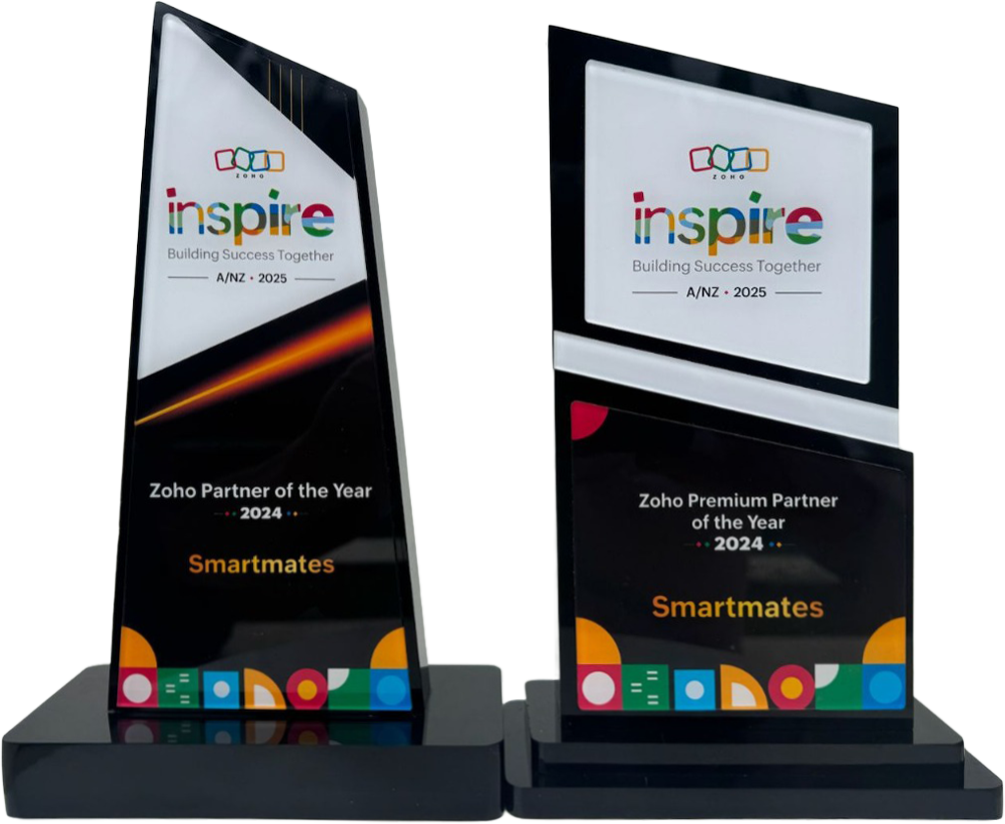
4 Years in a Row
Officially awarded Zoho Partner of the Year in Australia for 2022, 2023, 2024 and 2025. Chosen from 60+ Australian Zoho Partners by Zoho themselves.*
- First Top-Up Special $129 $99/hr + GST
Book your free video conference with our Zoho Consultants
Get your free comprehensive Zoho rollout quotation
Recognised as Australia’s #1 Zoho Partner, 4 years running
Minimum project size 10 consulting hours.

Practical Zoho CRM Training for Teams That Need Adoption


You’ve invested in Zoho CRM. You’ve configured it carefully. You’ve loaded your data. Everything’s ready to transform how your sales team operates.
Then you watch as they find every possible excuse not to use it.
“The old spreadsheet worked fine.” “I don’t have time to learn new software right now.” “I’ll update it later.” “This seems complicated for what we need.”
Sound familiar?
The problem isn’t your CRM. It’s not even your team. It’s that most Zoho CRM training treats software adoption like a technical challenge when it’s actually a human one.
Let’s talk about training approaches that actually get teams using CRM willingly instead of grudgingly.
Why Generic Training Fails Spectacularly
Here’s what typically happens. Someone runs a training session showing every feature Zoho CRM offers. Two hours of clicking through menus, demonstrating capabilities, explaining options. Everyone nods politely, takes notes they’ll never read again, and leaves more confused than when they started.
Three days later, nobody’s using the system properly. Because knowing where buttons are doesn’t mean understanding why you should click them.
Generic Zoho CRM training fails because it focuses on features rather than workflows. It teaches the software instead of teaching how the software helps people do their actual jobs better. It dumps information rather than building practical capability.
Your team doesn’t need to know everything Zoho CRM can do. They need to know exactly what they should do with it every day.
The Adoption Problem Nobody Addresses
Let’s be honest about what drives CRM adoption. It’s not enthusiasm for new technology. Most people resist change, especially when current approaches feel comfortable even if they’re inefficient.
CRM adoption happens when using the system is easier than not using it. When it genuinely saves time rather than adding work. When the benefits are obvious and immediate, not theoretical and distant.
This means training needs to make using CRM feel natural and valuable from day one. Not “you’ll appreciate this in six months.” Right now, in their first week, your team needs to experience CRM making their work better.
That requires a completely different training approach than the standard feature walkthrough.
Role-Based Training: The Game Changer
Here’s the shift that changes everything: train people for their specific role, not for the entire system.
Your sales reps don’t need to know how marketing automation works. Your marketing team doesn’t need deep knowledge of sales pipeline management. Your customer service team needs different capabilities than your account managers.
Role-based Zoho CRM training teaches each person exactly what they need to do their job well. Sales reps learn how to manage their pipeline, update opportunities, and generate quotes. Marketing learns campaign management and lead scoring. Support learns case management and customer communication.
Everyone gets training that’s immediately relevant to their daily work. Nothing extra, nothing confusing, just the capabilities they’ll actually use.
This approach cuts training time dramatically while increasing effectiveness. Two focused hours beats eight scattered ones every time.
Workflow-Centric Teaching
Instead of “here’s how to create a contact,” teach “here’s how you handle a new lead from initial contact to closed deal.”
Walk through complete workflows that mirror real business processes. Show how CRM supports each step. Demonstrate actual scenarios your team encounters, not generic examples from training manuals.
“When a prospect emails asking for pricing, here’s exactly what you do in CRM. When they agree to a meeting, this is how you record it. After the meeting, this is how you update the opportunity and set follow-up tasks.”
Concrete, practical, immediately applicable. Your team sees how CRM fits into work they’re already doing rather than learning abstract features they’ll need to figure out how to apply later.
The Hands-On Requirement
Watching someone click through CRM teaches almost nothing. Doing it yourself while guided teaches everything.
Effective Zoho CRM training is intensely hands-on. Participants work in the actual system throughout training, not just watch demonstrations. They create records, update information, run reports, complete workflows, make mistakes and learn from them.
This means training needs proper preparation. Practice environments set up with realistic data. Scenarios ready to work through. Time allocated for actual doing, not just watching and listening.
It also means smaller groups. You can’t provide hands-on guidance to 30 people simultaneously. Groups of 5-8 allow trainers to watch what participants are doing, catch mistakes in real-time, and ensure everyone’s actually getting it rather than just nodding along.
The Follow-Up Nobody Does
Here’s where most training fails completely: it treats go-live as the finish line.
Real learning happens after training, when people try to apply what they learned to actual work and hit questions or challenges. This is when they need support most, and it’s exactly when traditional training disappears.
Effective Zoho CRM training includes structured follow-up. Check-ins at one week, two weeks, and one month to address questions and reinforce learning. Quick refresher sessions on specific features people struggled with. Ongoing support that makes getting help easy rather than frustrating.
Think of initial training as building foundation, and follow-up as building the house. Both are essential.
Making Champions, Not Just Users
Every team has natural enthusiasts who pick up new systems quickly and help others. Identify these people early and invest extra training in them.
Your CRM champions become peer support for colleagues who struggle. They answer quick questions, demonstrate workflows, and reinforce good practices. They provide help that feels friendly rather than formal, which lowers barriers to asking for assistance.
This multiplies training effectiveness dramatically. Instead of everyone depending on formal support channels, you have embedded help throughout the team.
Train champions deeper than general users. Give them understanding of customisation options, reporting capabilities, and troubleshooting approaches. Make them confident enough to help colleagues effectively.
The Documentation That Actually Helps
Nobody reads 50-page user manuals. But everyone appreciates quick reference guides that answer specific questions fast.
Practical documentation for Zoho CRM training includes short how-to guides for common tasks, visual checklists for multi-step processes, screenshots showing exactly where to click, and FAQs addressing questions that actually come up rather than questions someone thought might come up.
Keep it simple, visual, and searchable. When someone needs to remember how to generate a specific report or update a particular field, they should find the answer in under 30 seconds.
Good documentation reduces support requests and builds user confidence. Bad documentation gets ignored and wastes the time spent creating it.
Addressing Resistance Directly
Some team members will resist regardless of training quality. They’re comfortable with current approaches and suspicious of change.
Don’t ignore this. Address it directly and respectfully.
Acknowledge that change is uncomfortable. Explain why CRM matters for business success and their role specifically. Show concrete examples of how it makes their work easier, not just different. Give them space to voice concerns and address those concerns seriously.
Sometimes resistance stems from legitimate issues with how CRM is configured or what’s being asked of users. Listen to feedback. If people say something’s unnecessarily complicated or doesn’t match how they work, investigate whether they’re right.
Treating resistance as a problem to overcome rather than feedback to consider creates ongoing friction. Treating it as valuable input that might reveal improvements builds buy-in.
Australian Business Context in Training
Training needs to reflect how Australian businesses actually operate. Examples should reference Australian scenarios, integrations with Australian systems, compliance with local regulations.
When you’re teaching quote generation, show Australian tax handling. When demonstrating reporting, use Australian financial year structure. When explaining automation, include workflows relevant to Australian business practices.
This seems minor but makes training feel relevant rather than generic. People learn better when examples match their actual experience rather than requiring mental translation from foreign contexts.
The Timing Question
When should Zoho CRM training happen? Before go-live? After? Both?
Best practice includes foundational training before launch so people aren’t completely lost on day one. Then practical training shortly after go-live when they’ve encountered real scenarios and have context for what they’re learning.
Pre-launch training covers basics: navigation, core concepts, essential workflows. Post-launch training goes deeper: optimisation, advanced features, specific use cases that emerged.
Gap between training and usage kills retention. Train too early and people forget before they start using it. Train right before they need it and learning sticks.
Measuring Training Success
How do you know if Zoho CRM training actually worked? Not by whether people attended sessions. By whether they’re using the system properly.
Track actual usage metrics. Are people logging in regularly? Creating and updating records? Using key features? Generating reports? Measure adoption rates, data quality, and process compliance.
Survey users about confidence and challenges. What do they feel comfortable with? Where do they struggle? What additional support would help?
Review common support questions. If everyone’s asking the same thing, that topic needs better training coverage.
Use these insights to improve training continuously rather than treating it as one-and-done.
The Technology Training Trap
Here’s a mistake that kills adoption: treating CRM purely as technology training rather than business process training.
Your team doesn’t need to become Zoho experts. They need to become better at their jobs with Zoho as a tool that helps them do it.
Frame training around business outcomes. “Here’s how to manage your pipeline more effectively” rather than “here’s how to use the pipeline module.” “Here’s how to ensure you never miss a follow-up” rather than “here’s how tasks and notifications work.”
When people understand how CRM helps them achieve goals they already care about, adoption becomes natural rather than forced.
Cost-Effective Training Approaches
Comprehensive Zoho CRM training doesn’t require enormous budgets. But it does require thoughtful investment.
Working with specialists like Smartmates means getting training designed for your specific business and roles. At $99 per hour plus GST for initial projects, you might invest 10-20 hours in training development and delivery. That’s $1,000-2,000 plus GST for professional training that drives real adoption.
Compare that to the cost of poor adoption. If your CRM investment doesn’t deliver results because people won’t use it properly, you’ve wasted far more than training would have cost.
Training is the bridge between CRM capability and CRM results. Skimping here undermines everything else you’ve invested in.
What Great Training Looks Like in Practice
Let me paint you a picture of effective Zoho CRM training from start to finish.
It starts with understanding your team’s actual roles and workflows. What do they do daily? What information do they need? What slows them down currently?
Training gets designed around these realities, not generic best practices. Each role gets focused sessions covering exactly what they need. Sessions are short, hands-on, and practical.
Participants work through real scenarios in the system. They make mistakes in safe environment and learn from them. They ask questions and get answers immediately. They finish each session having actually done the tasks they’ll need to do on the job.
Documentation provides quick reference without overwhelming detail. Champions get extra training to support their colleagues. Follow-up sessions address emerging questions and reinforce learning.
Within weeks, CRM becomes the natural way of working rather than the annoying new requirement. Adoption is high, data quality is good, and the system delivers the promised value.
That’s what proper training achieves.
Also read: How Smart Zoho CRM Customisation Improves Long Term Adoption
The Smartmates Training Difference
We’ve trained hundreds of Australian teams on Zoho CRM, and we’ve learned what actually drives adoption versus what sounds good but fails in practice.
Our training is ruthlessly practical. We don’t teach features you won’t use. We focus entirely on what makes your team more effective at their actual jobs. We design training around your specific workflows, not generic examples.
We make it hands-on. Participants spend training time actually working in CRM, not just watching demonstrations. They finish training having completed real tasks successfully.
We stick around after go-live. Follow-up support is built into our approach because we know that’s when questions emerge and reinforcement matters most.
And we’re Australian. Our training uses local examples, addresses local requirements, and reflects how Australian businesses actually operate.
Transform Resistance Into Adoption
The gap between implementing CRM and getting teams to actually use it properly is where most initiatives fail. Technology works perfectly. Configuration is solid. But adoption never reaches the levels needed to justify the investment.
Training is the bridge across that gap. Not generic feature tours, but practical, role-based instruction that shows people exactly how CRM makes their work better.
When training is done right, resistance melts into acceptance and eventually enthusiasm. People discover that CRM genuinely helps rather than hinders. Data quality improves because users understand why accurate information matters. The system delivers results because it’s actually being used properly.
Your CRM is only as valuable as your team’s willingness to use it well. Training determines whether that willingness develops or whether your expensive system becomes expensive shelfware.
Book Your Free Planning Session
Book a complimentary planning session with Smartmates to discuss your Zoho CRM training needs and explore a free Zoho trial. We’ll assess your team’s specific requirements, design training that matches their actual workflows, and create an adoption strategy that gets your CRM delivering results instead of gathering dust.
Request a Callback from Smartmates

Sarah
I’ll listen to your Zoho needs to understand your business challenges and goals, ensuring a tailored approach.
I’ll bring a certified Zoho engineer to our first consultation to explore solutions and clarify your requirements.
We’ll deliver your free project plan quotation, detailing the steps, timeline, and costs—up to this point, it’s completely free!
“My mission is to solve your key problems, build your trust in our capabilities and deliver exceptional value for money.”