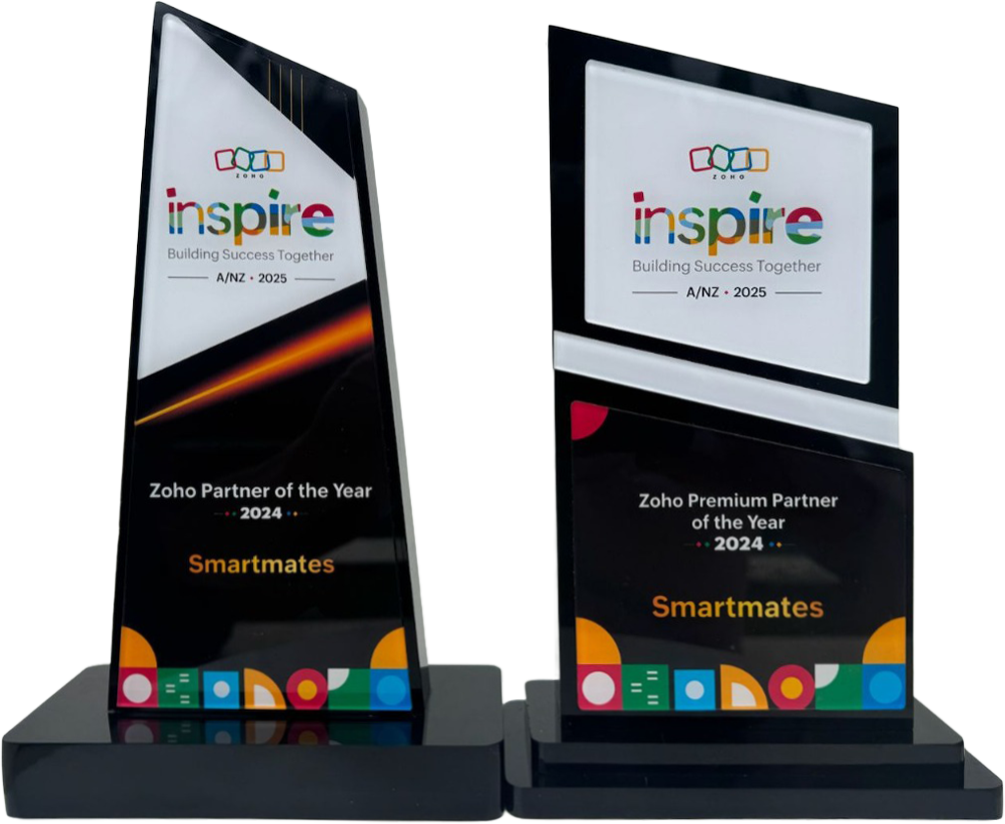
Recognised as Australia’s Best Zoho Partner for 2022, 2023, 2024 and 2025, we simplify clients’ workflows with Zoho.
- Zoho One set up and customisations for $99/hour + GST.
- Book a video call with our specialists.
- Get a detailed, personalised setup and optimisation plan.
- Let Smartmates transform your data into actionable insights.
Minimum project size: 10 hours ($1290 + GST).

Enhance Your Business Processes with a Zoho Authorised Partner
Running a business often means relying on various apps to manage every aspect of your day-to-day operations. But what if there is a single solution for all of these needs?

As a certified Zoho Partner, let Smartmates introduce you to Zoho One, an integrated suite that gives you access to over 60 Zoho applications in a single subscription. Designed to streamline and simplify your business management, Zoho One allows you to interconnect them – from sales and marketing to customer support, finance, HR, project management, and more. Instead of juggling multiple tools, Zoho One consolidates everything into a unified system, ensuring that your data flows smoothly across different departments, improving collaboration, reducing redundancy, and increasing efficiency.
Meet one of our clients who, like many others, once juggled multiple standalone subscriptions before moving to Zoho. While each tool delivered value, the disconnected nature of their setup led to challenges:
- Data Silos: Their database was not seamlessly flowing into their email communication or customer insights. Everything is there and ready to use, but they are not speaking with each other.
- Wasted Time: Switching between applications slowed down workflows and created redundancies.
- Missed Opportunities: Lack of integration meant potential leads or customer needs sometimes fell through the cracks.
When they transitioned to Zoho One, everything changed. Teams could now access and share real-time data across departments, ensuring everyone was on the same page. Additionally, instead of toggling between platforms, they worked from a centralised platform, boosting efficiency and enabling quicker responses. What began as a frustrating experience of disconnected tools now transformed into a streamlined, efficient, and productive workflow, thanks to Zoho One.
Zoho One: The All-in-One Tool for Success
Using Zoho One enables your business to operate more effectively, particularly when it comes to syncing critical data across different platforms. Imagine trying to manage multiple tools that cannot communicate with each other, or paying for several separate subscriptions just to get the functionality you need. That would create confusion, inefficiency, and added costs. With Zoho One, everything is integrated under one umbrella, eliminating those challenges and streamlining your workflow. As a certified Zoho partner, Smartmates can certainly help you achieve this.
Here are some of many Zoho One’s plus points:
- Comprehensive Apps: Access to a wide range of business applications, such as Zoho CRM for sales management, Zoho Campaigns for marketing campaigns, Zoho Books for accounting, Zoho People for HR, Zoho Desk for customer support, Zoho Projects for project management, and many more.
- Scalability: As your business grows, Zoho One can scale with you, allowing you to add users, apps, and features as needed without disruption.
- Seamless Integration: All the apps are designed to work together, allowing data to flow seamlessly across your organisation. This reduces manual work, enhances accuracy, and provides a unified view of your business.
- Customisations: Zoho One allows you to tailor apps and workflows to suit your specific business needs, with extensive customisation options available for both individual apps and the entire suite.
- Security Control: With Zoho One, you get centralised administration, giving you control over user access, data security, and compliance. It also offers advanced reporting tools for monitoring performance across your organisation.
So, what are you waiting for? Contact Smartmates, Australia’s leading and certified Zoho Partner, to help optimise your business operations with Zoho One.
Request a Callback from Smartmates

Dave
I’ll listen to your Zoho needs to understand your business challenges and goals, ensuring a tailored approach.
I’ll bring a certified Zoho engineer to our first consultation to explore solutions and clarify your requirements.
We’ll deliver your free project plan quotation, detailing the steps, timeline, and costs—up to this point, it’s completely free!
“My mission is to solve your key problems, build your trust in our capabilities and deliver exceptional value for money.”