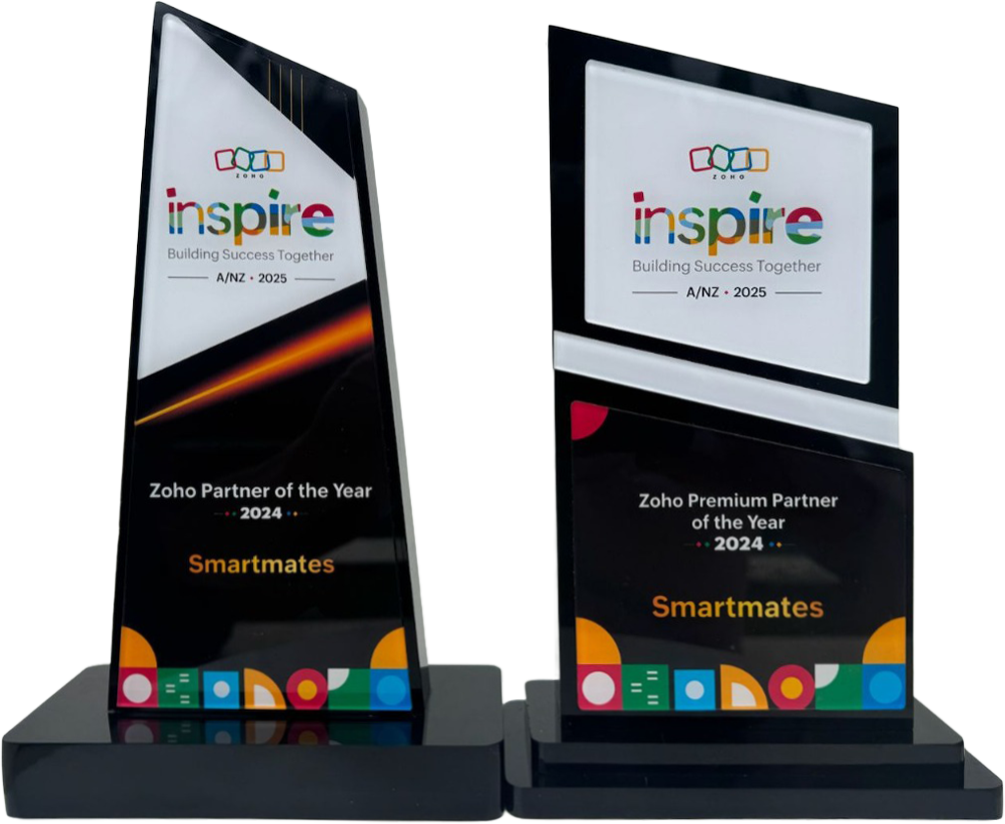
4 Years in a Row
Officially awarded Zoho Partner of the Year in Australia for 2022, 2023, 2024 and 2025. Chosen from 60+ Australian Zoho Partners by Zoho themselves.*
- First Top-Up Special $129 $99/hr + GST
Book your free video conference with our Zoho Consultants
Get your free comprehensive Zoho rollout quotation
Recognised as Australia’s #1 Zoho Partner, 4 years running
Minimum project size 10 consulting hours.

Modern Teams Rely On A Zoho One Partner For Integration


Modern business teams don’t struggle from lack of software. They drown in it.
You’ve got your CRM tracking customer relationships. Your project management tool coordinating work. Your accounting software managing finances. Your marketing platform running campaigns. Your communication tools connecting teams. Your documentation systems storing knowledge. Your analytics dashboards showing performance.
Each application works brilliantly in isolation. Each solves specific problems effectively. Each has its champions who’d resist switching to anything else.
And collectively? They create operational chaos.
Data lives in silos. Information doesn’t flow between systems. Your sales team manually re-enters customer details that already exist in marketing. Your project team can’t see client communication history from the CRM. Your finance team reconciles information from five different sources. Manual coordination replaces automatic integration.
You’re paying for a dozen sophisticated tools but getting Stone Age efficiency because nothing talks to anything else properly.
This is the integration crisis facing modern teams. More applications creating more disconnection. More capability creating more complexity. More investment creating more frustration.
Enter Zoho One. Forty-plus integrated applications designed to work together seamlessly. The promise of unified operations instead of fragmented tools. One platform. One login. One source of truth.
But here’s the catch: having integrated applications doesn’t automatically create integrated operations. The potential exists. Realising that potential requires expertise that most teams simply don’t have internally.
This is where a Zoho One partner becomes genuinely essential. Not because Zoho One is complicated (though it is comprehensive), but because transforming theoretical integration into practical unified operations requires strategic expertise, technical skill, and implementation experience that partners bring.
Let me show you exactly why modern teams rely on Zoho One partners for integration and how that partnership transforms operations.
Also read: Better Business Systems Built By A Zoho Consulting Partner
The Integration Challenge Zoho One Solves
Before we explore why partners are essential, let’s properly understand the integration problem Zoho One addresses.
The App Sprawl Problem
Average business uses 15-20 different applications. Growing businesses use even more. Each solves a specific need. Each creates another data silo.
Your customer information lives in CRM. Your project details live in project management. Your communications live in email and chat. Your documents live in cloud storage. Your finances live in accounting software.
None of these systems knows what the others know. Complete customer view? Impossible. Unified reporting? Manual compilation nightmare. Automated workflows spanning systems? Forget it.
The Manual Integration Tax
Without proper integration, humans become the integration layer. Your team manually transfers information between systems. They create reports by compiling data from multiple sources. They maintain parallel records because systems don’t sync.
This manual integration tax costs enormous time and creates massive error risk. Your team spends hours doing work that proper integration would automate instantly.
The Data Integrity Crisis
When information lives in multiple places without integration, it becomes inconsistent. Customer address updated in CRM but not accounting. Project status changed in project management but not reflected in client communication. Data diverging until nobody trusts any of it.
This data integrity crisis undermines decision-making and creates customer service nightmares.
The Workflow Fragmentation
Your business processes span multiple systems. Lead generation touches marketing platform. Lead qualification touches CRM. Project delivery touches project management. Billing touches accounting. Customer support touches helpdesk.
Without integration, these fragmented workflows require constant manual coordination. Handoffs fail. Context gets lost. Efficiency evaporates.
Why Zoho One Integration Requires Partner Expertise
Zoho One provides integrated applications. But having integrated apps doesn’t automatically create integrated operations. Here’s why partner expertise is essential.
Integration Architecture Complexity
Deciding which Zoho One apps to use for what purposes requires strategic thinking. The platform has over 40 applications with overlapping capabilities.
Should you use Zoho Projects or Zoho Sprints for project management? Zoho Books or Zoho Invoice for billing? Zoho Desk or Zoho CRM for customer support? Each choice affects integration architecture.
Partners bring experience making these decisions strategically rather than arbitrarily.
Data Flow Design Challenges
How should information flow between applications? What’s the source of truth for each data type? How do you maintain consistency? What triggers updates between systems?
These data flow decisions determine whether integration creates unity or complexity. Partners design data architectures that work coherently rather than creating new problems.
Workflow Integration Sophistication
Business workflows that span multiple Zoho One apps require sophisticated integration design.
Lead comes through Zoho Forms. Gets qualified in Zoho CRM. Triggers project in Zoho Projects. Generates invoice in Zoho Books. Sends communication through Zoho Campaigns. Creates support ticket in Zoho Desk.
Designing workflows that orchestrate this complexity smoothly requires deep platform understanding and integration expertise.
Customisation and Extension Requirements
Even comprehensive platforms like Zoho One sometimes need customisation to match specific business requirements.
Custom fields. Custom modules. Custom integrations with external systems. Custom workflows handling unique business logic.
Partners bring development expertise to extend Zoho One where necessary while maintaining integration integrity.
Change Management Across Multiple Applications
Implementing integrated Zoho One affects multiple teams simultaneously. Marketing. Sales. Projects. Finance. Support. Each team adopts new applications. Each changes workflows.
Coordinating this cross-functional change requires expertise in change management that partners provide.
The Smartmates Zoho One Integration Approach
Right, let’s talk about what exceptional Zoho One partnership actually delivers for integration. And since we’re being direct, let me show you how Smartmates approaches comprehensive integration for Australian businesses.
Why Smartmates Excels at Zoho One Integration
First, they view Zoho One as integrated business platform, not collection of separate applications. Integration strategy comes first. Application selection follows from that strategy.
This integration-first mindset ensures coherent unified operations rather than just using multiple apps from same vendor.
Certified Zoho One expertise with integration architecture skills. The Smartmates team holds Zoho certifications across multiple applications, but more importantly, they understand integration architecture and data flow design.
Proven integration methodology. Smartmates has refined their approach through dozens of Zoho One implementations. They know which integration patterns work and which create problems.
Australian business understanding. Being locally based means Smartmates understands typical Australian business structures, processes, and integration requirements. Solutions address real local operational realities.
Dual platform expertise. Unlike partners locked into one ecosystem, Smartmates works with both Zoho and HubSpot. This flexibility means they can recommend best platform for your needs or design strategic integrations between platforms when appropriate.
But here’s what genuinely sets Smartmates apart: their commitment to creating genuinely unified operations rather than just implementing multiple applications from the same vendor.
What working with Smartmates delivers:
You get strategic integration architecture designed for your business processes. You get data flow mapping maintaining consistency and integrity. You get workflow orchestration spanning multiple applications seamlessly. You get customisation and extension where necessary. You get cross-functional change management.
And critically, you get unified operations delivering the efficiency and visibility that integrated platforms promise but DIY implementations rarely achieve.
Visit smartmates.com.au to discover how Zoho One partnership creates genuinely integrated operations.
Zoho One Integration in Practice: What It Enables
What does successful Zoho One integration actually deliver beyond theoretical unified platform? Here’s what practical integration creates.
Unified Customer View
Every customer interaction. Every purchase. Every support ticket. Every project. Every communication. All visible in one place regardless of which application owns each piece.
Sales sees customer service history. Support sees sales opportunities. Projects sees complete customer relationship. Marketing sees engagement across all touchpoints.
This unified view transforms customer relationships by providing complete context to everyone who interacts with customers.
Automated Cross-Function Workflows
Workflows that previously required manual coordination between departments now happen automatically.
New customer in CRM automatically creates project in Zoho Projects, generates invoice in Zoho Books, sets up support in Zoho Desk, adds to marketing list in Zoho Campaigns.
Manual handoffs eliminated. Context preserved automatically. Nothing falls through cracks.
Consolidated Reporting and Analytics
Instead of compiling reports from multiple systems manually, integrated Zoho One provides unified analytics across entire operation.
Revenue. Customer acquisition costs. Project profitability. Support efficiency. Marketing ROI. All in coherent dashboards drawing from integrated data.
Decision-making based on complete information rather than fragmentary views from isolated systems.
Elimination of Duplicate Data Entry
Information entered once flows automatically to everywhere it’s needed. Customer details captured in one application available everywhere.
No more manual re-entry. No more inconsistency from multiple versions. No more wasted time on data administration.
Seamless Team Collaboration
Teams working across different applications still maintain complete visibility and coordination.
Project team sees sales context. Finance sees project status. Support knows customer history. Everyone working from shared complete picture rather than isolated fragments.
| Before Zoho One Integration | After Zoho One Integration |
|---|---|
| Data in disconnected silos | Unified customer and operational view |
| Manual handoffs between systems | Automated cross-function workflows |
| Fragmented reporting requiring compilation | Consolidated real-time analytics |
| Duplicate data entry across tools | Information entered once, available everywhere |
| Teams working in isolation | Seamless collaboration with complete context |
| Manual coordination overhead | Automated orchestration |
Strategic Integration Architecture: How It’s Designed
How do Zoho One partners actually create integrated operations? Here’s the strategic approach.
Phase One: Integration Strategy Development
Integration begins with understanding complete business operations, not just software requirements.
Current processes mapped. Pain points identified. Integration opportunities discovered. Workflow requirements understood. Data relationships clarified.
This strategic foundation ensures integration serves business needs rather than just connecting applications arbitrarily.
Phase Two: Application Selection and Role Definition
With integration strategy clear, partners select which Zoho One applications to use and define each application’s role clearly.
Which app owns which data? What’s the source of truth for each entity? How do applications interact? Where do boundaries lie?
This clear definition prevents the confusion that emerges when multiple apps could handle same function but nobody’s sure which should.
Phase Three: Data Architecture Design
Partners design how information flows between applications maintaining consistency and integrity.
Data models across applications. Synchronisation rules. Update triggers. Conflict resolution logic. Master data management.
This architecture ensures integration creates unity rather than just connecting silos that still disagree.
Phase Four: Workflow Orchestration
Business processes spanning multiple applications get orchestrated through integrated workflows.
Triggers in one app causing actions in others. Information flowing automatically where needed. Complete processes automated end-to-end despite spanning multiple applications.
Phase Five: Implementation and Integration Build
With architecture designed, technical implementation builds the integrated system.
Applications configured. Integrations established. Workflows created. Data migrated. Customisations developed.
Technical execution following strategic design rather than ad-hoc implementation.
Phase Six: Testing and Validation
Before full deployment, comprehensive testing validates integration works under real conditions.
Data flows correctly. Workflows trigger properly. Integration maintains consistency. Performance acceptable under load.
Phase Seven: Deployment and Adoption
Finally, integrated Zoho One deploys with proper change management ensuring teams adopt new unified operations.
Training across applications. Support during transition. Adoption monitoring. Refinement based on usage feedback.
Common Zoho One Integration Mistakes Partners Prevent
Even with integrated platform like Zoho One, certain mistakes consistently undermine integration success. Here’s how partners prevent them.
Using Too Many Applications Too Fast
Zoho One includes 40+ applications. Temptation exists to implement everything immediately. This creates overwhelming complexity rather than useful integration.
Partner prevention: Phased rollout. Start with core applications. Add capabilities incrementally as team competence grows and needs emerge.
Poor Data Ownership Definition
When multiple apps could own same information but ownership isn’t clearly defined, data conflicts and inconsistency emerge.
Partner prevention: Clear data ownership architecture. Each entity has defined source of truth. Update patterns established maintaining consistency.
Over-Integration Creating Tight Coupling
Making every application deeply dependent on every other creates fragility. One application problem cascades everywhere.
Partner prevention: Strategic integration coupling. Tight integration where valuable. Loose coupling where appropriate. Balance integration benefits against brittleness.
Neglecting External System Integration
Even comprehensive Zoho One doesn’t replace all systems. Accounting software. Industry-specific tools. Legacy systems.
Partner prevention: Strategic external integration planning. Connect Zoho One to necessary external systems properly rather than creating new silos.
Integration Without Process Improvement
Integrating poor processes just automates inefficiency. Integration opportunity should drive process improvement.
Partner prevention: Process redesign before integration implementation. Improve workflows then integrate improved processes.
Measuring Zoho One Integration Success
How do you know if Zoho One integration has succeeded? Here are metrics that matter.
Manual Coordination Reduction
How much time previously spent manually coordinating between systems has been eliminated?
Track hours saved weekly across team. Calculate productivity gains. Quantify efficiency improvements.
Data Entry Elimination
What percentage of duplicate data entry has been eliminated through integration?
Measure time saved. Calculate error reduction. Quantify data quality improvements.
Workflow Completion Time
How much faster do cross-function processes complete with automated integration versus manual coordination?
Compare before and after cycle times. Document acceleration. Calculate throughput improvements.
Reporting Time Reduction
How much faster can you compile operational reports with integrated data versus manual compilation?
Measure time savings. Calculate decision-making acceleration. Quantify visibility improvements.
User Satisfaction and Adoption
Are teams actually using integrated Zoho One? Are they satisfied with unified operations?
Survey users. Monitor adoption rates. Gather feedback. Measure growing competence.
Getting Started: Finding Right Zoho One Partner
Ready to leverage Zoho One integration through expert partnership? Here’s how to choose wisely.
Evaluate Integration Architecture Expertise
Don’t just assess whether partners know individual Zoho applications. Evaluate their integration architecture and data flow design expertise.
Can they articulate integration strategy? Do they think holistically about unified operations? Do they understand data architecture?
Review Comprehensive Implementation Experience
Zoho One integration requires experience across multiple applications, not just expertise in one or two.
How many complete Zoho One implementations have they delivered? Can they demonstrate cross-application integration success?
Assess Change Management Capability
Zoho One affects multiple teams simultaneously. Partners need change management expertise alongside technical capability.
How do they manage cross-functional adoption? What’s their approach to training and support? How do they handle resistance?
Verify Ongoing Optimisation Commitment
Integration isn’t one-time implementation. It evolves as business changes and needs emerge.
What ongoing optimisation do they provide? How do they support evolution? What’s their long-term partnership model?
Transform Disconnection Into Unified Operations
Here’s the bottom line, and I’ll be direct because your operational efficiency depends on it.
Modern teams don’t lack software. They lack integration. Disconnected applications create operational chaos despite each tool working well individually.
Zoho One provides integrated applications addressing this challenge comprehensively. But having integrated apps doesn’t automatically create integrated operations.
Realising Zoho One’s integration potential requires expertise most teams don’t have internally. Strategic integration architecture. Data flow design. Workflow orchestration. Cross-application implementation. Change management.
A Zoho One partner transforms theoretical integration into practical unified operations. They bring expertise designing integration strategy. They bring experience implementing across multiple applications. They bring methodology preventing common mistakes. They bring change management ensuring adoption.
The result? Genuinely unified operations delivering efficiency, visibility, and collaboration that disconnected applications never achieve regardless of individual quality.
That’s exactly what Smartmates delivers for Australian businesses. You get strategic integration architecture designed for your operations. You get data flow mapping maintaining consistency. You get workflow orchestration spanning applications seamlessly. You get comprehensive implementation across Zoho One suite. You get change management driving adoption.
And you get unified operations transforming disconnected tools into coherent integrated platform delivering genuine competitive advantage.
Your team deserves integrated operations, not operational chaos from disconnected tools. Zoho One provides the platform. Partnership provides the expertise transforming potential into reality.
Ready to transform disconnected applications into unified integrated operations? Connect with Smartmates at smartmates.com.au and discover how Zoho One partnership creates genuinely integrated operations, eliminates manual coordination, and delivers the efficiency and visibility that modern teams require. Your operations should be unified, not fragmented. Integrate properly.
Request a Callback from Smartmates

Sarah
I’ll listen to your Zoho needs to understand your business challenges and goals, ensuring a tailored approach.
I’ll bring a certified Zoho engineer to our first consultation to explore solutions and clarify your requirements.
We’ll deliver your free project plan quotation, detailing the steps, timeline, and costs—up to this point, it’s completely free!
“My mission is to solve your key problems, build your trust in our capabilities and deliver exceptional value for money.”