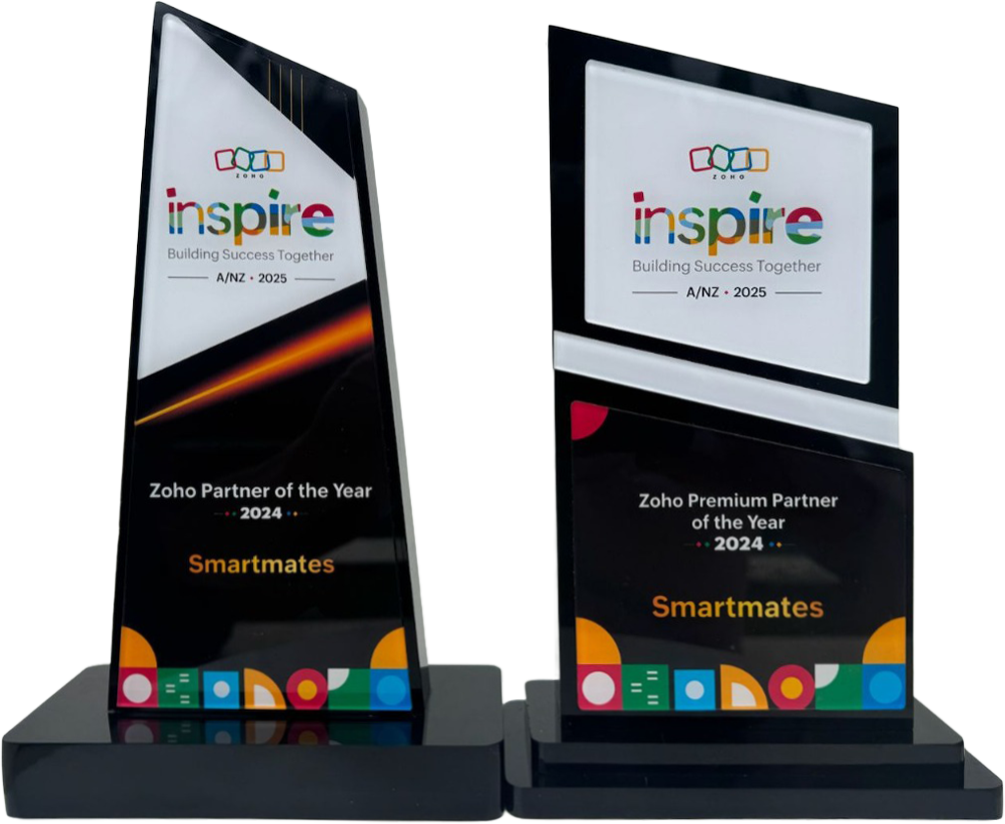
4 Years in a Row
Officially awarded Zoho Partner of the Year in Australia for 2022, 2023, 2024 and 2025. Chosen from 60+ Australian Zoho Partners by Zoho themselves.*
- First Top-Up Special $129 $99/hr + GST
Book your free video conference with our Zoho Consultants
Get your free comprehensive Zoho rollout quotation
Recognised as Australia’s #1 Zoho Partner, 4 years running
Minimum project size 10 consulting hours.

Enterprise Data Flow Unified Via Zoho CRM Consultants Configuration


Picture this: your sales team closes a major deal, but finance doesn’t know about it until three days later. Your marketing campaigns generate hundreds of leads, but they sit in a separate system that sales never checks. Customer support resolves a critical issue, but the account manager has no idea it happened. Sound familiar?
This is the reality for most Australian enterprises today. Not because people aren’t working hard, but because data lives in isolated pockets across the organisation. It’s like having a brilliant orchestra where every musician is playing in a different room. The talent is there, but the coordination? Absolutely missing.
Data silos aren’t just annoying. They’re expensive. They create duplicate work, missed opportunities, frustrated customers, and decisions based on incomplete information. In an era where data should be your competitive advantage, fragmented information becomes your biggest liability.
Here’s the good news: it doesn’t have to be this way. When Zoho CRM consultants properly configure enterprise data flow, something remarkable happens. Information starts moving freely between departments. Teams gain visibility into what’s actually happening across the business. Decisions get made faster because everyone’s working from the same truth.
Let’s dive into how expert consultants transform chaotic data landscapes into unified, flowing systems that actually serve your business goals.
Why Enterprise Data Flow Matters More Than Ever
Think about how your enterprise operates. Sales generates customer information. Marketing tracks engagement data. Finance manages billing and payments. Operations handles fulfilment. Support logs interactions and issues. Each department creates valuable data every single day.
Now here’s the problem: most of that data stays locked in the department that created it. Sales knows what customers bought but not what support issues they’ve had. Support knows customer pain points but not what upsell opportunities exist. Finance knows payment history but not why certain customers are late payers.
This fragmentation costs you in ways that don’t always show up on balance sheets:
Slower Decision Making
When executives need a complete picture, someone has to manually gather data from five different systems, reconcile the differences, and create a report. By the time it’s ready, the moment for action has passed.
Duplicate Efforts
How many times does your team enter the same customer information into different systems? How many hours get wasted updating records that should sync automatically?
Inconsistent Customer Experience
Customers expect you to know who they are and what they need, regardless of which department they contact. When your teams work from different data sets, customers repeat themselves constantly. It’s frustrating for them and embarrassing for you.
Missed Revenue Opportunities
Cross-sell and upsell opportunities hide in the gaps between systems. Support knows a customer is scaling up operations, but sales never finds out. Marketing identifies hot prospects, but they get lost before reaching sales.
Compliance Risks
When customer data exists in multiple places with no single source of truth, ensuring compliance becomes a nightmare. Which version is correct? Who has access? What’s the audit trail?
What Unified Data Flow Actually Looks Like
Before we get into how consultants build this, let’s paint a picture of what success looks like. Imagine your enterprise operating like this:
A lead fills out a form on your website. Marketing automation scores them based on behaviour and demographics. If they hit a threshold, they automatically flow to sales as a qualified lead. Sales receives not just contact information but complete engagement history, what content they consumed, which products they showed interest in.
Sales works the opportunity. Every interaction, every call note, every email gets logged. When they close the deal, the information flows automatically to finance for invoicing, to operations for fulfilment, to customer success for onboarding.
Customer success begins their relationship already knowing the customer’s original pain points, the promised outcomes, and the implementation timeline. They’re not starting cold. They’re continuing the conversation.
As the customer uses your product or service, usage data flows back into the CRM. Support tickets are visible to account managers. Renewal dates trigger workflows months in advance. Marketing can see which customers might be good case study candidates.
Finance sees outstanding invoices linked to customer health scores. Collections can prioritise based on relationship strength, not just dollar amounts. Executives can pull up any customer and see the complete 360-degree view in seconds.
This isn’t fantasy. This is what happens when Zoho CRM consultants configure enterprise data flow properly.
Also Read: The Competitive Edge Of Working With A Zoho CRM Expert
The Technical Architecture Behind Unified Data Flow
Now let’s get into how this actually works. Fair warning: this gets a bit technical, but stick with me because understanding the architecture helps you appreciate why experienced consultants are essential.
Central CRM as the Hub
Zoho CRM becomes your central repository for all customer-related data. Not just sales contacts, but the complete customer lifecycle from first touch to ongoing relationship. Everything radiates from this hub.
The mistake many enterprises make is trying to make their ERP or accounting system the hub. Those systems are built for transactions, not relationships. CRM is purpose-built for managing customer information, which is why it should be the centre of your data universe.
Integration Layers for System Communication
Your enterprise runs on multiple systems, and that’s okay. You’ve got accounting software, marketing automation, support platforms, project management tools, perhaps industry-specific applications. The solution isn’t replacing everything with one mega-system. It’s connecting them intelligently.
Zoho CRM consultants build integration layers that allow systems to communicate bidirectionally. Data flows where it needs to go, when it needs to go there, in the format each system requires.
These integrations can be:
- Real-time: Data syncs instantly as it changes
- Scheduled: Data syncs at regular intervals
- Event-triggered: Specific actions in one system trigger updates in others
The right consultants know which approach works for which data types and business processes.
Data Mapping and Transformation Rules
Here’s where it gets interesting. Different systems call things by different names. Your CRM might use “company” while your ERP uses “customer” and your marketing platform uses “account.” Same concept, different terminology.
Consultants create mapping rules that translate data as it moves between systems. They ensure a contact created in marketing automation appears correctly in CRM, then flows to your ERP with the right fields populated for billing.
They also build transformation rules. Perhaps your CRM tracks opportunities in stages, but your finance system only cares about closed deals. Consultants configure rules that transform CRM data into what finance needs without overwhelming them with sales pipeline details.
Access Control and Data Governance
Not everyone should see everything. Your sales team needs customer contact information but probably shouldn’t see detailed financial data. Your finance team needs payment history but doesn’t need to see every sales call note.
Zoho CRM consultants configure granular access controls that ensure people see what they need while protecting sensitive information. They build permission structures that match your organisational hierarchy and compliance requirements.
They also establish data governance rules. Who can edit which fields? What approval is required for changes? How long is data retained? These aren’t just technical questions; they’re business policy questions that consultants help you think through.
Workflow Automation Across Systems
The real magic happens when data flow triggers action. A customer support ticket gets logged with high priority. The system automatically notifies the account manager, creates a task for follow-up, and flags the customer record for review before the next renewal conversation.
Or: a customer’s usage drops significantly. The system alerts customer success, creates an outreach task, and adjusts the health score. If the issue persists, it escalates to management automatically.
These workflows don’t just move data; they orchestrate your entire customer lifecycle across departments.
Common Data Flow Challenges and Solutions
Let’s tackle the specific problems Australian enterprises face when trying to unify data flow.
Challenge: Legacy Systems That Don’t Play Nicely
You’ve got a 15-year-old ERP that your business runs on. It has no modern API, limited export capabilities, and developers who built it have long since retired. But it works, and replacing it would cost millions.
Solution: Experienced consultants have dealt with legacy systems before. They use middleware platforms, custom integration tools, or even scheduled data exports and imports to bridge the gap. It’s not always elegant, but it works reliably.
Challenge: Data Quality Issues
Your existing data is a mess. Duplicate records, inconsistent formatting, missing information, outdated contacts. You want to unify data flow, but you’re worried about spreading bad data everywhere.
Solution: Consultants start with data cleansing. They use automated tools and manual processes to deduplicate, standardise, and enrich your data before migration. They also set up validation rules that prevent bad data from entering the system going forward.
Challenge: Departmental Resistance
Your teams are comfortable with their existing systems. Sales likes their spreadsheets. Support loves their current ticketing platform. Nobody wants change forced on them.
Solution: Good consultants don’t force change; they demonstrate value. They start with pilot projects that show tangible benefits. They involve key users in the design process. They provide thorough training. Change management is half the battle, and experienced consultants know it.
Challenge: Real-Time vs. Batch Processing Trade-offs
Some data needs to sync instantly. Other data can wait. Getting this balance wrong either overloads your systems with constant API calls or leaves people working with stale information.
Solution: Consultants analyse each data type and business process to determine appropriate sync timing. Customer contact changes might sync real-time while monthly usage reports sync overnight. They optimise for both performance and usefulness.
Challenge: Security and Compliance Requirements
You operate in regulated industries. Customer data can’t just flow freely everywhere. You need audit trails, encryption, compliance with privacy laws, and detailed access controls.
Solution: Consultants build security into the architecture from day one. They configure encryption for data in transit and at rest. They create audit logs that track every data access and modification. They ensure your configuration meets Australian privacy requirements and industry-specific regulations.
The Implementation Journey: What to Expect
Unifying enterprise data flow isn’t a weekend project. But with experienced Zoho CRM consultants, it’s also not a multi-year odyssey. Here’s a realistic timeline:
Phase 1: Discovery and Assessment (4-6 weeks)
Consultants map your current systems, data flows, and processes. They identify pain points, opportunities, and technical constraints. They work with stakeholders across departments to understand requirements.
This phase is critical. Rush it, and you’ll build the wrong solution.
Phase 2: Architecture Design (2-3 weeks)
Based on discovery, consultants design the data flow architecture. Which systems integrate with what? How does data flow? What transformations are needed? What workflows automate processes?
You review and approve this design before any building begins.
Phase 3: Configuration and Integration (8-12 weeks)
The heavy technical work happens here. Consultants configure Zoho CRM, build integrations, set up workflows, and migrate data. This phase includes extensive testing to ensure everything works correctly.
Phase 4: User Acceptance Testing (2-3 weeks)
Your team tests the system with real scenarios. Issues get identified and resolved. Consultants refine configurations based on feedback.
Phase 5: Training and Launch (2-3 weeks)
Department-by-department training ensures everyone knows how to use the new unified system. You launch in phases, usually starting with one department or region before rolling out enterprise-wide.
Phase 6: Optimisation (Ongoing)
After launch, consultants continue optimising based on usage patterns and feedback. New automation opportunities emerge as people become comfortable with the system.
Most enterprises see significant improvements within the first quarter post-launch, with benefits accelerating as adoption deepens.
Why Australian Enterprises Choose Smartmates
You could attempt data unification with internal IT teams or overseas consultants. But here’s what you’d miss:
Enterprise-Specific Experience
We’ve worked with Australian enterprises across industries. We understand the complexity, compliance requirements, and change management challenges unique to large organisations.
Zoho Platform Expertise
Our team holds advanced Zoho certifications and has configured hundreds of implementations. We know the platform’s capabilities and limitations intimately.
Integration Specialists
Connecting diverse systems is what we do. We’ve integrated everything from modern cloud platforms to legacy mainframes. If it has data, we can connect it.
Australian Based, Australian Standards
We understand Australian privacy laws, business practices, and compliance requirements. We work in your time zone and speak your language.
Business Process Focus
We’re not just techies who configure software. We’re business consultants who use technology to solve problems. We start with your goals and work backward to the technical solution.
Ongoing Partnership
We don’t disappear after launch. We provide ongoing support, optimisation, and strategic guidance as your business evolves.
Real Stories: Enterprises Transformed by Unified Data Flow
Let’s look at how unified data flow transforms actual operations.
National Retail Chain
They had 47 locations, each operating semi-independently. Customer data existed in store systems, the website, the loyalty platform, and a basic CRM. Customers complained about inconsistent experiences. The marketing team couldn’t effectively segment campaigns.
After Zoho CRM consultants unified their data flow, every touchpoint shared information instantly. Store associates saw online purchase history. The website displayed loyalty points. Marketing could create sophisticated campaigns based on complete customer behaviour. Customer satisfaction scores jumped 23% within six months.
Professional Services Firm
With multiple practice areas and hundreds of staff, they struggled with client visibility. Account managers didn’t know which other services clients were using. Cross-selling was hit-or-miss. Project information stayed isolated in practice areas.
Unified data flow gave them complete client visibility. Account managers saw all services, all projects, all interactions. Cross-sell opportunities became obvious. Client retention improved because no one felt like just another number.
Manufacturing and Distribution Enterprise
Sales, operations, and finance operated in separate worlds. Sales promised delivery dates without checking inventory. Operations scheduled production blindly. Finance chased payments without context about customer relationships.
After implementation, information flowed seamlessly. Sales saw real-time inventory and production capacity. Operations received advance visibility into the pipeline. Finance understood customer health before collections outreach. The entire operation became coordinated and efficient.
The Future of Enterprise Data Flow
We’re moving toward a world where data doesn’t just flow between systems; it anticipates needs and triggers intelligent actions.
Imagine: your CRM detects patterns suggesting a customer is at risk of churning. It automatically adjusts their engagement plan, alerts the account manager, and creates a retention task with suggested talking points based on similar successful saves.
Or: your system notices a customer’s usage pattern matches companies that typically buy additional services. It calculates the ROI they’d achieve, drafts a personalised proposal, and queues it for your sales team to review and send.
This isn’t far-future speculation. The infrastructure for this exists today in Zoho CRM. The question is whether you have consultants who know how to build it.
Taking the First Step Toward Unified Data
Every transformation begins with acknowledging the current state isn’t working. Your data silos are costing you money, frustrating your customers, and limiting your growth. You know it. Your team knows it. The question is what you’ll do about it.
Unifying enterprise data flow isn’t easy. It requires expertise, careful planning, and proper execution. But the alternative is continuing to operate with one hand tied behind your back while competitors leverage their data more effectively.
The good news? You don’t have to figure this out alone. Smartmates has guided dozens of Australian enterprises through this exact transformation. We know what works because we’ve done it repeatedly. We know the pitfalls because we’ve navigated them. We know how to deliver results because we measure them.
Your enterprise generates valuable data every single day. Right now, much of that value is locked away in isolated systems, inaccessible to the people who need it. Imagine what becomes possible when that data flows freely, when every team has the information they need to excel, when decisions get made with complete confidence.
That’s not a distant dream. It’s what happens when Zoho CRM consultants properly configure enterprise data flow. Your teams stop fighting against systems and start using them as force multipliers. Your customers experience the consistency and insight they expect. Your executives gain visibility that drives better strategy.
Ready to transform how information moves through your enterprise? Ready to break down the silos that limit your potential? Ready to give your team the unified data flow they deserve?
It starts with a conversation about your specific challenges and goals. Let’s talk about where your data flow breaks down, what you’ve tried before, and how Zoho CRM consultants can build something better. Your enterprise’s next chapter of efficiency and growth is waiting.
Request a Callback from Smartmates
Sarah
I’ll listen to your Zoho needs to understand your business challenges and goals, ensuring a tailored approach.
I’ll bring a certified Zoho engineer to our first consultation to explore solutions and clarify your requirements.
We’ll deliver your free project plan quotation, detailing the steps, timeline, and costs—up to this point, it’s completely free!
“My mission is to solve your key problems, build your trust in our capabilities and deliver exceptional value for money.”