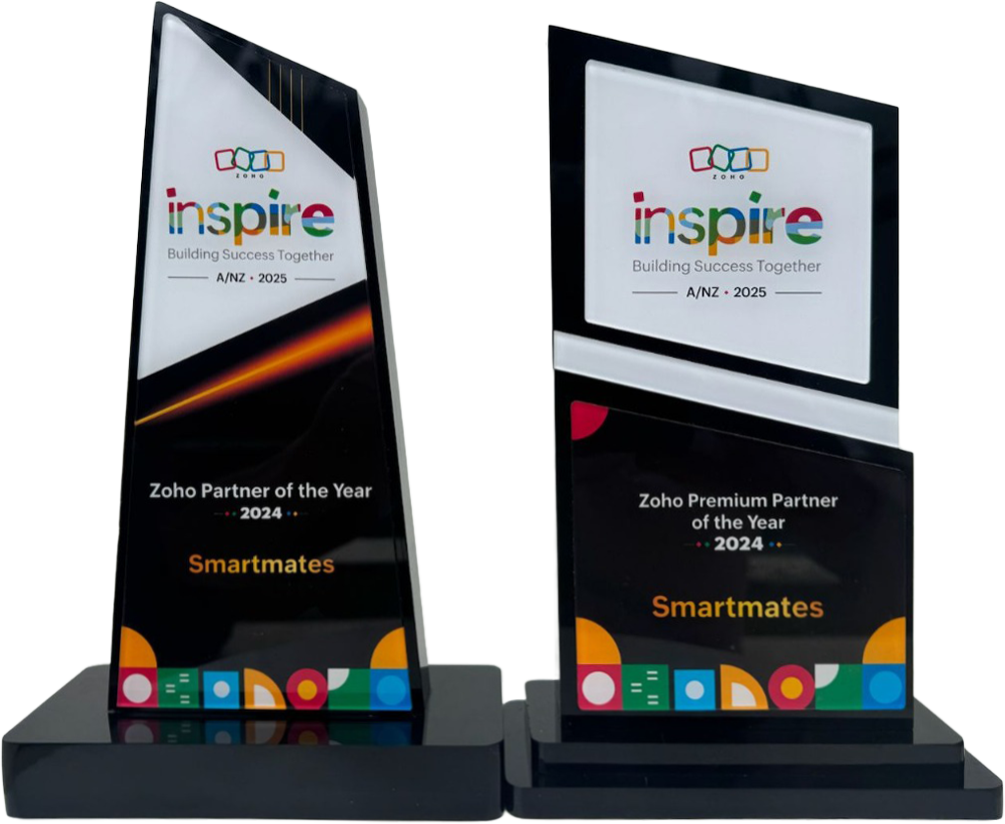
4 Years in a Row
Officially awarded Zoho Partner of the Year in Australia for 2022, 2023, 2024 and 2025. Chosen from 60+ Australian Zoho Partners by Zoho themselves.*
- First Top-Up Special $129 $99/hr + GST
Book your free video conference with our Zoho Consultants
Get your free comprehensive Zoho rollout quotation
Recognised as Australia’s #1 Zoho Partner, 4 years running
Minimum project size 10 consulting hours.

Eliminate CRM Resistance With Zoho CRM Training


You’ve just invested thousands in Zoho CRM. Maybe tens of thousands. You’ve sold the board on its potential. You’ve imagined the beautiful dashboards, the automated workflows, the seamless collaboration. You can practically taste the efficiency gains.
Then you introduce it to your team.
“Another system to learn?” your sales manager groans. “I’ll just keep using my spreadsheet,” your longest-serving rep mutters. “This seems complicated,” someone else offers diplomatically. Within two weeks, adoption sits at maybe 30%. Within two months, people are actively avoiding it. Your expensive CRM becomes digital shelf-ware, and you’re stuck explaining to leadership why the ROI never materialized.
If this sounds uncomfortably familiar, you’re not alone. CRM resistance is the silent killer of digital transformation across Australia. It doesn’t matter how powerful Zoho CRM is if your team refuses to use it. And here’s the brutal truth: most resistance isn’t about the technology. It’s about training. Or more accurately, the complete lack of proper Zoho CRM training.
Let me show you how to turn skeptics into believers and transform resistance into enthusiasm.
Why Your Team Actually Resists CRM (And Why They’re Not Wrong)
Before we solve the problem, we need to understand it. Your team isn’t resisting Zoho CRM because they’re difficult or change-averse. They’re resisting for legitimate reasons that nobody wants to acknowledge.
Reason one: They don’t see what’s in it for them. From their perspective, CRM is extra work. More data entry. More boxes to tick. More systems to remember. You’re asking them to trade their comfortable, familiar processes for something new and uncertain. What do they get in return? More reporting for management? Great. That’s not exactly motivating.
Reason two: They’ve been burned before. This probably isn’t their first CRM rodeo. Three years ago, the company rolled out that other system with big promises. Everyone was forced to use it for six months until leadership lost interest, and it quietly died. Why should this time be different?
Reason three: The training was rubbish. Someone gave them a 90-minute webinar featuring a monotone voice clicking through generic features. They were shown where buttons are but never learned how to actually use the system to make their jobs easier. No wonder they’re resistant.
Reason four: It genuinely is complicated. Let’s be honest. Out of the box, Zoho CRM can be overwhelming. There are modules, workflows, blueprints, validation rules, custom functions, and about 47 other things nobody explained. Your team looks at this complexity and reasonably concludes it’s not worth the headache.
Reason five: Nobody’s holding them accountable. If using CRM is “encouraged” but not enforced, and people can still do their jobs (sort of) without it, why would they bother? Humans naturally take the path of least resistance.
See what I mean? These aren’t irrational objections. They’re predictable responses to bad implementation and inadequate training. The good news? Every single one of these obstacles disappears with proper Zoho CRM training.
Also read: Zoho CRM Training For Multi-Location Operations
The Real Cost Of CRM Resistance
Let’s talk numbers because vague concerns don’t drive action. What’s resistance actually costing you?
You paid somewhere between $5,000 and $50,000 for Zoho CRM licenses, implementation, and setup. If only 30% of your team actively uses it, you’re burning 70% of that investment. That’s bad, but it gets worse.
The bigger cost is operational inefficiency. Your team is split across multiple systems. Some people are in CRM, some are in spreadsheets, some are using notebooks. This fragmentation means:
Lost deals because nobody knew what conversations happened with a prospect. One rep thinks they’re hot, another rep accidentally contacts them twice with conflicting information, and the prospect goes elsewhere thinking you’re disorganized.
Wasted time duplicating data entry. Your sales team enters information in one place, someone else re-enters it elsewhere, and nobody’s sure which version is current.
Impossible forecasting because you have no reliable pipeline data. You’re making business decisions based on gut feel and optimistic guesses rather than actual intelligence.
Team conflicts over lead ownership, follow-up responsibilities, and who dropped which ball. Without a system of record everyone trusts, these arguments become endless.
Management blind spots where leadership has no visibility into what’s actually happening. They can’t identify struggling reps who need coaching, successful strategies worth replicating, or bottlenecks killing conversion.
One of our clients, a technology distributor in Perth, calculated their CRM resistance was costing roughly $320,000 annually in inefficiency and lost opportunities. Once they implemented proper training and got full adoption, they recovered that loss within seven months. The system they’d owned for 18 months finally started delivering returns.
The Psychology Of Getting People On Board
Here’s where most companies go wrong. They treat CRM adoption like a logic problem. “Here’s why it’s beneficial. Here’s how to use it. Now use it.”
Humans don’t work that way.
You need to address the emotional and psychological barriers before the technical ones. Proper Zoho CRM training does exactly this, and it starts with reframing the entire conversation.
From “You Have To” To “This Helps You”
Stop positioning CRM as something management wants. Position it as something that makes your team’s lives easier. Because when configured and trained properly, it genuinely does.
Your sales reps spend less time searching for information and more time selling. Your customer service team stops hunting through email chains and instantly sees complete customer history. Your managers stop chasing people for updates because the data’s already there.
But your team won’t believe these benefits until they experience them firsthand. That’s what quality training delivers. It shows them, in their specific roles with their specific tasks, exactly how Zoho CRM removes friction rather than adding it.
Building Confidence Before Demanding Compliance
Think about learning to drive. If someone shoved you behind the wheel on a busy motorway and said “figure it out,” you’d be terrified and probably crash. But with proper instruction, practice in safe environments, and gradual progression to complex scenarios, driving becomes second nature.
CRM training works the same way. You can’t throw people into the deep end and expect success. Quality training builds confidence progressively:
Phase one: Here’s why we’re doing this and how it benefits you specifically.
Phase two: Here are the basic features you’ll use daily. Let’s practice together.
Phase three: Here are advanced capabilities that make your job even easier once you’re comfortable.
Phase four: Here’s ongoing support when questions arise.
This staged approach eliminates intimidation and builds genuine competence. People who feel confident using a system will actually use it.
What Effective Zoho CRM Training Actually Looks Like
Generic training fails because it treats everyone the same. Your sales team, customer service reps, marketing people, and managers all have completely different needs. They use different features, have different goals, and encounter different obstacles.
Effective Zoho CRM training recognizes this and customizes accordingly.
Role-Based Training That Actually Makes Sense
Sales reps need to know how to manage their pipeline, log activities, create quotes, and update deal stages. They don’t need to understand workflow automation or report building. Trying to teach them everything guarantees they’ll remember nothing.
Sales managers need pipeline visibility, forecasting tools, performance dashboards, and team activity tracking. They need to know how to coach their team using CRM data and spot problems before they become crises.
Customer service teams need quick access to customer history, ticket management, case escalation workflows, and communication logging. They couldn’t care less about sales pipelines.
Marketing people need campaign tracking, lead scoring, segmentation tools, and analytics that show ROI. Their interaction with CRM is completely different from sales.
Executives need high-level dashboards, strategic insights, and exception reporting. They don’t need to know where every button lives.
One training session for everyone? Waste of time. Role-specific training that addresses actual daily tasks? That’s what drives adoption.
Hands-On Practice With Real Scenarios
Remember school? The classes where you actually learned things involved doing, not just listening. Same principle applies here.
Effective Zoho CRM training uses your actual data, your real processes, and scenarios your team encounters daily. Not generic “imagine you’re contacting a client named John Smith” examples. Actual situations like:
“A high-value prospect from your territory just submitted a contact form. Walk through how you’d handle this in CRM from first contact to closed deal.”
Or: “A customer just called angry about a delayed shipment. Show me how you’d document this, escalate appropriately, and ensure nothing falls through the cracks.”
This practical approach accomplishes two things. First, it proves the system can handle real situations, not just theoretical ones. Second, it creates muscle memory so using CRM becomes automatic rather than something people have to consciously remember to do.
Addressing The “But I’m Comfortable With My Old Way” Problem
This is the hardest resistance to overcome. People have systems that work for them, even if those systems are inefficient nightmares from an organizational perspective.
Quality training doesn’t dismiss these concerns. It acknowledges them directly and shows specifically how Zoho CRM replicates what works about their old system while eliminating what doesn’t.
Your top rep uses a spreadsheet to track her pipeline? Great. Show her how CRM gives her the same visual overview but with automatic updates, reminders, and collaboration features her spreadsheet can’t match.
Your service manager swears by his notebook? Fine. Demonstrate how CRM captures the same information but makes it searchable, shareable, and secure so it doesn’t die if he loses the notebook or goes on holiday.
Meet people where they are, then show them a better path forward.
The Implementation Timeline That Actually Works
Most CRM rollouts fail because they happen too fast or drag on forever. There’s a sweet spot, and proper Zoho CRM training hits it.
Week One: Foundation And Buy-In
This isn’t about Zoho CRM features yet. It’s about context, vision, and answering the “why” questions.
Leadership explains the business reasons for CRM adoption. Not in abstract terms, but with specific pain points the team experiences daily and how CRM solves them.
Show examples from similar Australian businesses that achieved results. Nothing theoretical. Real metrics from real companies in comparable situations.
Get team input on concerns and requirements. Make them part of the solution rather than victims of change.
Week Two: Basic Training By Role
Each team gets role-specific training on core features they’ll use daily. Not every feature Zoho CRM offers. Just the essentials that deliver immediate value.
This training is hands-on. People practice with real data in a sandbox environment where mistakes don’t matter. They build confidence without consequences.
Quick reference guides get created for common tasks. “How to log a call,” “How to update a deal,” “How to create a quote.” Simple, visual, accessible.
Week Three: Go-Live With Support
The system goes live, but training doesn’t end. Trainers remain available for questions, troubleshooting, and hand-holding. Someone struggling doesn’t wait three days for help. They get immediate support.
Daily check-ins identify obstacles early. “What’s frustrating you?” “Where are you getting stuck?” “What’s taking longer than expected?” Problems get solved before they become reasons to quit.
Week Four: Advanced Features And Optimization
Once people are comfortable with basics, introduce time-saving advanced features. Automation that eliminates repetitive tasks. Templates that speed up common processes. Integration with other tools they use.
This staged approach prevents overwhelm while continuously demonstrating value. Each week, CRM gets easier and more useful.
Ongoing: Refreshers And New Capabilities
Training doesn’t stop after month one. New people join. Zoho releases new features. Processes evolve. Business needs change.
Regular refresher sessions keep skills sharp. “Lunch and learn” sessions showcase tips and tricks. Internal champions emerge who help colleagues and share best practices.
This ongoing approach ensures CRM adoption doesn’t decay over time.
Measuring Success (Because What Gets Measured Gets Managed)
You can’t improve what you don’t track. Proper Zoho CRM training includes clear success metrics:
| Metric | Target | Why It Matters |
|---|---|---|
| User Login Frequency | Daily for 90%+ of team | If people aren’t logging in, they’re not using it |
| Data Completeness | 95%+ required fields filled | Incomplete data makes CRM useless |
| Activity Logging | 100% of customer interactions captured | Missing activities create blind spots |
| Pipeline Accuracy | Forecast variance under 15% | Proves people are updating CRM honestly |
| Time To Proficiency | 80%+ confident within 2 weeks | Faster proficiency means faster ROI |
| Support Ticket Volume | Declining each month | Fewer questions means growing competence |
These metrics tell you whether training worked and where gaps remain. They give you objective data rather than subjective feelings about adoption.
Common Training Mistakes That Guarantee Failure
We’ve seen dozens of CRM implementations crater. The mistakes are predictable:
Mistake one: Training too early. You train people before the system is properly configured. By the time it goes live, they’ve forgotten everything and resent having to learn twice.
Mistake two: Training everyone at once. Forty people in a webinar where nobody can ask questions or practice. Guaranteed disaster.
Mistake three: Outsourcing to someone who doesn’t understand your business. Generic trainers teach generic features. Your team leaves thinking “that’s nice, but it doesn’t apply to us.”
Mistake four: One-and-done training with no follow-up. People have questions. They get stuck. They need help. If support isn’t there, they quit.
Mistake five: Not connecting training to actual work. “Here’s how to create a contact” is useless without context of when, why, and how that fits into their daily workflow.
Mistake six: Leadership doesn’t use CRM either. If managers aren’t in the system daily, the team interprets this as “it’s not really important.” Lead by example or don’t expect compliance.
Avoiding these mistakes requires expertise and experience. It’s why proper training matters so much.
The Australian Business Context
CRM adoption challenges in Australia have specific flavors that overseas training completely misses.
Tall poppy syndrome is real. If management comes across as too enthusiastic or forceful about CRM, you risk backlash. The training approach needs to be consultative rather than dictatorial.
Work-life balance expectations differ from American hustle culture. If CRM is positioned as something that helps people work smarter rather than longer, adoption improves dramatically.
Regional and remote challenges affect many Australian businesses. Your Perth team, your Brisbane team, and your Sydney team all need training that accounts for different time zones and potentially different workflows.
Privacy sensitivity is high. Training must address data security, consent management, and Australian Privacy Principles so teams feel confident they’re handling customer information properly.
Trainers who understand these nuances deliver better results than generic international programs.
The Transformation Story You Need To Hear
Sarah runs a professional services firm in Canberra with 35 staff. Two years ago, she bought Zoho CRM after a competitor bragged about their results. She gave her team a webinar-style training session, sent them a link to Zoho’s documentation, and expected adoption.
It didn’t happen.
After six months of frustration, only her newest hires (who didn’t know any other way) used CRM consistently. Everyone else had reverted to email, spreadsheets, and tribal knowledge. She’d wasted $18,000 on licenses and implementation.
That’s when we got involved.
We didn’t rebuild her CRM. The configuration was actually fine. The problem was training, or lack thereof. We designed a role-based training program that took three weeks to roll out properly.
Here’s what changed:
Month one: Adoption jumped from 30% to 75% as people realized CRM actually made tasks easier, not harder.
Month three: Adoption hit 95%. The holdouts finally capitulated when they saw colleagues working more efficiently and didn’t want to be left behind.
Month six: The team was suggesting improvements and asking for advanced features because they saw CRM’s potential.
Month twelve: Sarah calculated CRM was saving roughly 8 hours per person weekly, eliminating duplicate work and miscommunication. That’s 280 hours weekly across her team. The ROI was undeniable.
The technology didn’t change. The training did. That made all the difference.
What To Look For In Zoho CRM Training Partners
If you’re serious about overcoming resistance and achieving adoption, look for these qualities:
Industry experience. Trainers who understand your specific business model can create relevant examples and scenarios. Generic training from someone who’s never worked in your industry misses crucial context.
Australian expertise. Local trainers understand local business culture, regulations, and communication styles. They train in your time zone and can provide ongoing support when you need it.
Change management skills. Technology training isn’t enough. You need trainers who understand human psychology, resistance patterns, and how to actually get people on board.
Customization capability. Cookie-cutter programs fail. Training should adapt to your team size, structure, skill levels, and specific use cases.
Post-training support. Questions always arise after formal training ends. You need access to expertise during the critical first weeks when obstacles could derail adoption.
Track record of results. Ask for case studies. Talk to references. See examples of teams that went from resistance to enthusiasm. Proof matters more than promises.
Your Path Forward
You’ve invested in Zoho CRM. You believe in its potential. You’ve imagined the efficiency gains, the better forecasting, the improved collaboration.
That vision only becomes reality if your team actually uses the system. And they’ll only use it if they’re properly trained, supported, and convinced it makes their lives better rather than harder.
Resistance isn’t permanent. It’s not a character flaw in your team. It’s a predictable response to change that proper training systematically eliminates.
The teams that overcome resistance and achieve full CRM adoption aren’t lucky. They didn’t hire better people. They invested in better training.
At Smartmates, we’ve specialized in exactly this challenge across Australian businesses for years. We’re not generic tech consultants offering one-size-fits-all webinars. We’re certified Zoho experts who understand the psychology of change management, the specific needs of different industries, and how to transform skeptical teams into CRM believers.
We’ve seen the resistance patterns. We’ve solved the adoption problems. We’ve turned around implementations that leadership had nearly given up on.
We know the difference between training that looks good on paper and training that actually drives results. We know how to address the emotional barriers before tackling the technical ones. We know how to make CRM feel like a gift rather than a burden.
If you’re tired of watching your CRM investment gather dust while your team clings to spreadsheets and email, we should talk. Not next quarter after you’ve tried (and failed) to fix it yourself. Now, while you still have team goodwill and organizational momentum.
Because every month that passes with poor adoption is another month of lost efficiency, missed opportunities, and wasted investment. Every day resistance continues is another day your competitors who got this right pull further ahead.
Transform resistance into adoption. Transform skepticism into enthusiasm. Transform your CRM investment from shelf-ware into the strategic advantage it was meant to be.
Let’s make it happen.
Request a Callback from Smartmates

Sarah
I’ll listen to your Zoho needs to understand your business challenges and goals, ensuring a tailored approach.
I’ll bring a certified Zoho engineer to our first consultation to explore solutions and clarify your requirements.
We’ll deliver your free project plan quotation, detailing the steps, timeline, and costs—up to this point, it’s completely free!
“My mission is to solve your key problems, build your trust in our capabilities and deliver exceptional value for money.”