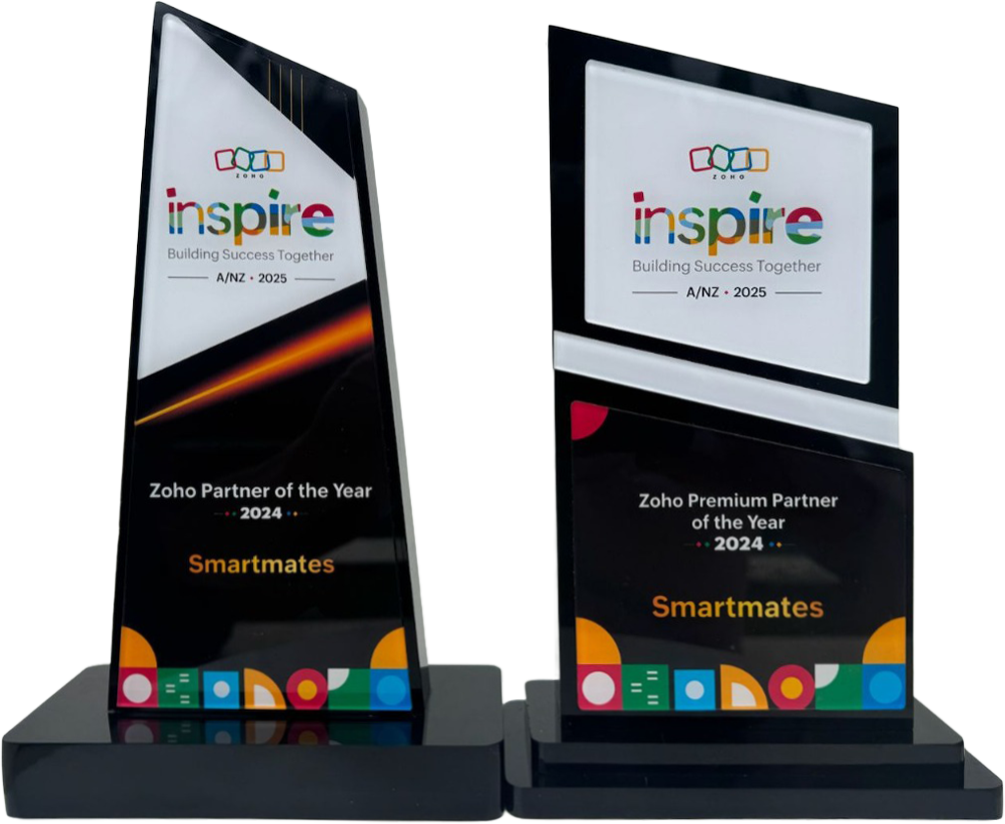
4 Years in a Row
Officially awarded Zoho Partner of the Year in Australia for 2022, 2023, 2024 and 2025. Chosen from 60+ Australian Zoho Partners by Zoho themselves.*
- First Top-Up Special $129 $99/hr + GST
Book your free video conference with our Zoho Consultants
Get your free comprehensive Zoho rollout quotation
Recognised as Australia’s #1 Zoho Partner, 4 years running
Minimum project size 10 consulting hours.

Create A Clear Automation Roadmap With Zoho CRM Consultants


You know automation would help your business. You’ve read the articles. Seen the case studies. Maybe even attended a webinar or two. But when you actually sit down to figure out where to start, what to automate first, and how to implement it all without disrupting operations, you’re completely overwhelmed.
So nothing happens. Another quarter passes. Your team keeps doing things manually. And your competitors who figured out automation keep pulling further ahead.
Here’s the problem: automation isn’t something you just “do.” It requires a roadmap. A clear plan that prioritizes initiatives based on impact, sequences implementation to build capability progressively, manages resources realistically, and delivers wins continuously rather than promising transformation someday.
Most Australian businesses fail at automation not because they lack tools or budget, but because they lack a coherent plan. They implement random workflows that seemed like good ideas. They automate whatever someone complains about loudest. They build disconnected solutions that don’t integrate.
Professional Zoho CRM consultants create automation roadmaps that actually work. Not vague aspirations, but concrete plans with clear milestones, resource requirements, and measurable outcomes at each stage.
Let’s talk about how to build an automation roadmap that transforms your operations systematically rather than creating expensive chaos.
Why DIY Automation Roadmaps Usually Fail
Before we talk about how to do roadmapping right, let’s understand why most businesses struggle when they try to plan automation themselves.
Problem one: No objective assessment of current state. You can’t plan a journey without knowing where you’re starting from. But most businesses have only vague understanding of their current automation maturity, technical debt, and capability gaps.
Without accurate baseline assessment, roadmaps become wishful thinking disconnected from reality.
Problem two: Inability to prioritize effectively. Everything seems important. Sales wants pipeline automation. Marketing wants email sequences. Operations wants approval workflows. Finance wants reporting automation. How do you decide what comes first?
Without framework for prioritization, roadmaps become lists of everything everyone wants, which isn’t actually a plan.
Problem three: Underestimating dependencies and prerequisites. Some automation requires foundational work first. You can’t build sophisticated workflows on top of poor data quality. You can’t integrate systems without proper architecture. You can’t automate processes that aren’t defined clearly.
DIY roadmaps often sequence things incorrectly, creating frustration when initiatives fail because prerequisites weren’t in place.
Problem four: Unrealistic timelines and resource allocation. How long does it take to implement marketing automation? How much staff time will integration projects require? What skills are needed?
Without experience across multiple implementations, businesses guess wildly at these parameters, creating roadmaps that are either impossibly aggressive or unnecessarily conservative.
Problem five: No flexibility for learning and adaptation. Automation roadmaps should evolve based on what you learn during implementation. What works. What doesn’t. What new opportunities emerge.
Static roadmaps become irrelevant quickly as reality diverges from initial assumptions.
Also read: Sales Enablement That Works With Zoho CRM Training
The Strategic Automation Roadmap Framework
Experienced Zoho CRM consultants use structured frameworks to create roadmaps that deliver results. Here’s how proper automation planning actually works.
Phase One: Current State Assessment
Roadmapping starts with comprehensive assessment of where you are now.
Process maturity audit: Which business processes are well-defined versus chaotic? Which are ready for automation versus needing optimization first? This assessment identifies quick wins and areas needing foundational work.
Technology stack evaluation: What systems do you currently use? How do they integrate? What technical debt exists? Where are architectural weaknesses that will constrain automation? This reveals infrastructure prerequisites.
Data quality analysis: How complete and accurate is your data? What cleanup is needed? What governance is required? Poor data quality kills automation, so this assessment is critical.
Team capability review: What skills exist in-house? What training is needed? What external expertise is required? This shapes implementation approach and timeline.
Pain point prioritization: Where is manual work causing most frustration, delay, or cost? What processes are breaking under volume? Where are errors most common? This highlights high-impact automation targets.
One Melbourne professional services firm thought they were ready for advanced automation. Our assessment revealed their data was 40% incomplete and their processes weren’t documented. We built a different roadmap starting with data cleanup and process definition, then moved to automation once foundations were solid.
Phase Two: Vision and Objectives Definition
With current state clear, consultants work with you to define automation vision and measurable objectives.
Strategic alignment: How does automation support your business strategy? Are you focused on growth, efficiency, customer experience, or some combination? This shapes what to automate and why.
Outcome targets: What specific improvements do you want to achieve? Time savings? Cost reduction? Revenue growth? Customer satisfaction? These targets guide prioritization and provide success criteria.
Timeline expectations: What’s realistic given your resources and constraints? Some businesses need gradual implementation to manage change. Others can move faster. Honest conversation about pace prevents unrealistic plans.
Budget parameters: What investment makes sense given expected returns? This constrains scope appropriately and prevents planning more than you can afford to execute.
These discussions create shared understanding between business and consultants about what success looks like.
Phase Three: Initiative Identification and Prioritization
Now comes the actual roadmap building. Consultants identify automation opportunities and prioritize them strategically.
Quick wins for early momentum: What can be automated quickly with high visibility impact? These early wins build enthusiasm and prove value, making subsequent initiatives easier to implement.
Foundation initiatives that enable others: What data cleanup, integration architecture, or process standardization needs to happen before other automation can work? These prerequisites come early even if they’re not exciting.
High-impact initiatives that drive ROI: What automation delivers the biggest efficiency gains, cost savings, or revenue impact? These get prioritized based on business value.
Long-term capability builders: What advanced automation requires maturity you don’t have yet but want to build toward? These get planned for later phases after foundational work creates capability.
| Initiative Category | Timing | Purpose | Example |
|---|---|---|---|
| Quick Wins | Month 1-2 | Build momentum, prove value | Email follow-up sequences, basic task automation |
| Foundation | Month 1-3 | Enable future automation | Data cleanup, system integrations, process documentation |
| Core Efficiency | Month 3-6 | Drive measurable ROI | Lead routing, approval workflows, reporting automation |
| Advanced Capability | Month 6-12 | Build competitive advantage | Predictive scoring, complex workflows, AI features |
| Optimization | Ongoing | Continuous improvement | Refining existing automation based on results |
This phased approach delivers value continuously rather than requiring months of work before any benefits materialize.
Phase Four: Detailed Planning and Sequencing
With priorities clear, consultants create detailed implementation plans for each initiative.
Technical requirements: What Zoho features, integrations, or custom development is needed? What technical challenges might arise? How will they be addressed?
Resource allocation: Who needs to be involved? How much time will they need to commit? What outside expertise is required? This creates realistic capacity planning.
Dependencies and prerequisites: What must be completed before this initiative can start? What work can happen in parallel? This sequencing prevents starting things prematurely.
Success metrics and validation: How will you know if this automation works? What metrics indicate success? How will you test before full deployment? This builds quality assurance into the plan.
Timeline and milestones: What are the specific deliverables and due dates? What checkpoints allow for review and course correction? This creates accountability and progress visibility.
Phase Five: Risk Assessment and Mitigation
Good roadmaps identify risks and plan mitigation approaches.
Technical risks: What could go wrong technically? Integration failures. Data migration issues. Performance problems. How will these be prevented or addressed quickly?
Adoption risks: What if people resist using new automation? How will training and change management address this? What’s the backup plan if adoption struggles?
Business continuity risks: How do you implement automation without disrupting operations? What’s the rollback plan if something breaks? How do you maintain business continuity during transition?
Resource risks: What if key people leave or get pulled to other priorities? How do you ensure project continuity despite normal business disruptions?
Planning for risks doesn’t mean avoiding them. It means having thoughtful responses ready so problems don’t derail the roadmap.
Building Buy-In for Your Automation Roadmap
Even brilliant roadmaps fail without organizational buy-in. Consultants help secure support across your business.
Executive Sponsorship
Leadership must visibly support automation initiatives or they’ll get deprioritized when daily pressures arise.
Consultants help executives understand ROI in terms that matter to them. Not technical features, but business outcomes. Time savings translated to cost reduction. Efficiency gains enabling growth without proportional headcount. Customer experience improvements driving retention.
They also help frame automation as strategic investment rather than IT project. This shifts perception from “nice to have” to “critical for competitiveness.”
Team Engagement
People who’ll use automation need involvement in planning or they’ll resist implementation.
Consultants facilitate workshops where teams identify their pain points and contribute to solution design. When people help shape automation, they’re invested in making it work.
They also address fears honestly. Will automation eliminate jobs? (Usually no, it eliminates boring tasks.) Will it make work harder? (Initially maybe, but ultimately easier.) Frank discussion builds trust.
Cross-Functional Alignment
Automation often spans departments, requiring coordination between groups that don’t normally work together closely.
Consultants create governance structures that ensure departments align on shared automation. Regular coordination meetings. Clear decision-making processes. Conflict resolution mechanisms.
This prevents the common scenario where sales builds automation that breaks operations, or marketing implements workflows that create chaos for customer service.
Common Roadmap Pitfalls to Avoid
Let’s talk about what goes wrong with automation roadmaps so you can avoid these expensive mistakes.
Pitfall one: Boiling the ocean. Trying to automate everything at once. This overwhelms teams, delays results, and usually fails. Start targeted, build capability, then expand.
Pitfall two: Ignoring change management. Focusing purely on technical implementation without addressing adoption, training, and organizational change. Technology alone doesn’t transform operations.
Pitfall three: Perfectionism paralysis. Waiting to implement until everything is planned perfectly. Roadmaps need enough structure to guide without being so rigid they prevent starting until conditions are ideal.
Pitfall four: Siloed automation. Departments building automation independently without coordination. This creates disconnected solutions that don’t integrate and sometimes conflict.
Pitfall five: No measurement framework. Implementing automation without clear metrics to show whether it’s working. You need data to prove success and identify problems.
Experienced Zoho CRM consultants recognize these pitfalls early and steer roadmaps away from them.
Industry-Specific Roadmap Considerations
Different industries need different automation roadmap approaches based on their unique characteristics.
Professional Services
Law firms, consultancies, accounting practices. Their automation roadmap typically prioritizes time tracking and billing automation, client communication and reporting, project management workflows, and resource allocation visibility.
Implementation usually starts with CRM setup for client management, integration with time tracking and accounting, automated client reporting dashboards, and project-based workflows for engagement delivery.
Manufacturing and Distribution
These businesses need quote-to-order automation, production scheduling workflows, inventory management integration, and supplier coordination systems.
Roadmaps typically begin with CRM and accounting integration, quote automation with current pricing and inventory, order processing workflows connecting sales to production, and supplier portals for coordination.
Retail and E-Commerce
Retail automation roadmaps focus on customer data unification across channels, inventory synchronization, order fulfillment automation, and customer service workflows.
Starting points usually include e-commerce platform and CRM integration, automated customer communication sequences, unified inventory visibility, and returns processing workflows.
Each industry has proven patterns that experienced consultants leverage rather than reinventing approaches.
Adapting Your Roadmap Based on Learning
The best roadmaps evolve based on implementation experience rather than following initial plans rigidly.
Regular review checkpoints assess what’s working and what isn’t. Maybe an automation delivers more value than expected and similar initiatives should be prioritized. Maybe a workflow isn’t being used, suggesting different approach is needed.
User feedback loops capture insights from people using automation daily. They spot issues consultants miss and often suggest improvements that make automation more effective.
Metrics analysis shows which automation drives real business impact versus which just looks impressive but doesn’t move needles. This data guides ongoing prioritization.
Technology evolution introduces new capabilities that weren’t available when the roadmap was created. Periodic updates incorporate new Zoho features that enable better solutions.
Static roadmaps become obsolete quickly. Dynamic roadmaps that adapt remain relevant and valuable.
Measuring Roadmap Success
You need metrics that show whether your automation roadmap is delivering expected value.
Implementation velocity: Are initiatives completing on schedule? If projects consistently run late, the roadmap needs adjustment for more realistic timelines.
Adoption rates: Are people actually using automation? Low adoption means change management needs more focus or automation needs redesign to fit workflows better.
Business impact metrics: Are the promised benefits materializing? Time savings. Cost reduction. Revenue growth. Error reduction. These ultimate measures show whether automation is working.
Team satisfaction: Do people feel automation is helping or hindering? Improved satisfaction indicates successful implementation. Frustration suggests problems needing attention.
ROI tracking: Are automation investments paying off financially? Track costs versus measurable benefits to demonstrate value and justify ongoing investment.
One Brisbane distribution company tracked all these metrics quarterly. Their roadmap showed steady progress with 85% initiatives completing on time, 90%+ adoption of new automation, documented cost savings exceeding investment by 3x, and significantly improved team morale.
The Smartmates Roadmap Development Process
Look, plenty of consultants can implement Zoho CRM. Creating strategic automation roadmaps that actually drive transformation? That requires different expertise.
Smartmates specializes in automation roadmap development for Australian businesses. We’ve built roadmaps for companies from 10 to 500+ employees across industries. We know what works because we’ve seen automation succeed and fail dozens of times.
Our roadmap process starts with comprehensive discovery, not assumptions. We spend significant time understanding your business, processes, pain points, and goals before proposing solutions.
We create realistic timelines based on actual experience, not guesses. We know how long initiatives really take because we’ve implemented them repeatedly. This prevents roadmaps that are impossibly aggressive or unnecessarily slow.
We build flexibility into roadmaps so they adapt as you learn. Regular review checkpoints. Clear decision frameworks for adjusting priorities. Mechanisms for incorporating feedback and new information.
We’re based in Australia, which means we understand local business context, work culture, and market conditions. We know Australian accounting systems, compliance requirements, and the practical realities of operating here.
Plus, we work with both Zoho and HubSpot, giving us cross-platform perspective. We’re not locked into one approach. We design roadmaps using whatever tools best fit your needs.
And critically, we stay engaged through implementation and beyond. Roadmaps are useless if they sit in drawers. We help execute, adapt based on results, and continuously optimize.
Your Path to Strategic Automation
Right, you’ve made it through. You understand why automation needs strategic roadmapping and how professional consultants create plans that actually deliver results.
The question is what you do next.
You can keep implementing random automation based on whoever complains loudest. You can continue feeling overwhelmed by possibilities without clear priorities. You can watch systematic competitors pull ahead while you react chaotically.
Or you can build a roadmap that transforms operations methodically.
Imagine having complete clarity on automation priorities, sequencing, and expected outcomes. Imagine your team aligned on the plan and invested in execution. Imagine delivering automation wins consistently rather than hoping transformation happens someday. Imagine the competitive advantage of operations that improve systematically quarter after quarter.
That transformation from chaotic to strategic automation is what expert Zoho CRM consultants enable through professional roadmap development. Not through templates or generic best practices, but through customized planning based on your specific context, constraints, and goals.
Your Australian business deserves automation that drives real results, not just impressive-sounding initiatives that don’t deliver. You deserve clear priorities instead of overwhelming choices. You deserve a roadmap that guides sustained improvement, not just one-off projects.
Ready to create a clear automation roadmap with expert Zoho CRM consultants? Smartmates has helped dozens of Australian businesses build and execute automation strategies that transform operations. We know what works because we’ve navigated this journey repeatedly across industries and company sizes.
Let’s talk about your current state, your automation goals, and how to build a roadmap that delivers results progressively rather than promising transformation someday. No generic templates, just strategic planning customized to your reality.
Visit smartmates.com.au or reach out today. Your automation roadmap starts with a conversation. Let’s make it happen.
Request a Callback from Smartmates

Sarah
I’ll listen to your Zoho needs to understand your business challenges and goals, ensuring a tailored approach.
I’ll bring a certified Zoho engineer to our first consultation to explore solutions and clarify your requirements.
We’ll deliver your free project plan quotation, detailing the steps, timeline, and costs—up to this point, it’s completely free!
“My mission is to solve your key problems, build your trust in our capabilities and deliver exceptional value for money.”