

Behind Unified Business Systems Are Zoho One Solution Partners

Walk into any thriving business and you’ll notice something interesting. Not the fancy office or the latest equipment. Not even the impressive client list or revenue numbers.
It’s the rhythm. The flow.
Information moves effortlessly. Decisions happen quickly. Teams coordinate naturally. Customers get served smoothly. Everything just works together like a well-conducted orchestra, each section playing its part while contributing to the whole.
Now visit a struggling business. Same industry. Similar size. Comparable market position.
But the rhythm’s completely different. Jerky. Disjointed. Information trapped in silos. Teams working at cross-purposes. Customers falling through cracks. Everyone working hard but nothing flows naturally. It’s chaos poorly disguised as operation.
What creates this difference? It’s rarely talent. Struggling businesses often have brilliant people. It’s not usually funding. Chaotic operations waste more money than unified systems cost.
The difference is system integration. Or more accurately, the lack of it.
Thriving businesses run on unified systems where everything connects properly. Sales talks to marketing. Finance coordinates with operations. Support knows what sales promised. Projects track against budgets. Customer data lives in one place accessed by everyone.
Struggling businesses run on fragmented chaos. Ten different systems that don’t talk to each other. Information scattered across platforms. Manual work bridging gaps between disconnected tools. Everyone maintaining their own spreadsheets because systems don’t provide needed information.
Creating unified business systems isn’t about buying expensive enterprise software. It’s about thoughtful integration design implemented systematically. That’s exactly what Zoho One solution partners specialise in delivering.
Not just deploying software. Creating genuinely unified operational systems where information flows automatically, processes span applications seamlessly, and teams work from single sources of truth enabling the rhythm that separates thriving businesses from struggling ones.
Let me show you what unified business systems actually look like and how Zoho One solution partners create them for Australian businesses.
Also read: Zoho One Consultant Helping Businesses Run Everything In One Platform
What Unified Business Systems Actually Mean
The term “unified business systems” gets thrown around loosely. Let’s define it precisely so we understand what we’re actually pursuing.
Single Source of Truth for Critical Data
In fragmented systems, customer information exists in multiple places with different versions. CRM says one thing. Accounting says another. Support has different details. Nobody knows which is correct.
Unified systems maintain single authoritative records. One customer profile used everywhere. One product catalogue referenced by all applications. One project definition shared across teams. Single truth eliminating confusion and reconciliation work.
Seamless Information Flow Between Functions
Sales closes deal. Information flows automatically to operations initiating project setup, finance generating invoice, support creating customer account, and marketing adding to nurture sequences.
This automatic flow eliminates manual handoffs where information gets delayed, lost, or corrupted. Work initiates immediately based on upstream activities without requiring people to transfer information manually.
Cross-Functional Process Orchestration
Real business processes span functions. Customer onboarding involves sales, operations, finance, and support. Product launches coordinate marketing, development, sales, and logistics.
Unified systems orchestrate cross-functional processes end-to-end. Workflows span applications. Tasks route automatically. Stakeholders get notified at appropriate stages. Processes execute reliably without manual coordination overhead.
Consolidated Visibility and Reporting
Making informed decisions requires complete information. Fragmented systems force manual data gathering from multiple sources.
Unified systems provide consolidated visibility. Dashboards aggregating data across functions. Reports combining sales, finance, operations, and customer data. Complete picture enabling confident decision-making without manual compilation.
Consistent User Experience
Jumping between ten different applications with completely different interfaces, navigation patterns, and interaction models creates cognitive burden and learning difficulty.
Unified systems provide consistent experience. Similar interfaces. Common navigation. Shared interaction patterns. Reduced cognitive load enabling faster learning and more efficient daily work.
Why Fragmentation Is the Default State
If unified systems are so valuable, why do businesses default to fragmentation? Understanding this helps appreciate the expertise required to create actual unification.
Organic Technology Adoption
Most businesses don’t design technology stacks strategically. They adopt tools opportunistically solving immediate problems.
Need CRM? Buy Salesforce. Need accounting? Add Xero. Need project management? Get Asana. Need marketing automation? Subscribe to Mailchimp. Each decision makes sense individually. Collectively they create fragmentation.
Vendor Lock-In Fears
Businesses fear committing to single vendors. What if they increase prices? What if they discontinue products? What if competitors offer better solutions?
This fear drives multi-vendor strategies. But multiple vendors guarantee integration challenges. The diversity meant to provide flexibility creates fragmentation that constrains operational efficiency.
Integration Complexity Underestimation
When adopting new tools, businesses underestimate integration complexity. “They both have APIs, it’ll connect fine.”
Reality proves different. Different data models. Inconsistent update patterns. Authentication complications. Error handling challenges. Documentation gaps. Integration maintenance burden. Actual integration is substantially harder than anticipated.
Legacy System Attachment
Businesses grow attached to familiar systems even when they create fragmentation. “We’ve always used this.” “People know how it works.” “Migrating would be disruptive.”
This attachment preserves fragmentation indefinitely. The familiar chaos feels safer than unfamiliar unification despite unified systems delivering superior outcomes.
Insufficient Integration Expertise
Creating unified systems requires integration expertise most businesses lack internally. How to design information architecture. Configure data flows. Build cross-application workflows. Maintain integration over time.
Without this expertise, businesses can’t unify systems even when they recognise fragmentation problems. They lack capability to execute unification systematically.
How Zoho One Enables True System Unification
Zoho One isn’t just another software suite. Its architecture specifically enables unified business systems in ways fragmented multi-vendor approaches can’t match.
Comprehensive Application Coverage
Unification requires complete functional coverage. Gaps force adopting external tools creating integration challenges.
Zoho One provides 45+ applications covering virtually every business function. CRM and sales. Marketing automation. Finance and accounting. Projects and operations. HR and recruitment. Support and helpdesk. Analytics and BI. Collaboration and communication.
This comprehensive coverage eliminates most external tool requirements, enabling true unification without forced integration gaps.
Purpose-Built Integration Architecture
Zoho One applications share common architecture designed for seamless integration. Unified data models. Consistent APIs. Coordinated updates. Shared authentication. Common notification systems.
This purpose-built integration means applications connect naturally rather than requiring complex integration middleware. Unification is fundamental to platform design, not afterthought requiring complex workarounds.
Unified Data Platform
All Zoho One applications share underlying data platform. Customer record created in CRM exists across all applications automatically. Project defined in one place accessible everywhere. Data changes propagate instantly.
This shared platform eliminates data synchronisation complexity and ensures consistent information across all business systems without manual reconciliation.
Cross-Application Workflow Engine
Zoho One includes workflow automation spanning applications seamlessly. Trigger in one application executes actions in others. Build complex multi-stage processes crossing functional boundaries.
This cross-application orchestration enables genuinely unified business processes rather than disconnected application-specific workflows requiring manual coordination.
Single Vendor Simplification
One vendor relationship. One contract. One renewal date. One support channel. One billing statement. One security review. One compliance assessment.
This vendor consolidation reduces administrative overhead substantially, freeing resources for actual business activities rather than vendor relationship management.
What Zoho One Solution Partners Bring to Unification
Zoho One enables unification. Solution partners make it happen. The platform provides capability. Partners provide expertise translating capability into actual unified operational systems.
Unified System Architecture Design
Creating truly unified systems requires architecture design spanning all business functions. How should information flow? Which processes span applications? What integration patterns suit specific requirements?
Solution partners design comprehensive architecture before implementation. They map business processes. Identify information requirements. Design data flows. Plan integration points. Create blueprint for genuinely unified operations.


This architectural work ensures unification is systematic and comprehensive rather than ad hoc and incomplete.
Cross-Functional Implementation Coordination
Deploying unified systems affects every business function simultaneously. Sales. Marketing. Finance. Operations. HR. Support. Coordinating implementation across functions prevents disruption while building unified capability.
Solution partners coordinate complex multi-functional deployments. Phasing that maintains operations. Training spanning departments. Change management addressing cross-functional concerns. Project management ensuring coordinated execution.



Integration Configuration Expertise
Zoho One provides integration capability. Configuring it properly requires technical expertise and business process understanding.
Solution partners configure integration leveraging platform capabilities fully. They know which features enable specific workflows. How to optimise data flows. Where to apply automation. Which integration patterns deliver reliability.
This configuration expertise ensures unified systems actually work reliably rather than theoretically possible but practically broken.
Data Architecture Unification
Unified systems require unified data architecture. Consistent naming conventions. Standardised data structures. Clear ownership definitions. Quality validation rules.
Solution partners establish data architecture foundations supporting long-term unification. They design information models. Define standards. Implement validation. Create documentation. Build sustainable data foundations.
Migration from Fragmented Systems
Moving from fragmented multi-system chaos to unified Zoho One deployment requires careful migration. Data consolidation. Process transition. Team training. Operational continuity.
Solution partners execute systematic migrations. They plan transitions minimising disruption. Migrate data ensuring quality. Train teams across functions. Maintain business continuity throughout transformation.
The Smartmates Unified Systems Approach
Let’s talk about what exceptional unified system creation actually delivers. And since we’re being direct, let me show you how Smartmates transforms fragmentation into unification for Australian businesses.
Why Smartmates Excels at System Unification
First, they don’t view Zoho One deployment as just implementing software. They approach it as business transformation opportunity, fundamentally improving operational efficiency through genuine system unification.
This transformation mindset shapes everything they do.
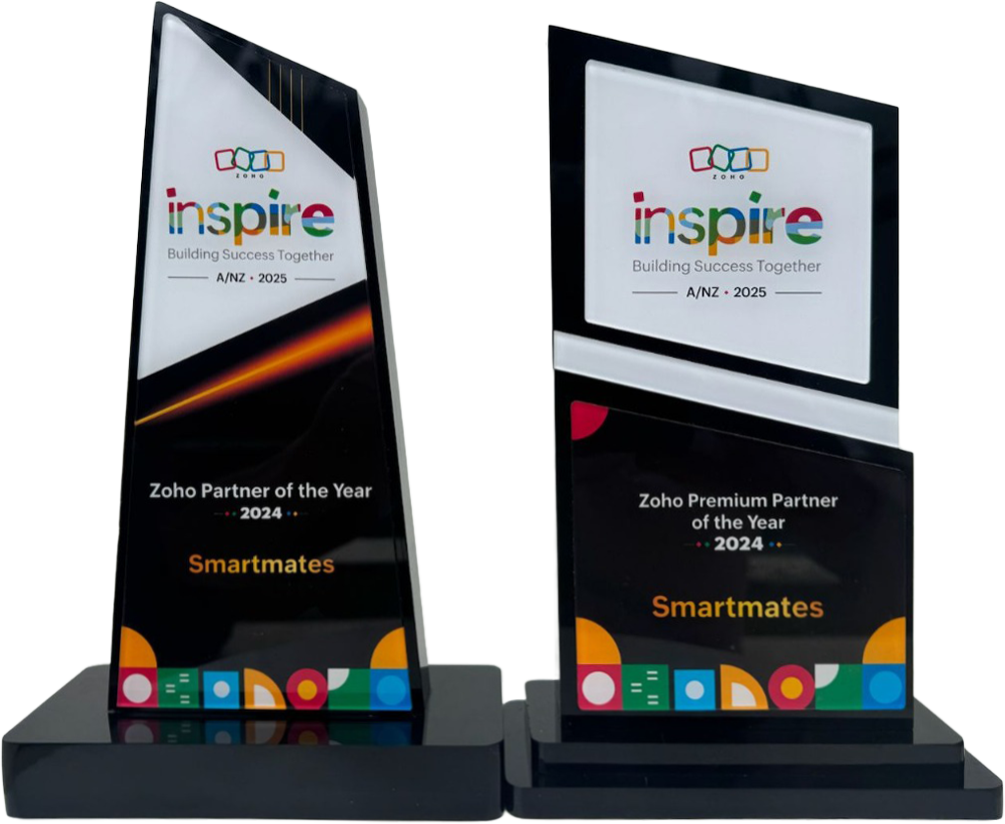
Certified Zoho One solution expertise. Smartmates holds official Zoho solution partner certification specifically for comprehensive unified system deployment. They specialise in turning fragmented chaos into integrated excellence.
Holistic business understanding. Unification requires understanding entire business operations, not just individual functions. Smartmates takes holistic view, considering how sales, marketing, finance, operations, HR, and support interconnect and designing systems supporting complete business flow.
Australian operational context. Local businesses have specific operational patterns, regulatory requirements, and market dynamics. Smartmates understands Australian business context, designing unified systems fitting our reality rather than forcing overseas approaches.
Complete technical capability. Unified system creation requires diverse technical expertise. CRM configuration. Financial integration. Workflow automation. Custom development. Data migration. API integration. Smartmates provides comprehensive capability across full technical spectrum.
Outcome-focused commitment. They measure success by operational improvement achieved, not applications deployed. Unified systems should deliver measurable efficiency gains, improved coordination, and enhanced decision-making capability.
This outcome focus ensures implementations deliver genuine business value.
What working with Smartmates delivers:
You get comprehensive architecture design spanning all business functions. You get cross-functional implementation coordination maintaining operational stability. You get expert integration configuration creating reliable unified systems. You get data architecture foundations supporting long-term success. You get systematic migration from fragmented chaos. You get holistic training ensuring organisation-wide adoption.
And critically, you get partnership committed to creating genuinely unified operations, not just deploying disconnected applications.
Visit smartmates.com.au to discover how Zoho One solution partners transform operational fragmentation into unified excellence.
Common Unification Challenges Solution Partners Overcome
Creating unified systems faces predictable challenges. Professional solution partners navigate these systematically while self-implementations typically struggle.
The “Too Many Cooks” Coordination Challenge
Unified systems affect everyone. Sales wants features supporting their needs. Finance demands accounting compliance. Operations requires project visibility. Marketing needs campaign capability. Everyone has requirements and opinions.
Without coordination, competing requirements create design paralysis or inconsistent implementations satisfying nobody fully.
Partner solution: Systematic requirements gathering and prioritisation. Facilitated cross-functional workshops. Conflict resolution through business outcome focus. Coordinated design satisfying critical needs across functions.
The “Legacy Data Quality” Migration Problem
Existing systems contain years of accumulated data. Quality varies wildly. Duplicates. Incomplete records. Inconsistent formatting. Outdated information. Migrating this mess creates messy unified systems.
Partner solution: Comprehensive data preparation before migration. Quality assessment. Cleaning and standardisation. Validation and enrichment. Controlled migration with quality gates. Clean foundation for unified operations.
The “Change Resistance” Adoption Barrier
People resist change, especially comprehensive change affecting daily work. “Old system worked fine for me.” “This seems complicated.” “I don’t have time to learn new tools.”
Resistance undermines adoption. Technology deployed but not used delivers zero value regardless of capability.
Partner solution: Change management throughout implementation. Early stakeholder engagement. Clear communication of benefits. Comprehensive training. Champions within each function. Support during transition. Managed adoption ensuring actual usage.
The “Process Variation” Standardisation Conflict
Different teams often perform similar processes differently. Sales regions have different qualification approaches. Support teams use varied resolution methods. Operations locations follow inconsistent procedures.
Unified systems require some standardisation. But excessive standardisation eliminates necessary flexibility. Balancing standardisation and flexibility is challenging.
Partner solution: Collaborative process design identifying necessary standards while preserving appropriate flexibility. Configuration supporting both consistency and adaptation. Designed variation rather than inconsistent chaos.
The “Integration Maintenance” Ongoing Burden
Integrations don’t configure once and work forever. Applications update. Business requirements change. Data patterns evolve. Integration needs ongoing maintenance.
Without maintenance, integration degrades creating gradual return to fragmentation despite unified system investment.
Partner solution: Documented integration architecture. Clear maintenance procedures. Monitoring for integration health. Ongoing support ensuring sustained unification rather than gradual degradation.
| Unification Aspect | Fragmented Multi-Vendor | Zoho One with Solution Partner |
|---|---|---|
| Application coverage | Multiple vendors creating gaps | Comprehensive 45+ app suite |
| Integration approach | Complex third-party middleware | Native purpose-built integration |
| Data consistency | Manual reconciliation required | Automatic unified data platform |
| Process orchestration | Disconnected function-specific | Cross-application workflow engine |
| User experience | Inconsistent across platforms | Consistent unified interface |
| Vendor management | Multiple relationships and contracts | Single vendor simplification |
| Implementation complexity | Extremely high DIY burden | Guided professional deployment |
| Ongoing maintenance | Continuous integration repairs | Stable integrated platform |
Measuring Unified System Success
How do you know system unification actually delivered value? Here are metrics demonstrating unified system effectiveness.
Information Access Time Reduction
How quickly can people find needed information? How many systems do they search? How much time locating data?
Unified systems dramatically reduce information access time. Single search spanning applications. Consolidated dashboards. Linked related data. Target 60-70% reduction in information search time.
Manual Handoff Elimination
Count manual handoffs in key processes. How often do people manually transfer information between systems? How many email notifications saying “I’ve completed my part, over to you”?
Unified systems automate handoffs. Information flows automatically. Target eliminating 80%+ of manual process handoffs through automation.
Decision-Making Cycle Compression
How long does gathering information for decisions take? How many people must provide data? How much reconciliation required?
Unified visibility accelerates decision-making. Consolidated dashboards provide complete pictures immediately. Target 40-50% reduction in decision preparation time.
Data Quality Improvement
Measure data completeness, accuracy, and consistency. Are customer records complete? Do different systems agree? How many duplicates exist?
Unified systems improve data quality dramatically through single source of truth. Target 90%+ data completeness and near-zero cross-system inconsistency.
Team Satisfaction Enhancement
Survey team satisfaction with operational systems. Are people frustrated with tools? Do systems help or hinder work? Has satisfaction improved?
Unified systems reduce frustration substantially. People appreciate smooth workflows and reliable information. Target 30%+ satisfaction score improvement.
Getting Started: Selecting Zoho One Solution Partners
Ready to transform fragmented chaos into unified excellence? Here’s how to choose solution partners ensuring successful unification.
Verify Unified System Experience
Not all partners specialise in creating genuinely unified systems. Some focus on single application deployment.
Ask specifically about unified system projects. How many complete Zoho One unifications? What cross-functional workflows built? How do they approach enterprise-wide integration?
Assess Cross-Functional Understanding
Unification requires understanding how business functions interconnect. Can partners think across sales, marketing, finance, operations, HR, and support holistically?
During discussions, notice whether they grasp cross-functional complexity or focus narrowly on single departments. Unified system expertise requires enterprise thinking.
Review Integration Architecture Capability
Creating unified systems requires integration architecture expertise. Can partners design information flows, data models, and workflow orchestration spanning applications?
Request examples of integration architecture. How do they document designs? What patterns do they apply? Systematic architecture capability indicates professional approach.
Check Change Management Approach
Technology succeeds through adoption. How do partners ensure organisation-wide adoption across all affected functions?
Examine change management methodology. Stakeholder engagement. Communication plans. Training programs. Support during transition. Comprehensive approach essential for unified system success.
Evaluate Data Migration Expertise
Moving from fragmented systems to unified Zoho One requires careful data consolidation. How do partners handle migration complexity?
Ask about data preparation approaches. Quality assessment methods. Migration validation. Understand their systematic approach ensuring clean unified data foundations.
Understand Ongoing Partnership Model
Unification doesn’t end at launch. How do partners support continuous improvement and sustained unification?
Clarify ongoing support structure. Integration maintenance. Optimisation assistance. New function onboarding. Long-term partnership ensures sustained unified operations.
Confirm Local Presence
Australian business context matters. Is the partner locally based understanding our operational environment, regulatory requirements, and market dynamics?
Local presence enables better collaboration and culturally appropriate solutions fitting Australian business reality.
Transform Fragmentation Into Unified Excellence
Here’s the truth, and I’ll be direct because your operational efficiency depends on it.
The rhythm separating thriving businesses from struggling ones comes from unified business systems. Single sources of truth. Seamless information flow. Cross-functional orchestration. Consolidated visibility. Consistent experience.
Fragmentation creates opposite. Information trapped in silos. Manual work bridging gaps. Coordination overhead. Decision-making delays. Frustrated teams. Operational chaos.
Creating unified systems isn’t about buying expensive enterprise software. It’s about thoughtful integration design implemented systematically through comprehensive platform like Zoho One.
But Zoho One’s capability alone doesn’t guarantee unification. Comprehensive suite. Native integration. Unified data platform. Cross-application workflows. Single vendor simplicity. These enable unification but don’t create it automatically.
That’s exactly what Zoho One solution partners deliver. Architecture design spanning functions. Cross-functional implementation coordination. Integration configuration expertise. Data architecture unification. Systematic migration. Holistic training. They transform platform capability into actual unified operational systems.
The outcome isn’t just deployed software. It’s operational transformation. Reduced information access time. Eliminated manual handoffs. Compressed decision cycles. Improved data quality. Enhanced team satisfaction. The rhythm enabling business excellence.
That’s what Smartmates delivers for Australian businesses as certified Zoho One solution partner. You get comprehensive architecture design. You get cross-functional coordination. You get expert integration configuration. You get data architecture foundations. You get systematic migration from fragmentation. You get holistic training ensuring adoption.
And you get partnership committed to genuine operational unification, not just application deployment.
Your business deserves unified operational systems enabling excellence, not fragmented chaos creating burden. The rhythm separating thriving businesses from struggling ones isn’t accidental. It’s designed and implemented systematically.
Ready to transform operational fragmentation into unified excellence? Connect with Smartmates at smartmates.com.au and discover how Zoho One solution partners create genuinely unified business systems delivering operational rhythm that drives business success. Your teams deserve systems that work together naturally. Create them.
Request a Callback from Smartmates

Sarah
I’ll listen to your HubSpot needs to understand your business challenges and goals, ensuring a tailored approach.
I’ll bring our engineer onto our first consultation to explore solutions and clarify your requirements.
We’ll deliver your free project plan quotation, detailing the steps, timeline, and costs—up to this point, it’s completely free!
“My mission is to solve your key problems, build your trust in our capabilities and deliver exceptional value for money.”