

HubSpot Consultant Services That Align Sales, Marketing and Service

You know that feeling when your marketing team celebrates a campaign win, but sales groans because the leads are rubbish? Or when customer service has no idea what promises marketing made?
Welcome to the chaos of siloed departments.

Here’s the thing: your customers don’t care about your internal structure. They experience your business as one entity. When marketing says one thing, sales another, and service delivers something entirely different, trust evaporates faster than water on a Sydney summer footpath.
This is where a HubSpot consultant becomes your secret weapon.
Not just someone who clicks buttons in a CRM, but a strategic partner who understands how to weave sales, marketing and service into a single, powerful revenue engine. And if you’re serious about growth in 2026, this alignment isn’t optional anymore. It’s survival.
Why Your Teams Are Working Against Each Other (And Don’t Even Know It)
Picture this: Marketing generates 500 leads this month. They’re thrilled. Sales reviews them and bins 400 as “not ready.” Service deals with customers who were promised features that don’t exist yet.
Sound familiar?
The problem isn’t effort. Everyone’s working hard. The issue is they’re rowing in different directions.
Marketing optimizes for lead volume. Sales chases quick conversions. Service scrambles to retain customers who feel misled. Each team has different goals, different tools, and different definitions of success.
A skilled HubSpot consultant spots these fractures immediately. They’ve seen this movie before, in dozens of Australian businesses from Brisbane to Perth. The symptoms vary, but the disease is the same: misalignment costs you revenue, reputation and sanity.
What Actually Happens When You Align These Three Teams
Let’s get practical for a moment.
When sales, marketing and service operate as one unified front through HubSpot, something magical unfolds. Marketing creates content that sales actually wants to share. Sales provides feedback that makes marketing campaigns sharper. Service insights loop back to inform both teams about what customers truly need.
The data flows. The handoffs smooth out. The customer journey stops feeling like a relay race where everyone drops the baton.
We’ve watched businesses transform their operations with proper HubSpot implementation. One Melbourne-based SaaS company cut their sales cycle by 34% simply by ensuring marketing qualified leads properly before passing them to sales. Another Sydney retailer increased customer lifetime value by 28% when service teams started using HubSpot to trigger relevant marketing based on support interactions.
These aren’t flukes. This is what alignment delivers.
The Role of a HubSpot Consultant in Creating This Alignment
So what does a HubSpot consultant actually do beyond setting up dashboards?
Quite a lot, actually.
Strategic Architecture
First, they map your entire customer journey. Not the fantasy version you present at board meetings, but the messy, real-world path customers actually take. They identify every touchpoint, every handoff, every moment where things could (and do) fall apart.
Then they design your HubSpot instance around that reality. Custom properties that matter. Pipelines that reflect your actual sales process. Workflows that automate the tedious bits while keeping the human touch where it counts.

Team Translation
A good consultant speaks three languages fluently: marketing metrics, sales targets and service KPIs. They translate between these worlds, helping each team understand how their work impacts the others.
Marketing learns why “just send more leads” isn’t helpful. Sales discovers why lead nurturing matters. Service realizes they’re sitting on goldmines of upsell data.
Technology Integration
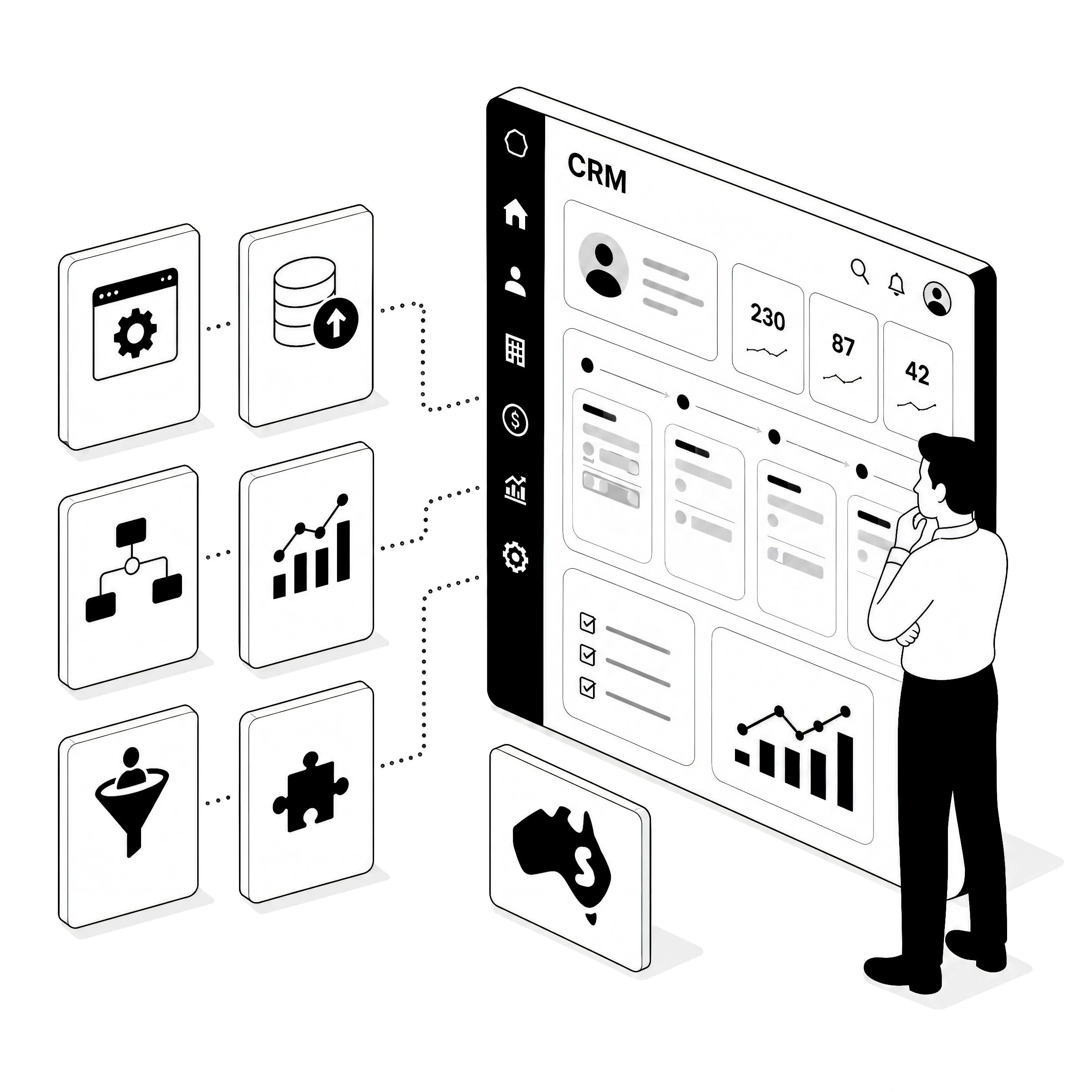
Your HubSpot consultant doesn’t work in isolation. They understand your tech stack, your industry quirks, your regulatory requirements. They integrate HubSpot with your accounting software, your product systems, your support tools. Everything talks to everything else.


This is especially crucial in Australia, where businesses often juggle MYOB, Xero, Stripe and a dozen other platforms. A consultant ensures HubSpot becomes the central nervous system, not just another disconnected tool.
Ongoing Optimization
Here’s what separates great consultants from mediocre ones: they don’t disappear after go-live.
Markets shift. Your business evolves. What worked in Q1 might be obsolete by Q3. The best consultants stick around, tweaking, testing, improving. They run A/B tests on email sequences. They analyze conversion rates across different lead sources. They spot bottlenecks before they become crises.
Key Services a HubSpot Consultant Provides
Let’s break down the specific ways a consultant drives alignment:
CRM Implementation and Customization
Setting up HubSpot isn’t like installing Microsoft Word. It requires deep understanding of how your business operates, how your teams collaborate, and how your customers buy.
A consultant builds custom deal stages that match your sales reality. They create contact properties that capture the information you actually need (not just what HubSpot suggests). They establish lead scoring that distinguishes between tire-kickers and ready-to-buy prospects.
Workflow Automation
Automation is where the magic happens. But automated chaos is worse than manual chaos.
Your consultant designs workflows that make sense. When a lead downloads a whitepaper, what happens next? When a deal closes, how does service get notified? When a customer submits a support ticket, should marketing pause their campaigns?
These decision trees get complex fast. A consultant maps them out, builds them in HubSpot, tests them ruthlessly and monitors them continuously.
Data Migration and Integration
Moving from Salesforce, Pipedrive, or god forbid, Excel spreadsheets? Data migration is where most DIY projects crash and burn.
A consultant ensures your historical data transfers cleanly. Contact records merge properly. Duplicate entries disappear. Custom fields map correctly. Nothing falls through the cracks.
They also connect HubSpot to your other business systems. Your e-commerce platform feeds purchase data into HubSpot automatically. Your support system creates tickets that sales can see. Your accounting software syncs customer details both ways.
Training and Change Management
Technology is easy. People are hard.
Getting your teams to actually use HubSpot requires more than a two-hour webinar. A consultant provides role-specific training. Marketing learns campaign tools. Sales masters pipeline management. Service explores ticketing and knowledge bases.
But training alone isn’t enough. Change management means understanding resistance, addressing concerns and demonstrating value quickly. When sales sees how much time they save with automated follow-ups, adoption skyrockets. When marketing tracks how their content directly influences closed deals, buy-in becomes enthusiasm.
Reporting and Analytics
What gets measured gets managed. What gets reported gets attention.
Your consultant builds dashboards that matter. Not vanity metrics, but numbers that drive decisions. Marketing sees which channels generate revenue, not just clicks. Sales tracks conversion rates at each pipeline stage. Service monitors customer health scores and churn risk.
Everyone works from the same data. No more arguing about whose spreadsheet is correct. No more “my numbers show something different.” Just one source of truth.
How Smartmates Approaches HubSpot Consulting Differently
Now, full disclosure: we’re not just writing about this theoretically.
At Smartmates, we’ve spent years helping Australian businesses untangle their sales, marketing and service operations using HubSpot. And we’ve learned a few things about what actually works.
Australian Business Context
We understand the Australian market. The regulatory environment. The cultural nuances. The specific challenges of operating in a geographically spread market with different state requirements.
When we set up HubSpot for a Perth business that also operates in Melbourne and Sydney, we account for time zones, regional campaigns and local compliance needs. These details matter.
Zoho and HubSpot Expertise
Here’s something unique: we’re experts in both Zoho and HubSpot. This dual expertise means we understand the strengths and limitations of each platform. We can integrate them when it makes sense. We can help you choose the right tool for specific needs.
Some businesses need Zoho for certain functions and HubSpot for others. Others consolidate everything into one platform. We guide you based on your reality, not our preferences.
Certified Experts, Real Experience
Certifications matter, but experience matters more. Our team holds the relevant HubSpot and Zoho certifications, yes. But more importantly, we’ve implemented dozens of systems across industries from manufacturing to professional services to retail.
We’ve seen what works in practice, not just in theory. We’ve debugged the weird edge cases. We’ve navigated the tricky integrations. We’ve managed the difficult conversations when teams resist change.
Client-Focused, Not Template-Focused
Cookie-cutter implementations fail. Always.
We don’t have a standard package we force everyone into. Instead, we start by understanding your business. Your goals. Your pain points. Your team dynamics. Your technical landscape.
Then we craft a solution that fits you. Sometimes that means using 30% of HubSpot’s features really well instead of trying to implement everything. Sometimes it means custom development to handle your unique workflows.
The point is: your business drives the solution, not our template.
The Transformation You Can Expect
Let’s talk outcomes, because that’s what matters.
When sales, marketing and service align through properly implemented HubSpot, businesses typically see:
Revenue Growth
Aligned teams close more deals, period. Marketing generates better leads. Sales converts them faster. Service retains and expands accounts. The compounding effect is substantial.
We’ve seen businesses increase revenue by 20-40% within the first year of proper HubSpot implementation. Not because they worked harder, but because they worked smarter.
Operational Efficiency
Automation eliminates repetitive tasks. Integration reduces manual data entry. Streamlined processes mean less time wasted on administrative nonsense and more time on strategic work.
One client calculated they saved 15 hours per week per team member after implementing our HubSpot workflows. That’s nearly two full working days returned to productive activity.
Customer Experience
When your teams share information seamlessly, customers notice. No more repeating their story to three different people. No more contradictory messages. No more falling through cracks.
Customer satisfaction scores rise. Retention improves. Referrals increase. The financial impact of better customer experience compounds over years.
Data-Driven Decisions
Finally, you can answer questions like: Which marketing channels drive the most valuable customers? What’s our actual conversion rate from lead to customer? Where do deals typically stall? Which service issues predict churn?
These insights transform how you allocate budget, structure teams and plan growth.
Common Mistakes to Avoid When Implementing HubSpot
Before you rush off to implement HubSpot, let’s talk about how businesses typically screw this up:
Trying to DIY Complex Implementations
HubSpot makes it look easy. It’s not. The interface is intuitive, but building a system that actually drives results requires expertise. We regularly rescue businesses who spent months DIY-ing HubSpot only to create a mess that nobody uses.
Implementing Without Strategy
Technology without strategy is just expensive chaos. Don’t set up HubSpot before you understand your customer journey, define your processes and align your teams on goals.
Neglecting Change Management
You can build the perfect HubSpot instance, but if your team won’t use it, you’ve wasted your money. Change management isn’t optional. It’s central.
Over-Automating Too Quickly
Automation is powerful but dangerous. Start simple. Prove value. Then layer in complexity. Trying to automate everything on day one usually creates automated chaos.
Ignoring Data Quality
Garbage in, garbage out. If you migrate messy data into HubSpot, you’ll just have organized mess. Clean your data first. Establish data governance. Make quality a priority.
Your Next Steps Toward Alignment
So where do you start?
Audit Your Current State
Take an honest look at how your teams operate today. Where do handoffs fail? Where does information get lost? Where do customers experience friction?
Document the problems. Quantify the costs. This baseline helps you measure improvement later.
Define Your Ideal Customer Journey
Map out how you want customers to experience your business. Every touchpoint from first awareness through ongoing service. What should happen at each stage? Who owns what?
This becomes your blueprint for HubSpot configuration.
Assess Your Technical Landscape
What systems do you currently use? What integrations are essential? What data needs to flow where? Understanding your technical reality prevents nasty surprises during implementation.
Choose the Right Partner
Not all HubSpot consultants are created equal. Look for Australian experience, relevant certifications, demonstrated results and cultural fit. You’ll work closely with this partner, so chemistry matters.
Start With Quick Wins
Don’t try to solve everything simultaneously. Identify one or two high-impact areas where alignment would deliver immediate value. Prove the concept. Build momentum. Then expand.
The Bottom Line on HubSpot Consulting
Aligning sales, marketing and service isn’t a nice-to-have anymore. It’s table stakes for competitive businesses in 2026.
Your customers expect seamless experiences. Your teams deserve tools that help instead of hinder. Your bottom line demands efficiency and growth.
A skilled HubSpot consultant makes this transformation possible. Not through magic, but through strategy, expertise and relentless focus on what actually works.
At Smartmates, we’ve built our reputation on delivering these results for Australian businesses. We understand the local market. We speak your language. We’ve navigated the challenges you’re facing.
Whether you’re implementing HubSpot for the first time, rescuing a failed DIY attempt, or optimizing an existing instance, we can help. Our team of certified experts brings both technical prowess and business acumen to every engagement.
The question isn’t whether you need aligned teams. The question is how long you’ll wait before making it happen.
Because while you’re debating, your competitors are executing. They’re closing deals faster. They’re delighting customers better. They’re growing more efficiently.
You can catch up. You can even pull ahead. But you need to start.
Ready to transform how your sales, marketing and service teams work together? Let’s talk. Visit Smartmates.com.au or reach out directly. We’ll audit your current setup, identify opportunities and map out a path to genuine alignment.
No fluff. No overselling. Just honest conversation about what’s possible for your business.
Your teams are ready to work together. Your customers are ready for better experiences. Your business is ready to grow.
All you need is the right partner to make it happen.
Let’s get started.
Also read: From Planning To Go-Live With HubSpot Implementation Partners
Request a Callback from Smartmates

Sarah
I’ll listen to your HubSpot needs to understand your business challenges and goals, ensuring a tailored approach.
I’ll bring our engineer onto our first consultation to explore solutions and clarify your requirements.
We’ll deliver your free project plan quotation, detailing the steps, timeline, and costs—up to this point, it’s completely free!
“My mission is to solve your key problems, build your trust in our capabilities and deliver exceptional value for money.”