

How Freight Operators Remove Bottlenecks Using HubSpot Sydney

Three AM on a Tuesday. Your dispatch team in Sydney is trying to track down a shipment that should have left Brisbane yesterday. The driver’s not answering. The customer’s calling every hour. The paperwork’s somewhere between two email chains and a WhatsApp message. Your operations manager is manually updating spreadsheets while fielding angry calls.

Welcome to freight operations in Australia, where bottlenecks don’t just slow you down. They cost you customers, damage your reputation, and keep your team working ridiculous hours trying to manually patch holes in broken processes.

Here’s what most freight operators don’t realize: those bottlenecks you’re fighting daily aren’t inevitable. They’re not just “part of the industry.” They’re symptoms of systems that can’t keep pace with the complexity of modern logistics. And increasingly, smart freight operators across Sydney are eliminating them using HubSpot.

Not because HubSpot is magic. Because when properly implemented by experts who understand freight operations, it transforms chaotic processes into smooth, automated workflows that actually work in the real world of Australian logistics.

Let me show you how.

The Bottlenecks Killing Freight Operations

Before we talk solutions, let’s get honest about the problems. Every freight operator we’ve worked with faces variations of the same bottlenecks:

Information scatter. Customer details live in one system. Shipment tracking lives in another. Driver communications happen via text. Invoicing happens in accounting software. Documentation lives in email. Nobody has a complete picture of anything, so every question requires hunting across five different places.

Manual status updates. Someone has to physically check shipment status, then manually update customers. This happens dozens or hundreds of times daily. It’s time-consuming, error-prone, and it scales terribly as you grow.

Quote and booking chaos. A customer requests a quote. Someone manually calculates it based on distance, weight, urgency, and current capacity. They email it over. The customer accepts. Someone else manually creates the booking. Then someone else manually schedules the driver. Then someone else manually creates the documentation. Five people, twelve steps, countless opportunities for mistakes.

Customer communication gaps. Customers want updates. But your team is too busy actually moving freight to constantly update everyone. So customers call. And call again. And leave angry emails. Your team spends hours on communication that should be automated.

Driver coordination nightmares. You’ve got drivers across Sydney, Melbourne, Brisbane, Perth. Coordinating pickups, deliveries, and returns involves endless phone calls, text messages, and crossed wires. Someone forgets to tell someone something, and suddenly you’ve got a truck in the wrong suburb.

Reporting that’s always outdated. Management wants to know on-time delivery rates, average transit times, customer satisfaction scores, and revenue per lane. But compiling these reports manually takes days, and by the time you finish, the data’s already old.

Sound familiar? These aren’t small annoyances. These are operational bottlenecks that cap your growth, frustrate customers, and burn out your team.

Also read: HubSpot Sydney Solutions For Australian Businesses

Why HubSpot Sydney Solves Freight-Specific Problems

You might be thinking: “HubSpot’s a CRM for marketing and sales. What’s it got to do with freight operations?”

Fair question. Generic HubSpot implementations don’t solve logistics problems. But when HubSpot’s properly configured by people who understand Australian freight operations, it becomes something entirely different. It becomes your operational backbone.

Here’s why HubSpot works brilliantly for freight:

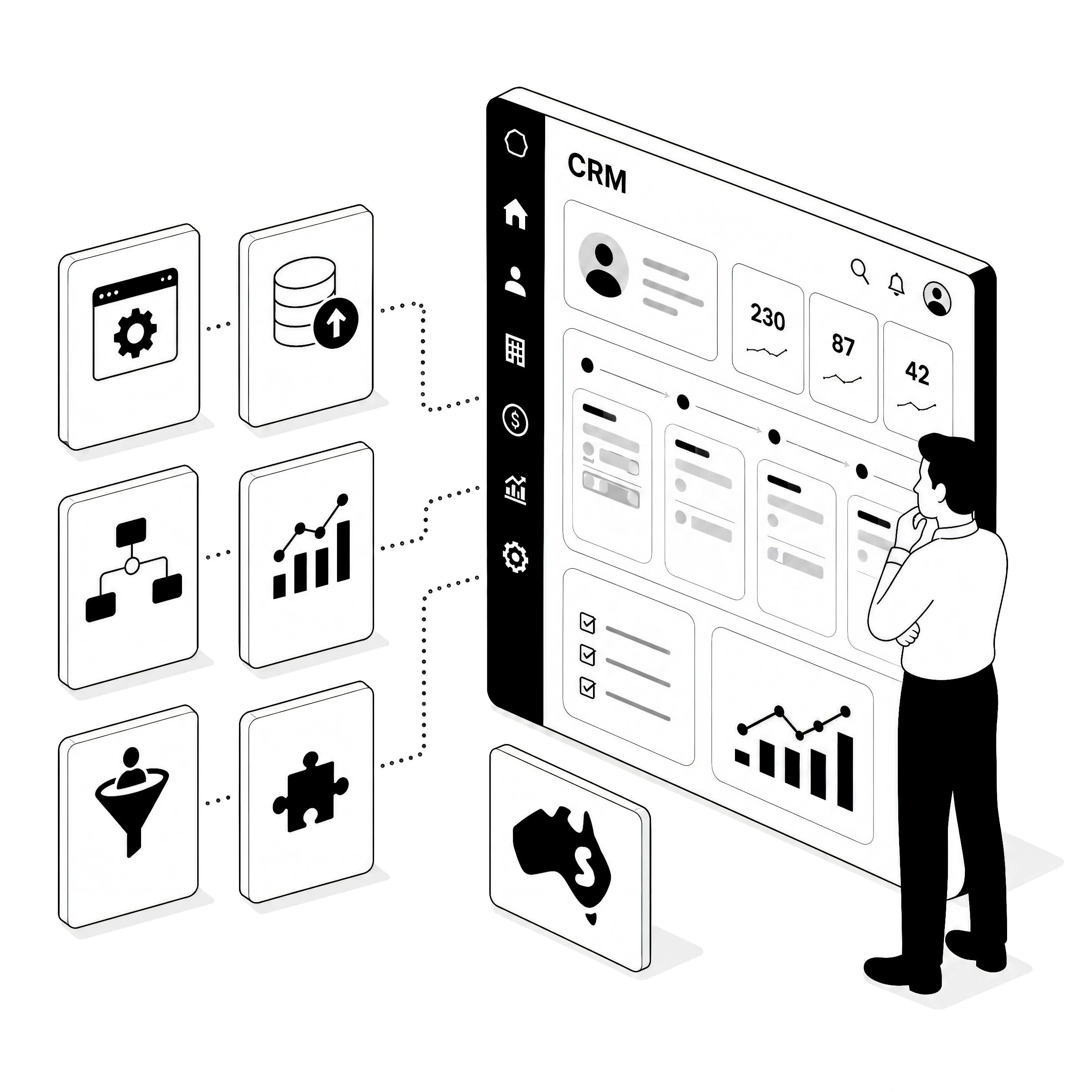
Everything in one place. Customer data, shipment tracking, communications, documentation, invoicing, and reporting all live in the same system. No more hunting across platforms. No more “wait, where did I see that information?”

Automation that mirrors real workflows. HubSpot’s workflow engine can automate the repetitive tasks that eat your team’s time. Quote generation, booking confirmations, status updates, driver notifications, documentation creation, all of it.

Custom properties for freight complexity. You can track pickup locations, delivery addresses, cargo types, weights, transit times, carrier assignments, special handling requirements, any data point your operations need. HubSpot’s flexibility handles freight’s complexity.

Communication threading. Every email, call, text, and note about a shipment stays attached to that shipment record. New team members can see complete history instantly instead of trying to piece together what happened from scattered sources.

Real-time visibility. Dashboard show what’s in transit, what’s delayed, what’s being quoted, what’s at risk. Management finally gets visibility without pestering operations for updates.

Integration capabilities. HubSpot connects with your GPS tracking, accounting software, e-signature tools, and anything else in your tech stack. Data flows automatically instead of requiring manual transfer.

The key phrase here is “properly configured.” Out-of-the-box HubSpot doesn’t solve these problems. HubSpot Sydney implementations by experts who understand freight operations do.

Real Bottleneck Solutions For Freight Operators

Let’s get specific about how HubSpot eliminates the bottlenecks we mentioned earlier.

Automated Quote Generation and Booking

Remember that five-person, twelve-step process for quotes? Here’s how it works with HubSpot:

Customer submits inquiry through your website. HubSpot captures pickup location, delivery destination, cargo details, and timeline. Based on rules you’ve configured (distance calculations, weight brackets, service tier, current capacity), HubSpot automatically generates an accurate quote and emails it to the customer within minutes.

Customer accepts? HubSpot creates the booking, assigns it to the appropriate driver or carrier based on location and availability, generates necessary documentation, and sends confirmations to everyone involved. What used to take hours and multiple people now happens automatically in minutes.

One of our clients, a Sydney-based freight operator specializing in interstate transport, cut their quote-to-booking time from an average of 4 hours down to 12 minutes. Same accuracy, fraction of the effort.

Smart Customer Communication

Nobody wants to field “where’s my shipment?” calls all day. HubSpot eliminates most of them through automated updates.

When a shipment gets picked up, HubSpot automatically sends confirmation to the customer. When it’s in transit, they get status updates at scheduled intervals. When it’s delivered, they receive notification with proof of delivery. All automatic, all branded, all professional.

But it gets smarter. If a shipment hits a delay (traffic, weather, vehicle issues), HubSpot can trigger proactive notifications. “Your delivery is running 2 hours behind schedule due to unexpected traffic. New estimated arrival: 3:30 PM.” Customers appreciate being informed before they have to chase you.

This automation dramatically reduces inbound communication while actually improving customer satisfaction. People don’t mind delays if they’re kept informed. They hate uncertainty and having to chase information.

Driver Coordination That Actually Works

Managing drivers without centralized systems is chaos. HubSpot brings order through automated scheduling and communication.

When a new job gets booked, HubSpot can automatically assess which drivers are in the right area, check their current capacity, and either auto-assign based on logic you define or present options to your dispatch team with all relevant context (driver ratings, current workload, distance to pickup).

Drivers receive job details automatically via SMS or mobile app. Pickup addresses, delivery addresses, contact numbers, special instructions, everything they need in one message. They can update status from the road, which automatically flows back to HubSpot and triggers customer notifications.

Your dispatch team sees real-time dashboard of all active jobs, driver locations, and potential issues. Instead of constantly calling drivers for updates, they have instant visibility.

Document Management That Doesn’t Suck

Freight operations generate paperwork. Bills of lading, proof of delivery, customs documents, insurance certificates, consignment notes, the list goes on.

Without good systems, these documents scatter across email, filing cabinets, and people’s desks. Finding last month’s POD for a customer dispute becomes an archaeological dig.

HubSpot centralizes this. Every document attaches to the relevant shipment record. Need to find proof of delivery from three months ago? Search for the customer or shipment number, and everything’s there. Instantly.

Better yet, document generation can automate. HubSpot can pull data from the shipment record and auto-populate templates for bills of lading, invoices, and other standard documents. Your team spends less time on paperwork and more time on high-value activities.

Reporting That Actually Helps

Most freight operators run on gut feel because compiling real data is too hard. HubSpot changes this completely.

Want to know your on-time delivery rate by route? One click. Average transit time by service tier? There it is. Customer satisfaction trends? Right in front of you. Revenue by customer segment? Done.

These aren’t reports that take someone two days to manually compile. They’re live dashboards that update automatically as data flows through your operations.

This intelligence helps you make smart decisions. Which routes are most profitable? Where are delays consistently happening? Which customers are growing and which are churning? What’s your capacity utilization looking like next week?

You stop guessing and start knowing.

The Sydney Advantage: Local Expertise Matters

Here’s something most businesses don’t consider: implementing HubSpot for freight operations isn’t just about technical configuration. It’s about understanding Australian logistics context, regulations, and business practices.

Australian compliance requirements around transport documentation, insurance, and safety standards need to be baked into your workflows. A consultant from overseas won’t know these nuances.

Sydney’s geographic challenges affect freight operations differently than Melbourne’s or Brisbane’s. Sydney’s traffic patterns, port access logistics, and metropolitan spread create specific operational considerations.

Australian business communication styles differ from American or European norms. Your automated messages need to sound appropriately Australian, professional but not overly formal, direct but friendly.

Time zone coordination for interstate shipments requires systems configured to account for cross-state operations without confusing customers or drivers.

Integration with Australian platforms like your accounting software (MYOB, Xero), banking systems, and other local tools requires knowledge of these specific ecosystems.

Working with HubSpot Sydney experts who understand these contexts means your implementation actually fits your reality instead of requiring you to awkwardly adapt to someone else’s template.

Common Implementation Mistakes That Create New Bottlenecks

We’ve rescued plenty of freight operators from botched HubSpot implementations. The mistakes are predictable:

Mistake one: Treating it like a sales CRM. HubSpot’s marketed primarily for sales and marketing. But freight operations need operations-focused configuration. Companies that just replicate marketing CRM setups end up with something that doesn’t fit their workflow.

Mistake two: Over-complicating the initial build. Some implementations try to automate everything on day one. You end up with a complex system nobody understands. Better to start with critical workflows and expand gradually.

Mistake three: Ignoring mobile accessibility. Your drivers and field staff aren’t at desks. If they can’t easily interact with HubSpot from phones, your data will be incomplete and inaccurate.

Mistake four: Poor integration planning. HubSpot’s power comes from connecting your various systems. Implementations that leave HubSpot as an island require duplicate data entry and create new bottlenecks instead of eliminating old ones.

Mistake five: Inadequate team training. Your operations team needs to understand not just how to use HubSpot, but why they’re using it and how it makes their jobs easier. Without proper training, adoption fails.

Mistake six: No ongoing optimization. Your business evolves. Freight routes change. Service offerings expand. Implementations that never get refined become outdated and eventually get abandoned.

Avoiding these requires experience with both HubSpot and freight operations. It’s why working with specialists matters.

Real Results From Sydney Freight Operators

Let’s talk actual numbers because theory only gets you so far.

Metric Before HubSpot After HubSpot Improvement
Quote Response Time 3-6 hours 8-15 minutes 95% faster
Customer Status Inquiries 40-60 daily 8-12 daily 80% reduction
Admin Hours Per Shipment 35-45 minutes 8-12 minutes 75% reduction
On-Time Communication 60-70% 95-98% 40% improvement
Data Entry Errors 8-12% 1-2% 85% reduction

These aren’t theoretical improvements. This is actual data from freight operators we’ve worked with across Sydney and broader Australia.

Take Michael, who runs a mid-sized freight operation in Western Sydney specializing in furniture and white goods delivery. Before HubSpot, his team of twelve was maxed out handling about 200 shipments weekly. Customer complaints were constant because communication was poor. Staff turnover was high because the work was frustrating.

After a properly configured HubSpot Sydney implementation, his team now handles 340 shipments weekly with the same staff count. Customer complaints dropped 73%. Staff satisfaction improved dramatically because they’re no longer drowning in manual tasks.

Or consider Jennifer’s operation in North Sydney focusing on time-critical medical equipment transport. Coordination and tracking were life-or-death concerns. Before HubSpot, they were managing everything through spreadsheets, phone calls, and prayer. Now they have real-time visibility, automated customer updates, and compliance documentation that happens automatically.

The technology didn’t make them bigger. It made them dramatically more efficient so they could grow without proportionally increasing headcount and chaos.

Integration With Your Existing Tech Stack

You’re not starting from scratch. You’ve already got GPS tracking, accounting software, maybe e-POD systems, possibly route optimization tools. HubSpot doesn’t replace these. It orchestrates them.

GPS tracking integration means location data flows into HubSpot automatically. You don’t manually check where drivers are and update customers. HubSpot pulls location data and sends updates automatically.

Accounting software integration (Xero, MYOB, QuickBooks) ensures invoices generate automatically when shipments complete. No manual data transfer between systems. Revenue data flows back to HubSpot for complete financial visibility alongside operational metrics.

E-signature integration allows proof of delivery to be captured digitally and automatically attached to shipment records. Drivers don’t return with paper, and you don’t manually file documentation.

Route optimization integration can feed optimal routes back to driver assignments in HubSpot, ensuring your dispatch team has complete context when coordinating jobs.

The goal isn’t to rip out everything and start over. It’s to make your existing investments work together instead of creating more silos.

What To Look For In HubSpot Sydney Partners

If you’re considering HubSpot to eliminate bottlenecks, choosing the right implementation partner matters enormously. Look for:

Freight industry experience. Someone who’s implemented HubSpot for marketing agencies can’t effectively configure it for freight operations. The workflows are completely different. Your partner needs to understand logistics, not just technology.

Local presence and understanding. Sydney-based partners understand Australian business context, compliance requirements, and can provide support in your time zone without language or cultural barriers.

Technical depth. HubSpot’s flexibility requires real technical capability to configure properly. Ask about custom properties, workflows, integrations, and API capabilities. Surface-level knowledge produces surface-level results.
Ongoing support model. Implementation isn’t the end. You need ongoing optimization, troubleshooting, and expansion as your business evolves. One-and-done consultants leave you stranded.


References from similar businesses. Talk to other freight operators they’ve worked with. Get specifics about results, challenges, and whether they’d work with them again.

Change management expertise. Technology is only half the battle. Getting your team to actually use HubSpot requires understanding human behavior and organizational change. Pure tech people often fail here.

Your Pathway To Bottleneck-Free Operations

You didn’t get into freight to spend your days fighting operational chaos. You got into it to move goods efficiently, serve customers well, and build a profitable business.

But somewhere along the way, growth made your processes break. What worked with 50 shipments a week collapses at 200. Manual systems that felt manageable become impossible. And suddenly you’re working harder for worse results.

That’s where most freight operators are right now. Stuck between the size they were and the size they want to be, held back by bottlenecks they can’t manually overcome.

HubSpot Sydney implementations by experts who understand freight operations eliminate those bottlenecks systematically. Not through some revolutionary new idea, but through automating the repetitive tasks, centralizing scattered information, and creating visibility where chaos existed before.

The freight operators who thrive over the next decade won’t be the ones with the most trucks or the cheapest prices. They’ll be the ones who’ve built operational efficiency that competitors can’t match. The ones who can scale without proportionally increasing complexity and costs.

At Smartmates, we’ve specialized in exactly this challenge for Australian freight operators. We’re not generic HubSpot consultants offering cookie-cutter implementations. We’re certified experts who understand both the platform and the specific operational realities of freight and logistics across Australia.

We’ve configured HubSpot for interstate transport, last-mile delivery, specialized cargo handling, and everything in between. We know the difference between a workflow that looks good in theory and one that actually works when drivers are running late, customers are demanding updates, and your dispatch team is juggling twenty active jobs.

We understand Sydney’s logistics landscape. The geographic challenges. The competitive pressures. The regulatory requirements. The customer expectations. We build implementations that fit your reality, not force your reality to fit some overseas template.

If you’re tired of watching bottlenecks limit your growth, frustrate your customers, and burn out your team, we should talk. Not next year when you’ve tried and failed to fix it yourself. Now, while you still have market opportunities and team energy.

Because every week you operate with bottlenecks is another week your competitors potentially pull ahead. Another week of inefficiency eating your margins. Another week of customer frustration eroding your reputation.

Transform your operations. Transform your efficiency. Transform your business.

Let’s make it happen.

Request a Callback from Smartmates

Sarah the sales engineer

Sarah

Senior Sales Engineer
  • I’ll listen to your HubSpot needs to understand your business challenges and goals, ensuring a tailored approach.

  • I’ll bring our engineer onto our first consultation to explore solutions and clarify your requirements.

  • We’ll deliver your free project plan quotation, detailing the steps, timeline, and costs—up to this point, it’s completely free!

“My mission is to solve your key problems, build your trust in our capabilities and deliver exceptional value for money.”


Fill in your details and

we’ll contact you fast.

Fill in your details and

we’ll contact you fast.